Waiting Times For Medial Appointments in Scotland Improving But So Slowly It Will Take Years To Get The Backlog down
1st July 2026
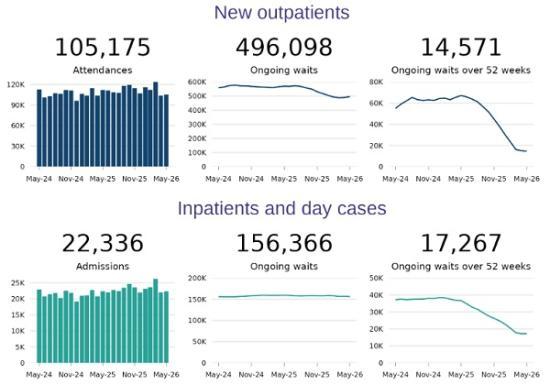
The Scottish Government is right to highlight that there has been measurable progress, particularly in reducing the number of people waiting more than a year. However, when you examine the underlying Public Health Scotland statistics, a more nuanced picture emerges.
The backlog is shrinking, but only slowly, and at the current pace it could take several years before waiting times resemble anything close to pre-pandemic levels.
The encouraging news
The headline figures do show genuine improvements.
For new outpatient appointments:
The overall waiting list has fallen to 496,098, almost 13% lower than a year earlier.
Patients waiting over 52 weeks have fallen to 14,571.
Those waiting more than two years have reduced to 1,073.
For operations and day-case treatment:
The treatment waiting list has reduced to 156,366.
This is around 2% lower than last year.
More than two-year waits continue to fall, although only gradually.
These improvements explain why ministers are describing the past year as one of progress.
But the backlog remains enormous
The more striking statistic is the sheer scale of the queues.
Across Scotland there are approximately:
half a million people waiting for a first outpatient appointment
another 156,000 waiting for treatment after already seeing a consultant.
Public Health Scotland estimates that around 580,000 individuals are on at least one NHS waiting list. That is roughly one in every ten people in Scotland.
That is still historically very high.
The pace of improvement is slowing
This is perhaps the most important finding hidden within the report.
Public Health Scotland notes that:
outpatient waits over one year continue to fall
but the speed of improvement has slowed
treatment waits over one year actually rose slightly during the latest month, ending a long run of monthly reductions.
That suggests the NHS may have cleared many of the easiest long waits first and is now reaching the more difficult cases involving complex surgery or specialties with severe workforce shortages.
Performance is still well below the target
The official standard remains that:
patients should begin treatment within 12 weeks once treatment has been agreed.
The latest figures show:
only 56% achieved this target.
For new outpatient appointments:
only 63.5% were seen within 12 weeks.
In other words, around four out of every ten patients are still waiting longer than the Government's own target.
So how long might recovery take?
A simple illustration helps.
The outpatient waiting list has fallen by about 74,000 over the past year (from around 570,000 to 496,000).
If improvements continued at roughly that pace—and that is a significant assumption that it would still take around six to seven years to eliminate today's backlog.
However, that is probably optimistic because:
new patients are continually joining the list
reductions are already beginning to slow
Scotland has an ageing population needing more treatment
workforce shortages remain across many specialties.
The treatment waiting list is improving much more slowly—only around 2% over the past year—which implies that surgical backlogs could take considerably longer to resolve unless capacity increases significantly.
What would speed recovery?
The Scottish Government has funded additional clinics and reports that NHS Scotland delivered more than 168,000 additional appointments and procedures over the past year compared with the previous year.
That is helping, but to restore waiting times more quickly the NHS would probably need several things to happen simultaneously:
sustained increases in consultant and nursing numbers
more operating theatre capacity
expanded diagnostic services
better use of community and independent-sector capacity where appropriate
fewer delayed hospital discharges, allowing beds to be used more efficiently.
My assessment
The Government can reasonably claim that the trend is now moving in the right direction. The number of patients experiencing the very longest waits has fallen substantially over the past year.
However, the statistics also suggest that the NHS is moving from rapid recovery into slower recovery. The easiest gains have largely been made, while the remaining backlog is proving much harder to reduce.
Unless Scotland can significantly expand treatment capacity beyond current levels, patients should probably expect waiting lists to remain well above pre-pandemic levels for much of the remainder of this decade. Progress is likely to continue, but it is increasingly looking like a marathon rather than a sprint.
For more details go to -
Stage of treatment waiting times