Uk Government May Be About To Make Announcements About Student Loans in England - How Much Better Off Are Scottish Students - Taxpayers Foot Some Of The Bill For Both
5th July 2026
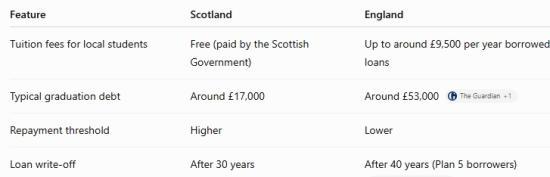
Student Loans are becoming an interesting political issue because reports suggest the UK Government is considering making the student loan system in England more generous again. Possibly by increasing the salary threshold at which graduates start repaying, or reducing the amount they repay. Nothing has been officially announced yet, but any such change would have consequences for taxpayers.
The first thing to understand is that Scotland and England already have very different systems.
Are Scottish students better off?
For most students studying at Scottish universities, yes.
A Scottish student typically:
leaves university with much less debt;
does not borrow for tuition fees;
starts repaying only when earning a higher salary;
has any remaining debt written off after a shorter period.
However, there are trade-offs:
maintenance support is often lower than the maximum available in England;
Scottish universities receive less money per Scottish student than many English universities receive through tuition fees, meaning universities rely more heavily on overseas students and students from the rest of the UK.
If England makes loans more generous, who pays?
Ultimately, the taxpayer in England and Scotland.
Student loans are already heavily subsidised because many graduates never repay the full amount before it is written off.
For example, previous government estimates suggested that around 45% of the value of English student loans would never be repaid, meaning taxpayers cover that cost.
If ministers:
raise the repayment threshold,
lower interest rates,
shorten the repayment period, or
write off more debt,
then graduates repay less and the taxpayer makes up the difference.
It is not "free money" as the cost simply shifts from graduates to the Exchequer.
Does Scotland pay for English changes?
This is where things become constitutionally interesting.
Student loans are not completely devolved financially.
Scotland controls tuition policy and student support through the Scottish Government, but some of the accounting for the loan book and write-offs still sits at UK level. That means UK taxpayers as a whole including Scottish taxpayers—share some of the costs of loan write-offs.
Could England become closer to Scotland?
Possibly, but it is unlikely to go all the way.
England would have to abolish tuition fees or have the government pay them directly, which would cost several billions of pounds every year.
More likely reforms would include:
increasing the repayment threshold;
reducing interest charges;
freezing or lowering tuition fees;
making repayments less onerous for lower earners.
Those measures would reduce graduate repayments but increase the cost to taxpayers.
A political question that may soon open the can of worms further.
One issue that has received surprisingly little attention is this:
If England moves towards a more generous student finance system, does that weaken one of the Scottish Government's biggest policy advantages?
For years, "free university tuition" has been presented as a major distinction between Scotland and England. But if English graduates begin repaying much less over their lifetimes, the practical financial gap could narrow, even though the systems remain structurally different.
Is free tuition still the best way to spend public money?
Would more generous maintenance support help poorer students more than free tuition?
Are English taxpayers now moving towards paying a similar subsidy just in a less obvious way?
And if taxpayers in both countries ultimately fund large parts of higher education, which model delivers the best value?
Those questions go well beyond student finance and touch on how the UK should fund higher education in the future.