Rare‑earth minerals in the UK: Are they present?
7th July 2026
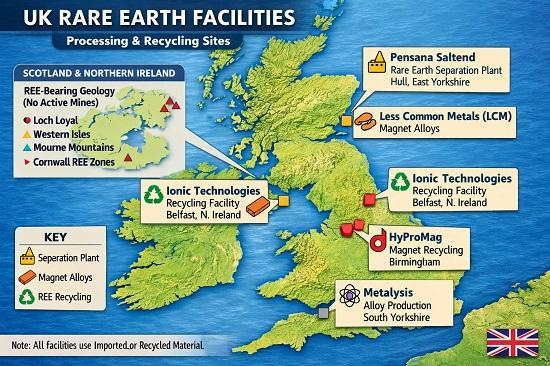
Geologically, rare‑earth elements (REEs) occur in several parts of the UK — notably in Scotland’s alkaline intrusions, Cornwall’s granites, and Northern Ireland’s basalts — but none are currently mined at commercial scale.
The UK Government’s Critical Minerals Strategy confirms that Britain imports almost all rare earths, with domestic capability focused on midstream processing and recycling rather than mining.
Highlands context
Even though Scotland has known REE‑bearing geology (e.g., the Loch Loyal syenites, the Mourne Mountains granites, and parts of the Hebrides), none are being developed, mainly because:
grades are modest compared to global deposits,
permitting and environmental constraints are high,
capital costs for full separation plants are enormous.
So: yes, REEs exist in the UK — but no, they are not being mined.
Where rare‑earth activity is happening: UK facilities
These are the real, operational rare‑earth sites — all midstream or recycling.
1. Pensana – Saltend Chemicals Park, Hull (East Yorkshire)
A major rare‑earth oxide separation plant under development.
Processes imported mixed rare‑earth carbonate into separated Nd, Pr, Dy, Tb oxides.
Relevance: This is the closest the UK has to a “refinery” for rare earths.
2. Less Common Metals (LCM) – Cheshire (near Liverpool)
One of the few Western plants capable of turning rare‑earth oxides into high‑purity metals and NdFeB magnet alloys.
Now owned by USA Rare Earth.
Relevance: Critical midstream node; supplies magnet alloy producers.
3. HyProMag – Tyseley Energy Park, Birmingham
Commercial‑scale rare‑earth magnet recycling using hydrogen decrepitation (HPMS).
Capacity: 100 tpa, scalable to 300 tpa.
Relevance: First UK sintered magnet production in 25 years.
4. Ionic Technologies – Belfast
Government‑backed recycling plant targeting 400 tonnes/year of magnet‑grade oxides from end‑of‑life electronics and industrial magnets.
Relevance: Circular‑economy supply of NdPr/Dy/Tb.
5. Metalysis – South Yorkshire
Solid‑state electrolysis producing aluminium‑scandium and other advanced alloys.
Relevance: Not a rare‑earth producer, but part of the critical‑minerals ecosystem.
Are any UK companies using rare earths?
Yes — several, but all rely on imported feedstock or recycled magnets.
Companies actively using rare earths:
LCM (Cheshire) – Produces Nd, NdPr, Dy, Tb metals and alloys.
HyProMag (Birmingham) – Produces recycled NdFeB magnet powder and sintered magnets.
Pensana (Hull) – Will supply separated oxides for magnet manufacturing.
Ionic Technologies (Belfast) – Supplies recycled magnet‑grade oxides.
University of Birmingham – Research and pilot‑scale magnet recycling.
Industries using rare earths in the UK:
Offshore wind turbine manufacturers (NdFeB magnets in generators)
EV motor manufacturers
Aerospace and defence systems
Electronics recycling firms
Robotics and automation companies
These industries depend heavily on the midstream facilities listed above.
So where exactly are rare‑earth minerals located in the UK?
Although not mined, REE‑bearing geology is known in:
Northern Scotland – alkaline intrusions (Loch Loyal, Loch Borralan)
Western Scotland & Hebrides – basalts and carbonatites
Cornwall – granites associated with lithium and tin systems
Northern Ireland – Mourne Mountains granites
North Pennines – minor REE occurrences
But again: none are commercially exploited, and the UK strategy explicitly focuses on processing and recycling instead of mining.
Why the UK isn’t mining rare earths
Three strategic reasons:
Geology: UK deposits are small compared to global giants (China, Australia, US).
Economics: Mining + separation requires billions in capital; midstream processing is cheaper and faster to scale.
Policy: Vision 2035 prioritises recycling (20% of demand) and domestic processing (10%) over mining.
Scottish rare earth geology
Scotland’s rare‑earth geology is quietly fascinating — not for its scale, but for its diversity. The Highlands and Islands contain several alkaline intrusions and carbonatite complexes that host rare‑earth elements (REEs) such as neodymium, praseodymium, dysprosium, and terbium, though none are mined commercially.
Key geological zones
Loch Loyal Complex (near Tongue, Sutherland)
A classic alkaline intrusion with syenite and carbonatite veins rich in light rare‑earths (La–Nd). It’s one of the most studied Scottish REE sites.
Loch Borralan Complex (Assynt area)
Contains nepheline syenite and ijolite, both associated with rare‑earth‑bearing minerals like bastnäsite and monazite.
Mourne Mountains (Northern Ireland)
Granitic intrusions with minor REE enrichment — geologically linked to the same Caledonian magmatic system.
Hebrides and Skye
Basaltic flows and small carbonatite dykes show trace REE anomalies, though grades are low.
Geological context
These intrusions formed during late Caledonian and post‑Caledonian magmatism, roughly 430–380 million years ago, when mantle‑derived magmas rose through crustal fractures.
REEs concentrate in alkaline magmas because they don’t fit easily into common rock‑forming minerals — so they accumulate in accessory minerals like allanite, monazite, bastnäsite, and xenotime.
Why they matter
Although Scotland’s deposits are small, they’re scientifically valuable for understanding REE genesis and strategically relevant for future exploration. The British Geological Survey has mapped these zones as part of the Critical Minerals Intelligence Centre, noting that:
Grades are modest but geochemically consistent with global REE systems.
Environmental sensitivity and remoteness make extraction challenging.
Research drilling (not mining) continues in Sutherland and Assynt.
Future potential
If global supply chains tighten, Scotland’s alkaline complexes could support small‑scale extraction or pilot processing, especially if paired with recycling and refining hubs like Pensana (Hull) or HyProMag (Birmingham).
The most likely path forward is geological mapping and resource quantification, not open‑pit mining.