Andy Burnham And A New UK Government Face Major Decisions On Welfare Etc as Three Reviews Coincide
10th July 2026
Any incoming administration under Andy Burnham will face immense pressure to address a soaring social security bill.
Three landmark reviews the Timms, Milburn, and Mayfield Reviews will shape his welfare strategy.
They focus on overhauling disability payments, tackling youth unemployment, and keeping people in work.
The Three Major Welfare Challenges.
The Timms Review (Personal Independence Payment Reform)Led by Sir Stephen Timms, this massive review looks into Personal Independence Payment (PIP) and is fundamentally reshaping how the government supports disabled people.
The interim report found that the current system is "not fit for purpose" and criticized the assessment process as deeply dehumanizing. A future Burnham government will have to balance the need to reform a failing assessment system with enormous fiscal pressures from rising claim numbers.
Responding to the Interim Report of the Timms Review of Personal Independence Payment (PIP), Louise Murphy, Senior Economist at the Resolution Foundation, said, "This report shows that Personal Independent Payment is failing on multiple fronts. It is not routinely providing the support that disabled people need, there is widespread distrust with the system, and with costs spiralling, it is not offering a fair deal to taxpayers either.
“The system needs an overhaul, but it must be done properly. For millions of people PIP is what makes working, caring and taking part in everyday life possible. But the system is not designed around the realities of disability in modern Britain, where the additional costs faced by disabled people vary widely and fluctuating conditions are common.
“The focus should be on reforming PIP so that it reflects how people actually experience disability, rather than on making short-term savings that have motivated the last two attempts at reform. This kind of approach is more likely to deliver sustainable savings in the long-term.”
The Milburn Review (Youth Unemployment & NEETs)
Former Minister Alan Milburn's review investigates the sharp rise in young people who are not in education, employment, or training (NEET). The review’s interim diagnostic report called the UK’s current approach a "catastrophic system failure," revealing that the state spends significantly more on benefits for young people than on actively supporting them into work.
Milburn argues for a "system reset" that transforms the welfare state into a working state.
The Mayfield Review (Keep Britain Working)
Sir Charlie Mayfield's Keep Britain Working review focuses squarely on economic inactivity linked to long-term illnesses.
It found that the UK's current approach is too quick to sign people off sick and too slow to help them remain in the workforce. The review pushes to make workplace health visible for the first time and urges a shared responsibility between the government and employers to provide stay-in-work and return-to-work plans.
Voices from the Experts and Campaigners
“...many found the experience distressing and ‘soul destroying’ - leading some to give up work and withdraw from their social lives.
“Increases in disability benefit prevalence have been sharpest among 16 to 19 year olds and those in their thirties, with autism and ADHD now dominating primary conditions among the youngest claimants.
What Does This Mean for a Potential Burnham Premiership?
If Andy Burnham becomes Prime Minister, he will inherit a benefits bill that has soared to record highs, with millions claiming sickness and disability payments. However, he has explicitly stated that he will not make "crude cuts" that force struggling people into deeper poverty.
Instead, the findings from the GOV.UK Timms Review and the GOV.UK Young People and Work Report suggest Burnham's administration will likely focus on:
Redesigning the assessment process: Moving away from hostile, dehumanizing disability evaluations towards holistic, participant-first support.
Shifting resources: Implementing a "Youth Guarantee" to prioritize employment support over simply writing benefit checks.
Employer engagement: Using the GOV.UK Keep Britain Working frameworks to encourage early medical interventions and keep people in work before they drop out of the workforce entirely.
What This Means for Andy Burnham
If Andy Burnham becomes Prime Minister, he is likely to inherit all three sets of recommendations. Together they represent the biggest review of Britain's welfare system since the introduction of Universal Credit.
The challenge for any new government will be balancing three competing objectives:
supporting disabled people fairly;
encouraging more people into work where possible; and
controlling a welfare bill that has risen sharply in recent years.
How Burnham responds will reveal whether he favours evolutionary reform or a more fundamental redesign of the welfare state.
More
PIP isn’t working. So what would?
Resolution Foundation Senior Economist Louise Murphy unpacks the interim report of the Timms Review of Personal Independence Payment – and reads the runes for the final report this autumn.
Forwarded this email? Subscribe here for more
The latest thoughts from staff at the Resolution Foundation…
PIP isn’t working. So what would?
Resolution Foundation Senior Economist Louise Murphy unpacks the interim report of the Timms Review of Personal Independence Payment – and reads the runes for the final report this autumn.
ResolutionFoundation
Jul 9
READ IN APP
It’s not often that a Government review of a benefit received by 4 million people delivers its verdict in four words. But the interim report of the Timms Review, published this morning, said simply: “PIP is not working.”
As someone who spends a lot of time immersed in disability benefits data and discourse, that diagnosis didn’t come as a total surprise. But the report is well worth reading – both for its assessment of the present and the insight it gives us about where reform is heading.
Why does PIP need reviewing at all?
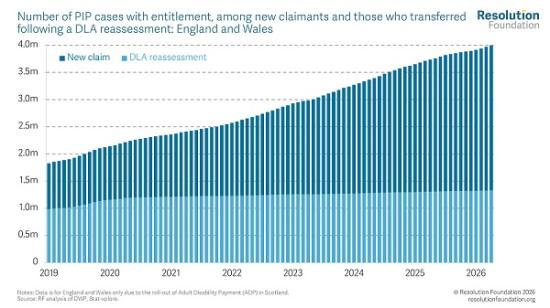
Personal Independence Payments (PIP) have expanded dramatically in recent years. Four million people in England and Wales now receive it – an increase of 270,000 in the past year alone – and the caseload has more than doubled since 2019.
On some level this isn’t surprising, as we know the country is getting older and sicker. But, of course, this has an impact on the benefits bill. Real-terms spending on working-age disability benefits has doubled from £14 billion in 2019-20 to £28 billion in 2026-27 and is set to reach £34 billion by 2030-31.
Forwarded this email? Subscribe here for more
The latest thoughts from staff at the Resolution Foundation…
PIP isn’t working. So what would?
Resolution Foundation Senior Economist Louise Murphy unpacks the interim report of the Timms Review of Personal Independence Payment – and reads the runes for the final report this autumn.
ResolutionFoundation
Jul 9
READ IN APP
It’s not often that a Government review of a benefit received by 4 million people delivers its verdict in four words. But the interim report of the Timms Review, published this morning, said simply: “PIP is not working.”
As someone who spends a lot of time immersed in disability benefits data and discourse, that diagnosis didn’t come as a total surprise. But the report is well worth reading – both for its assessment of the present and the insight it gives us about where reform is heading.
Why does PIP need reviewing at all?
Personal Independence Payments (PIP) have expanded dramatically in recent years. Four million people in England and Wales now receive it – an increase of 270,000 in the past year alone – and the caseload has more than doubled since 2019.
On some level this isn’t surprising, as we know the country is getting older and sicker. But, of course, this has an impact on the benefits bill. Real-terms spending on working-age disability benefits has doubled from £14 billion in 2019-20 to £28 billion in 2026-27 and is set to reach £34 billion by 2030-31.
Rising costs are clearly a big reason why politicians want to reform PIP. But the Timms Review is not overtly a cost-saving exercise. After last year’s failed attempt to cut PIP, this review is being co-produced with disabled people and its recommendations will fall within current OBR spending projections. In other words, this is about making the benefit work better, not (directly, at least) about making it cheaper.
So what’s the problem, if not the price tag?
Even without considering costs, the interim report does not find PIP to be functioning well. And even claimants who receive and value PIP feel overwhelming negativity and distrust towards the claims process, with many describing it as “dehumanising”. This means that even the people for whom the system has worked as intended – in the sense that they applied for and now receive the benefit – still don’t trust it.
The report also flags that the PIP assessment doesn’t “fully reflect real-life impacts” of disability in 2026, when many claimants have fluctuating, multiple and less visible conditions. PIP was introduced in 2013, but the assessment hasn’t changed in the intervening thirteen years.
As I said before, none of this is new. We’ve done research that shows a more claimant-centred, dignified system is possible without significantly driving up costs and caseloads. Essentially, a kinder system doesn’t have to be a costlier one – and it’s encouraging to see this review grappling with the same question.
Looking ahead to autumn
This is just the interim report, so there are no concrete recommendations yet. But two findings hint at the direction of travel.
First, the review’s steering group has agreed a new policy statement: PIP exists “to assist D/deaf and disabled people, and people with long-term conditions, to reduce the inequalities they face in participating in everyday life through a contribution towards the extra costs of disability.”
In other words, participation is the end and a contribution towards costs is the means. The report also argues that a greater emphasis on independent living and participation in society – through work, volunteering, or socialising – would strengthen PIP’s aim.
Second, the report recognises that PIP alone “will not always be sufficient” and that support and services matter too. That opens the door to thinking about what a PIP assessment could unlock beyond a monthly cash payment – pointing towards a more holistic approach to disability support.
The really difficult issues – how to calibrate entitlement, award rates, and reassessments better – have been saved for the final report in the autumn. In the meantime, we at the Resolution Foundation will be publishing major research on how to reform disability benefits later this summer. Watch this space.
Louise Murphy is a Senior Economist at the Resolution Foundation.
https://resolutionfoundation.substack.com/p/pip-isnt-working-so-what-would