The Great Scottish Layer Cake: How Many Governments Does It Take to Change a Light Bulb?
13th July 2026
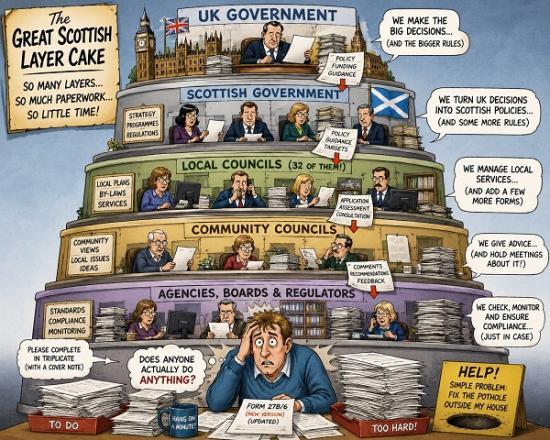
There is an old saying that if you ask three people to organise something, you end up with a committee.
In Scotland, we have perfected the idea.
We have the UK Government.
We have the Scottish Government.
We have 32 local councils.
We have community councils.
We have health boards.
We have national agencies.
We have regulators.
We have quangos.
And somewhere in all of this, there is hopefully someone who knows who is actually responsible for fixing the pothole outside your house.
Welcome to modern government — the great Scottish layer cake.
A Matter of Who Is Actually in Charge
Imagine you want to change something simple.
Perhaps you want to improve your village.
You might need to speak to:
the community council,
the local council,
a Scottish Government department,
a national agency,
a regulator,
possibly a consultation group formed to discuss the previous consultation.
By the time everyone has had their say, the original idea may have retired and moved somewhere warmer.
The UK Government: The Big Umbrella
At the top sits Westminster.
It looks after major issues such as:
defence,
foreign affairs,
pensions,
many benefits,
national taxation.
It raises a lot of the money.
It also produces a remarkable number of announcements explaining what it plans to do with that money.
Then comes the interesting part.
Some decisions apply across the UK.
Some do not.
Some provide funding to Scotland.
Some require Scottish Ministers to decide what happens next.
Confused?
That is perfectly normal.
Many people working inside government probably need a diagram.
The Scottish Government: More Powers, More Paperwork
Holyrood was created to bring decisions closer to Scotland.
It controls major areas including:
health,
education,
housing,
justice,
environment,
transport.
This means Scotland can do things differently.
Different laws.
Different policies.
Different approaches.
Which can be a strength.
But every difference also requires:
new systems,
new guidance,
new staff,
new forms.
Because the one thing government cannot resist creating is another form.
Councils: Where the Rubber Meets the Road
Then we arrive at local government.
Councils are where many people actually experience government.
They deal with:
bins,
roads,
planning,
schools,
social care,
housing.
When something goes wrong locally, most people do not contact a minister.
They contact their council.
The council then explains that the matter may actually belong to another organisation.
A useful skill in modern life is learning the sentence:
"That is not our department."
Community Councils: Democracy at Street Level
Community councils are perhaps the most local layer.
They are often run by volunteers who give their time because they care about where they live.
They may comment on:
planning applications,
local development,
community issues.
They can be an important voice.
However, they sometimes find themselves in the unusual position of having responsibility for expressing local concerns without always having the power or money to fix them.
They are often asked what people think.
Less often are they given the cheque book.
The Regulation Mountain
The problem is not necessarily that any one rule is unreasonable.
Most regulations exist because governments are trying to achieve something:
safety,
fairness,
environmental protection,
better services.
The difficulty comes when thousands of reasonable rules combine into a system that feels impossible to navigate.
A small business owner might need to understand:
employment law,
tax rules,
planning regulations,
licensing requirements,
environmental rules,
health and safety obligations.
By the time they have complied with everything, they may need a new member of staff simply to manage the paperwork.
Could We Simplify?
Almost every government promises simplification.
Then it creates a new body to simplify the existing bodies.
The new body requires:
a chairman,
a board,
staff,
offices,
a website,
a strategy document explaining why simplification is important.
And eventually someone suggests another review.
The Real Question
The answer is not necessarily fewer layers.
Large countries need different levels of decision-making.
A national government cannot understand every village issue.
A community group cannot manage national defence.
The challenge is making sure every layer has:
a clear purpose,
clear responsibility,
enough funding,
accountability.
The worst situation is when everyone has some responsibility but nobody has enough authority to solve the problem.
The Final Layer
Perhaps Scotland's government cake has too many layers.
Perhaps some layers are necessary.
Perhaps some could be removed.
But one thing is certain:
The average citizen does not want to spend their evening trying to discover whether a problem belongs to Westminster, Holyrood, their council, a national agency or a committee created by a committee.
They simply want someone to answer the phone and say:
"Yes, that is our responsibility. We will sort it."
Now that really would be a revolutionary reform.