Why Diesel Could Become the UK's Next Fuel Shock – Even if Oil Prices Don't Explode
18th July 2026
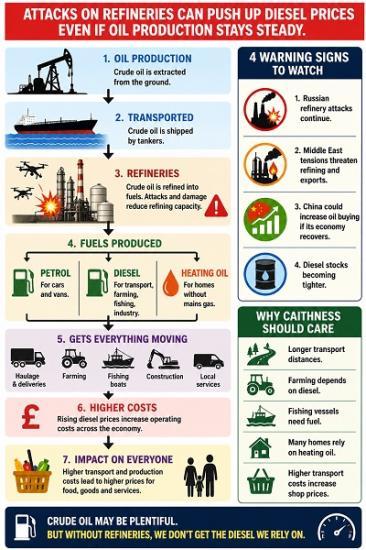
When people hear reports that oil prices are rising, they naturally expect petrol and diesel prices to follow. But there is another possibility that receives far less attention.
Diesel prices could rise sharply even if the price of crude oil only increases modestly.
That may sound strange, but it has happened before—and there are signs it could happen again.
It's Not Just About the Price of Oil
Crude oil is only the raw material. Before it reaches our vehicles, farms and fishing boats, it has to be refined into usable products such as petrol, diesel, aviation fuel and heating oil.
If enough refineries are damaged or taken out of action, the world can find itself with plenty of crude oil but not enough diesel.
That is rather like having plenty of wheat but too few mills to produce flour.
Refineries Under Pressure
Recent months have seen repeated attacks on oil facilities in both Russia and the Middle East.
Ukraine's long-range drone strikes have damaged several Russian refineries, forcing Russia to reduce exports of refined fuels and concentrate on supplying its own domestic market.
At the same time, instability in the Middle East has raised concerns over refining capacity and shipping routes through one of the world's most important energy regions.
Even if crude oil production continues, every damaged refinery reduces the world's ability to turn that crude into diesel.
Why Diesel Matters More Than Petrol
Diesel is the fuel that keeps much of the economy moving.
It powers:
Heavy goods vehicles delivering supermarket food.
Farm machinery during planting and harvesting.
Construction equipment.
Fishing boats.
Many buses and commercial vehicles.
Backup generators used by businesses and hospitals.
When diesel becomes scarce, its effects spread far beyond motorists filling their cars.
Almost everything transported by road becomes more expensive.
The China Question
Another factor worth watching is China.
For the past year, China's weaker economy has meant lower demand for oil than many analysts expected. That has helped prevent crude prices rising even further.
But China remains the world's largest crude oil importer.
If Beijing introduces fresh economic stimulus and factories begin expanding production again, Chinese buyers could quickly return to international oil markets in force.
That would increase competition for available crude supplies just as refining capacity is already under pressure.
The result could be higher crude prices—and even tighter diesel supplies.
What About Heating Oil?
Many homes across Caithness and the Highlands rely on heating oil rather than mains gas.
Heating oil is a different product from road diesel, but both come from the same refining process.
If refiners are producing less fuel overall, shortages in one product can affect prices across the whole barrel.
Distribution costs also rise when diesel becomes more expensive, adding another layer of pressure to rural fuel prices.
Why Rural Scotland Feels It First
People living in cities often have alternatives.
They may use public transport or have access to gas heating.
In rural areas, choices are more limited.
Longer journeys mean more fuel is used.
Farmers and contractors depend on diesel-powered machinery.
Hauliers delivering goods to remote communities face higher operating costs.
Fishing vessels see fuel become one of their largest expenses.
Every increase eventually feeds through into the prices paid by households.
Four Warning Signs Worth Watching
Anyone wanting an early indication of where fuel prices may head should keep an eye on four developments:
Further attacks on Russian refineries.
Any escalation affecting Middle East oil infrastructure.
A sudden increase in Chinese crude oil imports.
Reports that diesel supplies are tightening, even if crude prices remain relatively stable.
These often provide earlier warning than the Brent crude price shown on television news.
Could This Become the Next Cost-of-Living Story?
During previous energy crises, most headlines focused on crude oil prices.
This time, the bigger story may be refining capacity.
The world still has substantial oil reserves.
The challenge is whether there are enough working refineries to turn that oil into the diesel that powers modern economies.
For communities like Caithness, where transport distances are long and alternatives are limited, that distinction matters.
If diesel prices rise significantly while crude oil remains relatively stable, many people will wonder why.
The answer may not lie beneath the ground in the oil fields—but inside the refineries that transform crude into the fuels we rely on every day.
Food for Thought
Many economists watch the price of Brent crude as a measure of energy costs. But perhaps we should pay just as much attention to the world's refineries.
After all, crude oil sitting in storage tanks cannot deliver food to supermarkets, harvest crops, power fishing boats or heat homes. It only becomes useful once it has been refined.
The next fuel shock may therefore have less to do with how much oil the world produces—and more to do with how much diesel the world can make.