UK Inflation Falls to 2.6% – Welcome Relief, But Rural Households Still Face Pressures
22nd July 2026
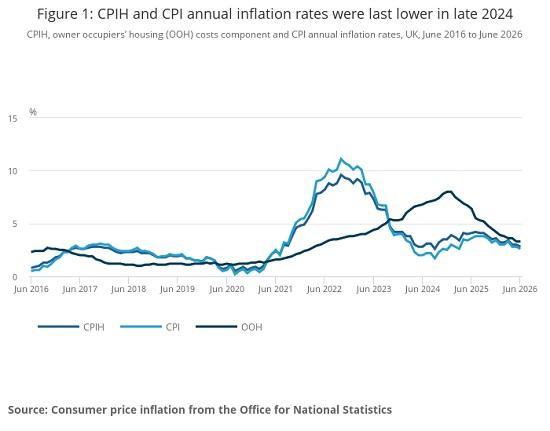
The latest figures from the Office for National Statistics (ONS), published today (22 July), show that UK inflation eased to 2.6% in the year to June 2026, down from 2.8% in May. The fall was slightly larger than many economists had expected and is another sign that the sharp inflation experienced over recent years is continuing to moderate.
What the figures show
The Consumer Prices Index (CPI) – the measure used by the Bank of England for its 2% inflation target – increased by 2.6% over the 12 months to June.
This means that, on average, the basket of goods and services used to measure inflation costs 2.6% more than it did a year ago. While that is an improvement, it is important to remember that prices have not fallen. They are simply rising more slowly than before.
What helped bring inflation down?
According to the ONS, the biggest downward influence came from transport costs, particularly lower petrol prices than a year earlier. Food price inflation also continued to ease, helping to reduce the overall rate.
These falls more than offset price increases elsewhere in the economy.
Why this matters
Lower inflation is good news because it eases pressure on household finances.
If wages continue to grow faster than inflation, many workers will begin to see a genuine improvement in their spending power after several difficult years. Businesses also benefit from a more stable pricing environment, making it easier to plan ahead.
However, inflation remains above the Bank of England's 2% target, so policymakers are unlikely to declare victory just yet.
What does it mean for interest rates?
Financial markets now expect the Bank of England to be able to leave interest rates unchanged in the near term while it assesses whether inflation continues to fall.
The Bank will still be watching developments carefully, particularly:
energy prices,
wage growth,
international events,
and the effect of recent oil market volatility.
Any renewed rise in fuel or energy costs could quickly change the outlook.
The Caithness perspective
National inflation figures do not always reflect the experience of households in rural areas.
People across Caithness often face costs that are much harder to reduce, including:
heating oil for homes off the gas grid,
long-distance travel by car,
higher delivery charges,
and limited local competition for many goods and services.
Even when the national inflation rate falls, many rural families may continue to feel significant pressure on their household budgets.
Looking ahead
Today's figures are encouraging, but there are reasons to remain cautious.
Oil prices have been volatile during recent months because of tensions in the Middle East. If fuel prices begin rising again, transport costs could push inflation higher later in the year.
The June figures therefore represent good news—but not necessarily the end of the cost-of-living challenge.
Bottom line
The latest ONS figures show inflation moving in the right direction, giving households and businesses some welcome breathing space.
For people in Caithness, however, the national picture is only part of the story. Higher transport costs, dependence on heating oil and the realities of rural living mean that many families may continue to feel that the true cost of living is rising faster than the official statistics suggest.
Source: Office for National Statistics – Consumer Price Inflation, UK: June 2026, published 22 July 2026.
Read the full ONS report HERE
Main points
The Consumer Prices Index including owner occupiers' housing costs (CPIH) rose by 2.8% in the 12 months to June 2026, down from 3.0% the previous month.
On a monthly basis, CPIH rose by 0.2% in June 2026, compared with a rise of 0.3% in June 2025.
The Consumer Prices Index (CPI) rose by 2.6% in the 12 months to June 2026, down from 2.8% the previous month.
On a monthly basis, CPI rose by 0.1% in June 2026, compared with a rise of 0.3% in June 2025.
Transport, and food and non-alcoholic beverages made the largest downward contributions to the monthly change in both CPIH and CPI annual rates.
Core CPIH (CPIH excluding energy, food, alcohol and tobacco) rose by 2.8% in the 12 months to June 2026, unchanged from the 12 months to May; the CPIH goods annual rate slowed from 2.0% to 1.7%, while the CPIH services annual rate was unchanged, at 3.6%.
Core CPI (CPI excluding energy, food, alcohol and tobacco) rose by 2.6% in the 12 months to June 2026, unchanged from the 12 months to May; the CPI goods annual rate slowed from 2.0% to 1.7%, while the CPI services annual rate eased from 3.7% to 3.6%.