Oban and north Lorn could play leading role in Scotland’s drones and robotics activity
24th July 2026
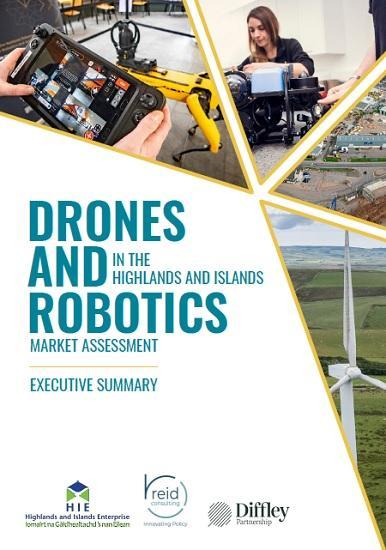
Oban and north Lorn is poised to become a leading location for developing drone, robotics and autonomous systems activity, attracting high-value jobs and investment.
This is according to a new study, commissioned by Highlands and Islands Enterprise (HIE), which assesses the market potential in the region for these types of technologies.
The research focused primarily on Argyll and the Islands and specifically Oban and north Lorn, where a growing cluster of businesses, research organisations and infrastructure is already supporting the development of autonomous technologies.
A partnership involving HIE, the Scottish Association for Marine Science (SAMS) and Argyll and Bute Council is now pursuing the report’s recommended phased approach around key priority areas.
The area is already testing, training and deploying drone and marine robotic technologies that support both commercial and public-sector applications. The plan is to expand this activity to include a series of flagship projects introduced with early customers to demonstrate the technology and build wider market demand. At the same time, skills opportunities will be broadened, and wider collaboration will strengthen complementary activities across other parts of the Highlands and Islands.
Researchers engaged with businesses, universities, public bodies and industry organisations, alongside extensive market analysis. They found that drones, marine robotics and other autonomous systems represent a promising opportunity for the Highlands and Islands.
Within this, Oban and north Lorn stands out as a credible and distinctive location for cross-sector collaboration and technology innovation. A combination of key assets include Oban Airport’s access to uncongested airspace, SAMS’ internationally recognised marine science expertise and the European Marine Science Park’s (EMSP) innovation facilities and access to demanding coastal conditions.
The area has strong links with sectors, such as health, offshore renewables and aquaculture, that are likely to become early users of new autonomous systems services. The technology also supports wider priorities around housing, transport and public services. This creates opportunities to align public investment more effectively, helping to deliver multiple objectives in a coordinated way.
As the hub is established, it’s likely to support year-round high-value jobs and strengthen public and industrial services in remote areas. It will also help position the Highlands and Islands as a recognised region for autonomous systems within Scotland and across the UK. HIE area manager for Argyll and the Islands Morag Goodfellow said:
“This report highlights the exciting opportunity we have here for the area to really take a lead on the wider commercialisation of these types of technologies. This will bring new economic activity, create high-value skilled jobs and put the area at the forefront of drones and robotics.
“SAMS, EMSP and Oban Airport will be central to establishing the area as a hub, and we’ve already formed a strong partnership to take forward a series of actions to make sure we capitalise fully on the potential that exists.”
Managing director of SAMS Enterprise Steve Ham said:
“This research strongly endorses our vision to establish a world-leading robotics innovation hub near SAMS, EMSP and Oban Airport. With its unique combination of airspace, coastal and marine environments, and scientific expertise, it’s an ideal location for robotics testing, training and innovation.
“Demand for these services is growing and the scope for expansion is huge. This could become a nationally significant hub for UK robotics, supporting safe BVLOS (Beyond Visual Line of Sight) operations and developing technologies to address coastal and marine challenges. We’re excited about the role the Highlands and Islands can play in advancing robotics and environmental monitoring, while delivering lasting economic and social benefits.”
Argyll and Bute Council’s head of development and economic growth Fergus Murray said:
“Drones and autonomous unmanned vehicles have the potential to be transformational for rural communities. I welcome this research, which expands on previous drone trial operations we have undertaken in Argyll and Bute, and look forward to delivering Argyll as a centre of excellence for drone operations.”
The research also identifies broader autonomous systems activity across the Highlands and Islands, with different locations offering distinct strengths, which enhances the case for investment.
Orkney is featured as a strong example with access to additional and complementary expertise. The area is already underpinned by assets such as the Sustainable Aviation Testing Environment (SATE), the European Marine Energy Centre (EMEC) and the emerging International Blue Economy Robotarium (IBER). These make Orkney a leading centre for innovation in sustainable aviation, offshore renewables, robotics and the blue economy.
HIE’s area team leader in Orkney Ruth Kirkpatrick said:
“Drones, robotics and autonomous systems present a significant opportunity for the Highlands and Islands as a whole. Orkney already plays an important role, with EMEC’s experience in providing real-world testing and demonstration capability leading to it partnering with The National Robotarium, Heriot Watt University and local businesses to form the International Blue Economy Robotarium.
“By connecting complementary strengths across Orkney, Oban and the wider region, the Highlands and Islands has a strong opportunity to build a coordinated capability for developing, testing and deploying autonomous systems that support the blue economy, clean energy and resilient island communities.”
Executive Summary
Pdf 8 Pages
Full Report
Pdf 95 Pages
Related Businesses
Related Articles