Retails Sale Bounced in June
24th July 2026
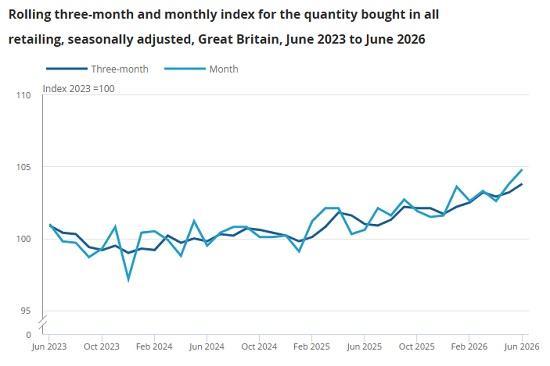
Retail sales in Great Britain rose 1.0% in June 2026, extending May’s rebound and reversing April’s decline. Quarterly growth reached 0.6%, and sales were 4.2% higher than a year earlier, signalling a clear recovery in consumer activity.
Warm weather, strong promotional campaigns, and continued momentum in online shopping drove the improvement, with non-store retailing and non-food stores leading the gains. Clothing, outdoor goods, fans, and sports merchandise saw notable spikes in demand, while online sales climbed to their highest share since April 2021.
The only major drag was automotive fuel, which fell sharply following earlier stockpiling and reduced travel. Overall, June 2026 marked a broad-based strengthening of retail activity across most sectors.
Retail Sales Rebound and Quarterly Momentum
June’s 1.0% rise in retail volumes built on the strong 1.2% increase recorded in May, creating a two‑month stretch of solid growth after April’s weather‑related decline. The April–June quarter ended with a 0.6% increase compared with the first quarter of the year, showing that the recovery was not just a one‑month anomaly but part of a broader upward trend. Year‑on‑year growth of 4.2% further underscored the strength of consumer demand, with sales now sitting slightly above pre‑pandemic levels.
Retailers attributed much of this momentum to a combination of warm weather and targeted promotional activity. June 2026 was the second‑warmest June on record, and this environmental boost helped drive footfall, stimulate discretionary spending, and support categories that typically benefit from outdoor conditions.
Strong Performance in Non-Store and Non-Food Retailers
The strongest gains came from non-store retailing, which includes online-only retailers, market stalls, and direct‑to‑consumer sellers. These businesses reported robust demand for outdoor goods, fans, sports merchandise, and seasonal products. Promotions played a significant role, with retailers using discounts to convert browsing into purchases during the warm spell.
Non-food stores also performed well, with quarterly volumes rising 1.2%. Within this category, computer and telecoms retailers benefited from product releases earlier in the spring, which continued to drive demand into June. Department stores saw a particularly strong May due to sales of warm‑weather goods such as fans, paddling pools, and garden accessories. Clothing stores were another standout, posting a 1.9% increase in June—its strongest monthly rise since September 2025—thanks to seasonal apparel and promotional pricing.
Household Goods and Sector-Specific Trends
Household goods retailers experienced steady growth across the quarter, with furniture sales rising consistently in April, May, and June. This suggests ongoing consumer investment in home improvement and interior upgrades, even as other household categories saw more modest movement. The stability of this sector contrasts with the more weather‑sensitive categories, indicating a mix of cyclical and structural drivers behind the overall retail recovery.
Automotive Fuel: The Main Downward Pressure
The only major drag on June’s retail performance was automotive fuel. Fuel volumes fell sharply across the quarter, reflecting a correction after stockpiling in March during heightened geopolitical tensions in the Middle East. Reduced travel and higher prices further suppressed demand, leaving fuel sales below February 2026 levels. This decline acted as a counterweight to the otherwise broad-based growth across the retail sector.
Online Retail Continues Its Structural Rise
Online retail remained a central driver of growth. Spending values increased 3.8% over the quarter and 11.7% year‑on‑year, with June alone seeing a 2.8% rise. The online share of total retail sales reached 29.4%, the highest proportion since April 2021. This reflects both the long-term shift toward digital shopping and the immediate impact of promotions and seasonal demand.
The continued rise of online retail underscores the importance of digital infrastructure, logistics capacity, and omnichannel strategies for retailers seeking to capture consumer spending. It also highlights the resilience of online channels during periods of fluctuating in‑store activity.
Data Quality and Methodological Notes
The ONS reported a survey response rate of 57.9%, slightly below the 12‑month average, but turnover coverage remained strong at 88.7%. Seasonal adjustment processes were reviewed and updated using the X‑13ARIMA‑SEATS method, with no residual seasonality detected in the main aggregates. This ensures that the reported figures accurately reflect underlying trends rather than seasonal distortions.
Outlook and Implications
June 2026’s retail performance suggests a consumer environment that is responsive to weather, promotions, and digital convenience. The broad-based nature of the growth—spanning non-store, non-food, clothing, and household goods—indicates that confidence and spending appetite remain healthy. The structural rise in online retail continues to reshape the sector, while the decline in fuel sales highlights ongoing sensitivity to price and geopolitical factors.
Retailers planning for the second half of 2026 may find opportunities in seasonal merchandising, digital investment, and targeted promotions, while remaining mindful of external pressures such as fuel costs and supply chain dynamics.
Read the full ONS report 24 July 2026 HERE