What Andy Burnham’s Social Care Announcement Means - and How It Compares to Scotland’s System
29th July 2026
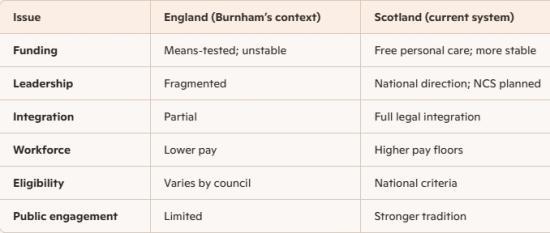
Andy Burnham’s announcement on social care in England has triggered strong reactions, including a detailed response from The King’s Fund, one of the UK’s leading health and care think tanks. For readers in Scotland, the debate can feel distant — but it’s highly relevant. England is considering reforms that resemble parts of Scotland’s existing system, while Scotland is itself debating the future of its own National Care Service.
This article explains Burnham’s proposals, summarises The King’s Fund’s response, and compares England’s situation directly with Scotland’s social care model so Scottish readers can clearly see where the systems align, differ, and face similar pressures.
What Andy Burnham Announced
Burnham’s announcement focused on major reform of England’s social care system, aiming to fix long‑standing problems such as:
Fragmented services
Inconsistent access
High personal costs
Workforce shortages
Lack of national leadership
His proposals emphasise national direction, stable funding, and public involvement — themes that Scotland has already been working on for years.
What The King’s Fund Said
The King’s Fund welcomed the ambition but stressed that England’s system needs:
Stronger national leadership
Long‑term, stable funding
Meaningful public engagement
Better integration with the NHS
Improved workforce pay and conditions
These points are crucial because they highlight gaps in England’s system that Scotland has already tried to address — though Scotland still faces its own challenges.
How England’s Social Care System Works Today
Key features
Means‑tested: People often pay large sums for care, including selling homes.
Locally funded: Councils decide budgets and eligibility.
Fragmented: No single national system.
Patchy integration with the NHS.
Lower workforce pay than Scotland.
England’s system is widely seen as underfunded, inconsistent, and financially risky for individuals.
How Scotland’s Social Care System Works
Key features
Free personal care for all adults since 2002.
National direction from the Scottish Government.
Health and social care integration since 2016 via Integration Joint Boards (IJBs).
Higher workforce pay and national pay floors.
More consistent eligibility criteria across the country.
Scotland’s system is more universal, more integrated, and more centrally directed than England’s.
Direct Comparison: England vs Scotland
This section shows how The King’s Fund’s points map directly onto Scotland’s system.
1. National leadership
King’s Fund view: England lacks national leadership and long‑term planning.
Scotland: Stronger national direction; the proposed National Care Service would centralise leadership further.
2. Stable funding
King’s Fund view: England’s funding is unstable and insufficient.
Scotland: More stable funding; free personal care reduces financial risk for individuals.
3. Public engagement
King’s Fund view: England needs deeper public involvement.
Scotland: More extensive consultation traditions, though the NCS consultation faced criticism.
4. Integration with the NHS
King’s Fund view: England’s integration is patchy.
Scotland: Legal integration since 2016; joint budgets and planning through IJBs.
5. Workforce pay and conditions
King’s Fund view: England’s workforce is undervalued and underpaid.
Scotland: Higher pay floors and more structured training, though rural recruitment remains difficult.
Why This Matters for Scotland
Even though Scotland is ahead in many areas, Burnham’s proposals highlight issues Scotland still faces:
Workforce shortages
Rural delivery challenges (especially Highlands & Islands)
Delayed discharge pressures
Uncertainty around the National Care Service
Rising demand from an ageing population
Scotland’s system is stronger, but not immune to the same pressures England is trying to fix.
Andy Burnham’s announcement and The King’s Fund’s response show England trying to move toward a model that looks more like Scotland’s — more national leadership, more stable funding, better integration, and stronger workforce support.
For Scottish readers, the key takeaway is this:
England is debating reforms Scotland implemented years ago, but Scotland is still grappling with how to strengthen and modernise its own system through the National Care Service.
Both nations face the same demographic and financial pressures — but Scotland starts from a more integrated, more universal foundation.