The Future of Work Has Already Begun: Which Jobs Will Thrive – and Which Could Disappear?
2nd August 2026
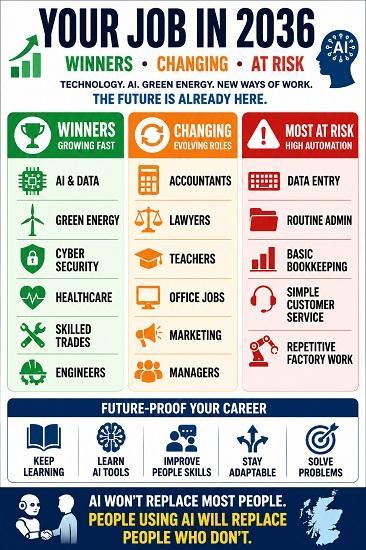
For generations, career advice was relatively straightforward. Train as a teacher, accountant, engineer, nurse, builder or civil servant and you could reasonably expect decades of stable employment.
That certainty is fading.
Artificial intelligence, automation, climate change, demographic shifts and changing work patterns are reshaping the labour market at a pace few imagined only five years ago. The question is no longer whether work will change—it already has. The real question is whether workers, businesses and governments can adapt quickly enough.
For Scotland and the wider UK, the coming decade could produce some of the biggest changes to employment since the Industrial Revolution.
The Rise of "Gig Economy 2.0"
The first gig economy was built around delivery drivers, ride-sharing and freelance platforms.
The next version looks very different.
Instead of low-paid casual work, many emerging freelance careers require specialist knowledge and command high salaries. Companies increasingly hire experts only when they need them rather than employing them permanently.
Growing examples include:
AI trainers and prompt engineers
Cybersecurity specialists
Data analysts
Renewable energy technicians
Offshore wind maintenance engineers
Drone operators and inspectors
Robotics maintenance engineers
Carbon accounting specialists
Digital health consultants
Virtual project managers
Rather than spending forty years with one employer, many professionals may work for several organisations simultaneously, combining consultancy, remote work and contract projects.
For younger workers this offers flexibility.
For older workers it may offer opportunities to remain economically active long beyond traditional retirement.
Scotland's Green Economy Is Expanding
Scotland is already seeing significant investment in renewable energy.
Large offshore wind developments around the Scottish coast, carbon capture projects, hydrogen research and electricity network upgrades all require skilled workers.
The challenge is not creating demand.
It is finding enough people with the right qualifications.
Current shortages include:
Electrical engineers
Grid specialists
Marine engineers
Surveyors
Environmental scientists
Heat pump installers
Electric vehicle technicians
Digital systems engineers
Many of these jobs simply did not exist twenty years ago.
Some may become among the highest-paid technical careers over the next decade.
Artificial Intelligence Is Creating Jobs—Not Just Replacing Them
Whenever AI is discussed, attention usually focuses on jobs disappearing.
That is only half the story.
History shows that technological revolutions destroy some occupations while creating entirely new industries.
The internet eliminated many traditional travel agents but created web designers, app developers, digital marketers and cloud computing specialists.
AI is following a similar pattern.
Growing occupations include:
AI implementation consultants
Machine learning engineers
AI ethics specialists
Human oversight managers
Digital workflow designers
Synthetic data specialists
AI security experts
Businesses increasingly need employees who understand how to work alongside AI rather than compete against it.
Remote Working Has Changed the Geography of Employment
The pandemic accelerated remote working by several years.
Although many organisations have encouraged staff back into offices, hybrid working appears likely to remain a permanent feature of the economy.
This has unexpected consequences.
Large cities no longer enjoy the same monopoly over skilled employment.
Someone living in Wick, Thurso, Inverness or rural Aberdeenshire may now work for companies based in Edinburgh, London or even overseas.
That creates opportunities for communities previously held back by geography.
However, the picture is mixed.
Some employers are insisting staff return to offices several days each week.
Businesses serving city centres — cafes, retail and transport—benefit from higher office attendance.
Meanwhile, towns hoping remote workers would permanently relocate have experienced more modest gains than initially expected.
The long-term outcome remains uncertain.
Which Areas Could Benefit?
Regions with good broadband, attractive housing and high quality of life could become increasingly competitive.
Northern Scotland has several advantages:
Lower housing costs than much of southern England
Outstanding natural environment
Expanding renewable energy sector
Strong engineering heritage
Growing digital connectivity
But challenges remain.
Reliable transport links, healthcare provision, housing supply and digital infrastructure will all influence whether employers and skilled workers choose to relocate.
Without those foundations, opportunities may pass elsewhere.
Jobs Facing the Greatest Pressure
Automation is no longer confined to factory production lines.
Software can now complete many routine administrative tasks faster than humans.
Jobs most exposed include:
Basic data entry
Routine bookkeeping
Simple customer service
Repetitive administrative work
Basic document processing
Some legal research
Standardised reporting
Basic coding tasks
This does not necessarily mean these professions disappear.
Instead, workers are likely to supervise AI systems while concentrating on judgement, communication and complex decision-making.
Jobs Likely to Remain Secure
Some occupations are surprisingly resistant to automation.
They usually require one or more of the following:
Human trust
Emotional intelligence
Complex manual skills
Creativity
Leadership
Physical presence
Examples include:
Healthcare professions
Doctors, nurses, paramedics and carers rely heavily on communication, empathy and judgement.
Teachers
AI may assist education, but inspiring, motivating and managing classrooms remains a fundamentally human task.
Electricians, plumbers and builders
Every building presents unique problems requiring practical experience and adaptability.
Engineers
Especially those working on energy infrastructure, transport systems and advanced manufacturing.
Cybersecurity professionals
As AI grows more sophisticated, cyber threats become more advanced.
Security expertise becomes increasingly valuable.
Skilled trades
Many manual occupations are far harder to automate than office-based work.
What About Accountants, Lawyers and Office Professionals?
These professions are changing rather than disappearing.
AI can already analyse contracts, prepare tax calculations and draft reports.
However, clients still need trusted professionals to interpret complex situations, make strategic decisions and provide reassurance.
The routine work may shrink.
The advisory role may become even more valuable.
Lifelong Learning Becomes Essential
Perhaps the biggest change is that education will no longer end in early adulthood.
Workers may retrain several times during their careers.
Skills likely to become increasingly valuable include:
Digital literacy
AI understanding
Data interpretation
Project management
Communication
Problem solving
Adaptability
Leadership
Technical knowledge alone may no longer be enough.
The ability to keep learning could become the most valuable skill of all.
The Challenge for Government
Economic development agencies increasingly face criticism when individual business investments fail.
Yet innovation always involves risk.
No organisation can accurately predict every successful industry ten years ahead.
The better measure of success may not be the number of individual companies supported but whether they help build resilient sectors, develop skilled workforces and create conditions where new industries can flourish.
Supporting retraining, digital infrastructure and innovation may prove just as important as attracting major employers.
Looking Ahead
Nobody can predict exactly what employment will look like in 2036.
But several trends appear increasingly clear.
Artificial intelligence will become part of almost every profession.
Renewable energy and digital technology are likely to remain major sources of new employment.
Workers who continually develop new skills will probably enjoy greater career security than those relying solely on existing qualifications.
For Scotland, the opportunity is significant.
With world-leading renewable resources, respected universities and growing digital capability, the country has many of the ingredients needed for future economic success.
The challenge is ensuring enough people acquire the skills those industries will require.
The future of work is not simply about replacing humans with machines.
It is about humans learning to work alongside increasingly capable technology—and using uniquely human skills that no algorithm can easily replicate.
For today's school pupils, college students and even mid-career workers, the best career advice may be simpler than ever:
Don't prepare for one job.
Prepare to keep learning throughout your working life.