Business Births and Deaths Tell the Real Story of Britain's Economy
4th August 2026
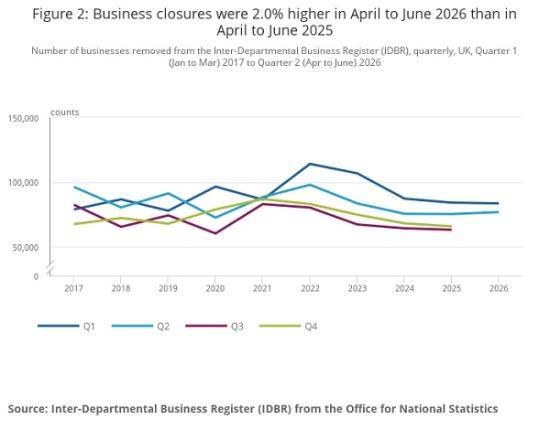
While economic headlines often focus on inflation, interest rates and GDP, another set of figures quietly provides one of the clearest pictures of the health of the UK economy - the number of businesses being created and the number disappearing.
The latest Office for National Statistics Business Demography report covering April to June 2026 tracks these changes across every major industry and region of the UK. Rather than measuring how much the economy has grown, these figures reveal whether entrepreneurs still have the confidence to start companies and whether existing firms are managing to survive.
Business births are often viewed as a sign of confidence. People are more willing to launch new ventures when they believe customers will spend money and finance is available. Conversely, business closures tend to increase when costs rise, borrowing becomes more expensive or demand weakens.
The figures come at a time when many firms continue to face higher wage costs, increased National Insurance contributions, elevated borrowing costs compared with recent years and ongoing uncertainty over consumer spending.
Many businesses have also been adapting to rapid technological change. Artificial intelligence, automation and digital services are creating opportunities for some firms while forcing others to rethink traditional business models.
The statistics also provide valuable insight into which sectors are performing well. Technology, professional services and some specialist manufacturing industries have generally shown greater resilience in recent years, while parts of retail, hospitality and construction have faced more difficult trading conditions.
Regional differences are equally important. Business creation is often strongest in areas experiencing investment, population growth or major infrastructure projects, while areas with slower economic growth may see fewer start-ups and higher closure rates.
For policymakers these statistics are particularly significant because small and medium-sized businesses account for the overwhelming majority of UK firms and employ millions of people. A slowdown in business creation today can translate into weaker employment growth and reduced investment in future years.
The quarterly figures should also be viewed alongside other recent economic indicators. Employment has remained relatively resilient, inflation has eased from its earlier peaks and interest rates have begun moving lower than the highs seen over the past two years. Even so, many firms continue to report that trading conditions remain challenging.
For entrepreneurs, the message is mixed. Difficult economic conditions do not stop successful businesses from emerging, but they do mean new companies need stronger financial planning, tighter cost control and greater flexibility than during periods of rapid economic growth.
The ONS stresses that these remain official statistics in development, meaning the methodology continues to be refined as the quarterly series matures. Nevertheless, they provide one of the earliest indicators of whether Britain's business community is expanding or contracting.
Why these figures matter
They provide an early measure of business confidence.
More business births usually indicate economic optimism.
Rising business deaths can signal increasing financial pressures.
They help governments assess whether policies are encouraging entrepreneurship.
They often provide an early warning of future changes in employment and investment.
Read the full ONS report HERE