Scotland's Housing Target Looks Increasingly Out of Reach as New Building Falls to Near Decade Low Making It Difficult To Form Families
4th August 2026
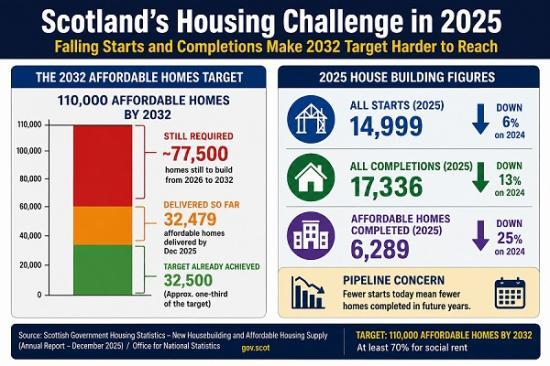
Scotland is facing a housing emergency, yet the latest official figures reveal that the number of new homes being built is moving in the opposite direction to what is needed.
The latest statistics from the Scottish Government, reflected in the Office for National Statistics housing data, show that housebuilding declined sharply during 2025.
While ministers remain committed to delivering 110,000 affordable homes by 2032, the mathematics behind the latest figures suggest the challenge is becoming increasingly difficult if not impossible.
No government can meet an ambitious housing target if fewer homes are being started and fewer homes are being completed year after year.
The Numbers Behind the Headline
During 2025, Scotland recorded:
17,336 new homes completed across all sectors.
14,999 new homes started.
Completions fell 13% compared with 2024.
Starts fell 6% compared with 2024.
These are not simply small annual fluctuations.
Excluding the exceptional disruption caused by the Covid pandemic in 2020:
Private-sector completions were the lowest since 2017.
Private-sector starts were the lowest since 2013.
Social-sector completions were the lowest since 2014.
Social-sector starts were the lowest recorded since the current series began in 1997.
Those are remarkable statistics for a country that has officially declared a housing emergency.
The Pipeline Is Shrinking
Perhaps the most worrying figure is not the number of homes completed it is the number of homes being started.
Today's starts become tomorrow's completions.
When only 14,999 homes begin construction, there is little prospect of seeing a major increase in completed homes over the next year or two.
Housing works like a pipeline. If fewer homes enter the pipeline today, fewer emerge at the other end in future years.
That means even if demand continues to rise, the supply of new homes may continue to lag behind.
Affordable Housing Also Moving Backwards
The Scottish Government's flagship commitment is to deliver 110,000 affordable homes by 2032, with at least 70% for social rent.
Progress has certainly been made.
By the end of December 2025, 32,479 affordable homes had been delivered towards that target.
However, the latest annual figures show worrying declines:
Affordable home approvals down 9%.
Affordable housing starts down 15%.
Affordable housing completions down 25%.
Only 6,289 affordable homes were completed during 2025.
Although approvals and starts improved during the final six months of the year, the overall annual picture remained one of decline.
The Maths Becomes Increasingly Difficult
Targets are ultimately judged by arithmetic rather than aspiration.
The Government's target requires 110,000 affordable homes between 2022 and 2032.
By December 2025, just under one-third of that total had been delivered.
That leaves roughly 77,500 homes still to build over the remaining years of the programme.
Achieving that will require a substantially faster rate of delivery than has been achieved during the last year.
In other words, every year that housing output remains below previous levels increases the pressure on future years.
Unless annual construction accelerates significantly, catching up becomes progressively harder.
Why Are Fewer Homes Being Built?
The slowdown is not caused by one single factor.
Instead, the industry faces several pressures simultaneously:
higher construction costs
expensive borrowing
shortages of skilled labour
slower planning processes
pressure on housing association finances
tighter public spending
increased regulatory requirements.
Many developers say projects that were financially viable only a few years ago no longer generate sufficient returns to proceed.
Housing associations have also warned that funding uncertainty has delayed or cancelled schemes.
Scotland's Housing Emergency
The irony is obvious.
Demand for housing continues to grow.
Many councils have declared housing emergencies.
Waiting lists remain lengthy.
Homelessness remains a major challenge.
Yet the supply of newly built homes is falling rather than rising.
That creates a widening gap between the number of homes Scotland needs and the number being delivered.
Could the Trend Still Be Reversed?
Yes but it would require a significant change.
The recent improvement in affordable housing approvals and starts during the second half of 2025 provides some encouragement.
However, approvals do not immediately become completed homes.
Construction takes time.
Planning takes time.
Labour takes time.
Materials take time.
Even if activity accelerates during 2026, it may be several years before the effect is fully reflected in completion figures.
The Political Challenge
Housing has become one of the defining issues facing Scotland.
The debate is no longer simply about whether governments have ambitious targets.
The more important question is whether those targets remain achievable under current conditions.
The latest statistics suggest that Scotland is not currently building homes at the pace needed to eliminate the housing shortage.
The figures do not prove that the Scottish Government will miss its target.
There is still time for construction rates to recover.
But they do demonstrate that the margin for error is rapidly disappearing.
Falling starts today mean fewer completions tomorrow.
After successive years of declining construction, Scotland now faces the prospect of needing its strongest period of housebuilding just to get back on schedule.
Unless there is a sustained increase in both private and affordable housing construction over the next few years, the ambition of delivering 110,000 affordable homes by 2032 will become increasingly difficult to achieve.
The latest statistics therefore tell an important story. Scotland's housing ambitions have not changed—but the pace of building is moving further away from what those ambitions require.
Rising House Prices
The ONS data shows that UK housebuilding has not kept pace with population growth, and Scotland faces the same structural shortage. That imbalance is a major driver of rising prices. If current trends continue, affordability pressures in Scotland will worsen, especially for younger and lower‑income households.
Scotland-specific trends
Scotland’s housing supply is tracked by the Scottish Government’s Supply of New Housing statistics. The key points:
New-build completions in Scotland are below pre‑2008 levels.
Population growth and household formation (especially single-person households) have outpaced new supply.
Social housing construction has increased, but not enough to offset shortages in the private sector.
Rural and island areas (including parts of the Highlands) face acute shortages, partly due to construction costs and limited local labour.
These trends align with the UK-wide picture: supply is not keeping up.
Why this drives rising prices
When supply is constrained, several things happen:
Existing homes appreciate faster because demand has nowhere else to go.
Private rents rise, making it harder to save for deposits.
Competition intensifies, especially in areas with limited stock (Highlands, Edinburgh, Aberdeen suburbs).
Second homes and short‑term lets further reduce available housing in some Scottish regions.
Even if demand cools temporarily (e.g., due to interest rates), the structural shortage keeps prices elevated.
Will it get harder for people in Scotland to find an affordable home?
Unless supply increases significantly, yes affordability will continue to worsen. The main pressures:
High construction costs in Scotland compared to England.
Slow planning processes and limited land availability in desirable areas.
Demographic change: more single-person households means more homes needed per capita.
Persistent undersupply relative to Scottish Government targets.
Affordability is already strained: the average Scottish house price is now £190,000–£200,000, while wages have not kept pace.
Scottish housing affordability is likely to worsen over the next few years, based on current evidence from the Scottish Government, Registers of Scotland, and major market analysts. The core drivers are slowing housebuilding, continued price growth, and pressure on incomes, even though interest rates may ease slightly.
The Falling Birth Rate Due Partly To The Housing Situation
1. Housing costs and shortages are directly affecting family formation
Scotland is experiencing a housing emergency, with long waiting lists for permanent housing and shortages of affordable homes.
The Herald reports that Glasgow and Edinburgh — both facing housing emergencies — have some of the lowest birth rates in Scotland.
National Records of Scotland data shows fertility has fallen to 1.25 children per woman, the lowest since records began.
People are delaying having children because they cannot secure stable housing
UK-wide research (including Scotland) shows:
Millennials increasingly see stable housing as a prerequisite for starting a family.
But stable housing is “increasingly out of reach,” especially for non‑graduates.
The share of young adults living with parents has almost doubled, delaying family formation.
Renters spend a third of their net income on rent, leaving little for childcare or savings.
Lack of family‑sized homes is a major barrier
A 2026 report warns:
Soaring house prices and shrinking living space are preventing Britons from having the number of children they want.
81% of surveyed adults say housing costs and availability make it harder to marry and start families.
Moving from a one‑bedroom to a two‑bedroom home increases confidence about having a baby as much as cutting housing costs by £1,100–£1,900 per month.
Housing is part of a wider cost‑of‑living pressure
Childcare costs, low maternity pay, and general financial insecurity also play major roles.
But housing is consistently identified as one of the top structural barriers.
So is housing a cause of Scotland’s falling birth rate?
Yes — housing costs and shortages are a significant contributing factor, alongside childcare costs, economic uncertainty, and changing social attitudes.
The evidence shows:
People want more children than they are having.
Housing affordability is one of the biggest obstacles to achieving their desired family size.
Areas with the worst housing pressures often have the lowest birth rates.
Housing is not the only cause, but it is one of the most important economic drivers of Scotland’s fertility decline.
The ONS numbers can be checked HERE
Dwellings Started
1980 16,380
1981 14,980
1982 18,550
1983 19,070
1984 18,230
1985 17,850
1986 17,980
1987 17,610
1988 18,990
1989 22,370
1990 20,360
1991 20,040
1992 18,230
1993 22,860
1994 25,640
1995 23,150
1996 22,180
1997 23,140
1998 19,580
1999 22,610
2000 23,070
2001 22,910
2002 22,210
2003 24,180
2004 27,460
2005 26,190
2006 28,970
2007 27,130
2008 21,900
2009 16,330
2010 14,580
2011 13,480
2012 14,020
2013 14,640
2014 16,980
2015 18,580
2016 18,280
2017 19,490
2018 23,430
2019 25,080
2020 18,970
2021 21,680
2022 22,020
2023 16,530
2024 15,870
2025 14,970