Advancing the Royal Navy's mine-hunting capability
4th August 2026
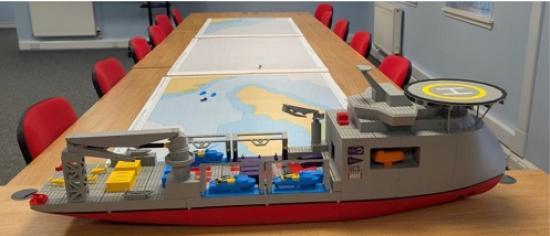
Dstl collaborated with industry and Defence partners to design and implement a rigorous and innovative test of the UK's underwater mine countermeasures.
Dstl analysts supported Naval Design Partnering (NDP) and colleagues in the Ministry of Defence’s National Armaments Director Group delivering an innovative exercise for the UK’s Mine Hunting Capability (MHC).
With just 2 weeks’ notice, Dstl mobilised its expertise to deliver a critical contribution to a high-profile naval table-top exercise. Working collaboratively with NDP, Defence Equipment and Support (DE&S), and Royal Navy stakeholders, Dstl designed and implemented realistic mine countermeasure scenarios and inputs, enabling Royal Navy subject matter experts to rigorously test operational concepts under realistic conditions.
Why mine-hunting matters
Underwater mines are a low-cost, high-impact threat that can block sea lanes, disrupt trade, and endanger lives. The UK depends on secure maritime access for economic security and NATO obligations.
Mine hunting ensures freedom of manoeuvre for military and commercial vessels. As mines grow more sophisticated, autonomous systems and advanced modelling are vital to stay ahead.
Actionable insights for future capability
Dstl analysts provided specialist guidance to create realistic, operationally relevant vignettes and real-time advice throughout the 2-day table-top exercise.
Analysts generated evidence-based insights into mine hunting capability performance in real-world environments.
Crucially, findings identified a key design change required for the adoption and optimisation of an offshore support vessel (OSV) design from Norway – helping ensure the UK’s future mine hunting mother ship delivers an enhanced UK mine-hunting capability.
Innovative use of 3D printed modelling
Using a large-scale 3D printed model created by NDP, Dstl facilitated exploration of deck operations for future mine-hunting mother ship designs. This modelling allowed stakeholders to visualise, test and assess integration challenges and operational frictions before committing to costly design decisions.
Turning concepts into reality
The team’s agility and expertise shone through in the shaping, design and implementation of realistic mine countermeasure scenarios and missions, enabling the testing of operational concepts under representative military conditions.
Through the innovative use of 3D printed modelling combined with traditional methods, stakeholders were able to visualise and discuss integration challenges and operational frictions early on, helping identify potential solutions. This proactive approach has already informed future work to reduce risk and cut planned expenditure.
De-risking a major investment
Dstl’s support underpins a major effort to de-risk a significant investment by ensuring procurement decisions are guided by evidence and expert analysis.
This collaborative effort between DE&S, Dstl, NDP and Royal Navy stakeholders has accelerated engagement and clarified requirements - reducing uncertainty in procurement.
It also enables the UK to engage with the Norwegian Government from a position of greater understanding of our needs and what we can offer in return.
Strategic impact
Dstl’s rapid response and technical leadership have directly influenced the Royal Navy’s approach to mine hunting, reducing risk, accelerating decision-making, and safeguarding operational effectiveness. This work exemplifies how Dstl’s science and innovation underpin Defence capability – keeping our forces and our nation safe.