Scotland's Wild Salmon Under Growing Pressure as New Report Shows Continuing Decline
6th August 2026
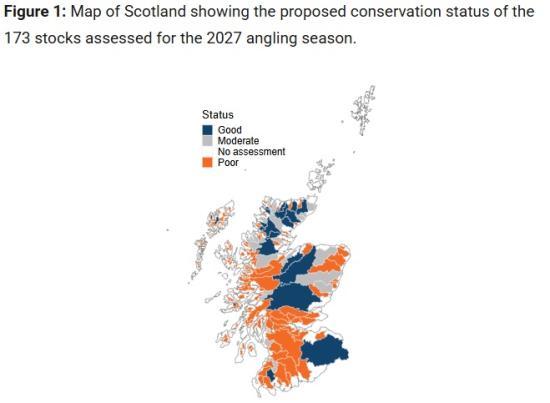
Scotland's iconic wild Atlantic salmon continue to face significant challenges, with a new Scottish Government assessment showing that most salmon stocks remain in poor conservation status despite decades of conservation efforts.
The latest Status of Salmon in Scotland report paints a mixed picture. While many of Scotland's largest rivers still support substantial salmon populations, the overall trend remains one of long-term decline, with increasing pressure on fish stocks across much of the country.
Two-thirds of salmon stocks classed as poor
The assessment covers 173 individual salmon stocks across Scotland.
For the proposed 2026 angling season:
115 stocks (66%) are classed as being in poor conservation status.
Only 32 stocks (18%) are considered to be in good conservation status.
The remaining stocks fall into the moderate category.
The figures continue a worrying trend. In 2017, there were 61 stocks considered to be in good condition. That number has now almost halved.
Bigger rivers still hold most salmon
The report also highlights an important point that is often overlooked.
Although only 18% of assessed stocks are rated as being in good condition, these are mainly the larger east coast rivers, which together are estimated to contain around 84% of Scotland's total wild salmon population.
That means Scotland still has internationally important salmon rivers, but many smaller rivers and burns are struggling.
Declines seen across Scotland
Scientists found significant long-term declines in 63 salmon stocks between 2011 and 2024.
Even among rivers where no statistically significant decline was detected, many still contained fewer salmon than they did at the start of the period.
The report concludes that declines are occurring across all regions of Scotland and affect rivers currently classed as good, moderate and poor.
Strong protection measures remain
The conservation assessments determine whether salmon may legally be retained by anglers.
Stocks classed as poor are managed on a catch-and-release basis, while additional national protections mean salmon caught before 1 April cannot normally be retained because spring salmon numbers remain historically low.
Why are salmon declining?
The Scottish Government says there is no single cause.
Instead, salmon are being affected by a combination of pressures, including:
Changing ocean conditions linked to climate change.
Warmer river temperatures.
Changes in river flows.
Habitat degradation.
Obstacles to migration.
Other environmental pressures acting throughout the salmon's complex life cycle.
Many of these challenges are shared across the North Atlantic, where wild Atlantic salmon populations have declined in many countries.
Importance for the Highlands
For many Highland communities, wild salmon are far more than a conservation issue.
Healthy salmon rivers support:
angling tourism,
hotels and accommodation providers,
ghillies and guides,
local shops,
rural employment,
and wider biodiversity.
A continued decline therefore has economic as well as environmental consequences.
A need for continued action
The Scottish Government says the figures reinforce the need for precautionary management and continued work under Scotland's Wild Salmon Strategy to improve habitats, remove barriers to migration and protect fish throughout their life cycle.
While Scotland still possesses some of Europe's most important wild salmon rivers, the latest assessment makes clear that many populations remain under considerable pressure. Reversing decades of decline is likely to require sustained action on rivers, estuaries and at sea if future generations are to continue enjoying one of Scotland's most iconic species.
Read the full report with maps HERE