Which Way to Hormuz? Alice, the Cheshire Cat and the World's Most Important Strait
8th August 2026
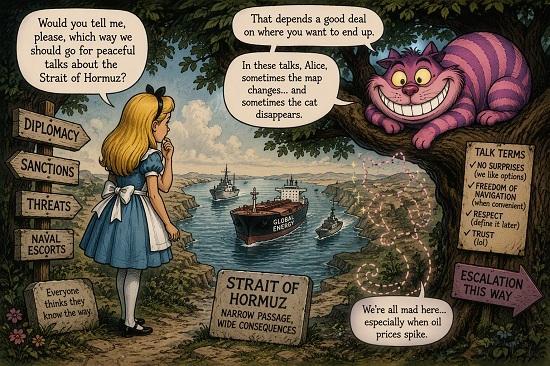
When America says a deal is almost done, Iran says there is no deal and everyone is trying to work out which way the oil tankers are going, perhaps it is time to ask the Cheshire Cat for directions.
Alice found herself in Wonderland with a rather familiar problem.
She didn't know which way to go.
Fortunately, she met the Cheshire Cat.
"Would you tell me, please, which way I ought to go from here?" Alice asked.
"That depends a good deal on where you want to get to," replied the Cat.
And there, strangely enough, we have the Strait of Hormuz in 2026.
Everyone appears to want to get somewhere.
The problem is that nobody seems entirely certain which direction everyone else is travelling.
Trump says the deal is nearly there
According to President Trump, an agreement with Iran is close.
That sounds encouraging.
Oil traders hear the words "deal is close" and immediately start wondering whether tankers will soon be moving normally through Hormuz again.
If that happens, the risk premium attached to oil could fall.
Shipping companies could plan their journeys.
Insurance costs could eventually come down.
And consumers around the world might breathe a small sigh of relief.
But then comes another message.
Iran says: What deal?
Iran's position has been considerably less enthusiastic.
Tehran has indicated that there is no completed agreement with Washington.
And that leaves the rest of us looking rather like Alice.
Which way are we going?
Trump says one way.
Iran appears to be pointing in another direction.
Oman is trying to help find a route somewhere between the two.
And oil traders are watching all of them very carefully.
Welcome to Hormuz Wonderland
The Strait of Hormuz is not an ordinary piece of water.
It is one of the world's most important energy chokepoints.
Huge quantities of oil and other energy supplies normally pass through it.
Which means that when somebody starts talking about closing it, controlling it, reopening it or creating special arrangements for ships using it, the consequences go far beyond the Middle East.
They reach petrol pumps.
Airports.
Factories.
Fishing boats.
Farmers.
Hauliers.
Supermarkets.
And ultimately household budgets.
So perhaps we should introduce the characters.
Alice — the world's consumers
Alice represents the ordinary consumer.
She doesn't particularly care which diplomatic formula is eventually agreed.
She simply wants to know:
"Will petrol get cheaper?"
And:
"Will my energy bill go up?"
And perhaps:
"How much will everything else cost if oil stays expensive?"
Unfortunately, nobody has given Alice a particularly clear answer.
The Cheshire Cat — the diplomats
The Cheshire Cat has the luxury of smiling mysteriously while everyone else tries to work out what he means.
Diplomacy can sometimes look remarkably similar.
There are discussions.
There are meetings.
There are proposals.
There are counter-proposals.
There are statements saying progress has been made.
And then there are statements saying nothing has actually been agreed.
The Cheshire Cat would probably approve.
Trump — "The deal is this way"
Trump appears convinced that an agreement is within reach.
If he is right, the world will eventually want to know what that agreement actually means.
Because saying that Hormuz will be open is one thing.
Making shipping companies believe that it will remain open is another.
Iran — "No, it's this way"
Iran has its own reasons for refusing to simply return to the old arrangement.
Tehran has discovered that Hormuz gives it enormous strategic leverage.
It doesn't necessarily have to permanently close the Strait.
It only has to demonstrate that it could disrupt shipping again.
That possibility alone can influence oil prices.
And that is a very powerful card to hold.
Perhaps the real question isn't who controls Hormuz
This is where the situation gets particularly interesting.
The ultimate outcome may not be an Iranian declaration that:
"We control the Strait."
That would provoke enormous international opposition.
Instead, something much more subtle could emerge.
Iran might retain a recognised role in security or regulation.
Ships might be allowed through designated routes.
Special arrangements might govern who can pass and under what circumstances.
The Strait could technically be open.
But everybody would know that Iran still has considerable influence over what happens there.
And that would change the economics of the world's energy trade.
The oil tanker asks for directions
Imagine the scene.
A tanker captain approaches the Strait.
He calls ahead.
"Is the Strait open?"
The answer comes back:
"Yes."
"Completely?"
"Well..."
"Can we sail through?"
"Probably."
"Is there an agreement?"
"Not exactly."
"Will the agreement still exist tomorrow?"
"That depends."
"On what?"
"Where you want to get to."
At which point the captain might reasonably decide that Wonderland is becoming rather complicated.
The oil market doesn't like uncertainty
Oil markets can cope with high prices.
They can cope with low prices.
What they dislike most is uncertainty.
If traders know that Hormuz will remain open, they can price oil accordingly.
If they know it will remain closed, they can also adjust.
But if nobody knows what will happen tomorrow morning, the market adds a risk premium.
That means consumers can end up paying more even before there is an actual shortage.
The possibility of disruption can itself become expensive.
And this is where Caithness comes into the story
It may seem that Hormuz is about as far from Caithness as it is possible to get.
But it isn't.
The consequences travel remarkably well.
Higher oil prices can mean higher diesel costs.
That affects hauliers.
It affects fishing.
It affects farming.
It affects construction.
It affects tourism.
It affects the cost of transporting goods to the far north.
And for households using heating oil, the connection is particularly obvious.
The tanker in Hormuz may be thousands of miles away.
But the price on a Caithness fuel delivery can still reflect what happens there.
The Cheshire Cat might have the answer
Perhaps Alice should stop asking:
"Which way is Hormuz going?"
And ask a different question:
"Where does everyone want to end up?"
The United States wants secure international shipping.
Iran wants security, influence and guarantees.
The Gulf states want their energy exports moving.
Shipping companies want predictable routes.
Insurers want predictable risks.
Oil producers want to sell their oil.
And consumers want lower prices.
There is actually a destination that everybody could agree on.
A functioning Strait of Hormuz.
The difficulty is deciding who gets to hold the map.
The danger of thinking the crisis is over
This is perhaps the most important point beneath the satire.
If a deal is announced, it won't necessarily mean the Hormuz problem has disappeared.
The world will want to know:
Will the agreement last?
Will commercial shipping return to normal?
Will insurers accept the risk?
Will tanker operators believe the guarantees?
Will Iran retain the ability to shut or restrict the route?
Will another disagreement cause the whole arrangement to collapse?
Until those questions are answered, the oil market may continue to carry some of the uncertainty.
So which way should we go?
Perhaps the Cheshire Cat would have one final piece of advice.
"That depends a good deal on where you want to get to."
Alice might reply:
"Lower oil prices."
The Cat would smile.
Iran might point one way.
Trump another.
Oman might suggest a compromise somewhere in between.
The oil tanker would probably just want a straight line through the Strait.
And millions of consumers around the world would be hoping that everyone eventually agrees on the same direction.
Because when it comes to Hormuz, the problem isn't simply finding a way through.
It is finding a way through that everyone believes will still be there tomorrow.
And that, perhaps, is where the real story begins.