Is It Already Too Late to Save Britain's High Streets?
Submitted by Bill Fernie
8th August 2026
Andy Burnham's latest focus on high streets reflects a growing political consensus: town centres matter, shops are closing, and something must be done. Burnham has spoken about making high streets "the symbols of Britain's renaissance" and has highlighted the need to tackle vacancy and decline.
But before accepting the rhetoric, it is worth asking a more difficult question:
Can Britain's high streets actually be saved?
Or are politicians trying to reverse economic changes that are already permanent?
The Wrong Question
Most discussions begin with:
"How do we bring shoppers back?"
That assumes shopping remains the primary purpose of a high street.
But does it?
Online retail has fundamentally altered consumer behaviour. Goods that once required a trip to town can now be ordered from a phone and delivered the next day.
No mayor, council leader or government minister can repeal that reality.
The challenge may not be saving the traditional high street.
The challenge may be recognising that it is already gone.
What Killed the High Street?
Politicians often blame:
Business rates
Out-of-town retail parks
Online retailers
Empty shops
Planning policy
All have played a role.
But perhaps the larger question is whether high streets were built for a world that no longer exists.
For over a century, town centres were places where people went primarily to buy things.
Today people can buy almost anything without leaving home.
That is not a temporary recession.
It is a structural shift.
Reimagining: Vision or Euphemism?
The fashionable word is "reimagining."
Empty shops become:
Health centres
Community hubs
Apartments
Libraries
Workspaces
Leisure venues
The theory is simple. If retail demand has fallen, find another purpose.
There is some evidence supporting this approach. Urban researchers argue that town and city centres with more residents living close by tend to have lower shop vacancy rates because they generate footfall and spending.
But another question follows.
Is a reimagined high street still a high street?
If most retail disappears and is replaced by housing, public services and leisure facilities, perhaps success should not be measured by the number of shops saved.
Perhaps success should be measured by whether the town centre remains alive.
The Uncomfortable Question
Politicians often describe every high street as if it can be revived.
Can it?
A prosperous city centre in London, York or Brighton is not facing the same challenges as a struggling post-industrial town. Centre for Cities notes significant differences in vacancy rates between places.
Some locations have growing populations, strong economies and rising incomes.
Others do not.
Can every town realistically support a thriving retail centre?
Or are some places being asked to fight economic gravity?
What If We Are Too Late?
This is the question few politicians like to ask.
Not because it is pessimistic.
Because it may be realistic.
Perhaps the age of the high street as Britain's primary shopping destination is ending.
If so, the objective should not be restoration.
It should be adaptation.
The town centres that survive may be those that stop thinking of themselves primarily as shopping districts.
Ask One Final Question
Whenever a politician announces a high street revival programme, ask:
What exactly is being saved?
The shops?
The buildings?
The footfall?
The community?
Or simply the memory of what the high street used to be?
The answer matters.
Because if we misunderstand the problem, we may spend years trying to resurrect something that has already changed beyond recognition.
The future of Britain's high streets may not depend on bringing back the past.
It may depend on accepting that the past is not coming back.
PHOTO
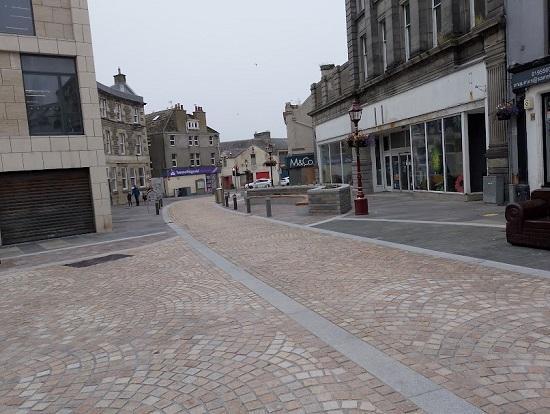
The town centre of Wick now has it refurbished roads and pavements with beautiful paving and street furniture at a cost of over £2million but is it too late - let's hope that more ideas come forward for the increasing number of empty shops.
Photographer - Bill Fernie