The Garden Could Be Worth More Than We Think: Why Highlands Households Should Start Growing Food Again
Submitted by Bill Fernie
13th August 2026
For generations, having a garden was not simply about having somewhere to sit in the sunshine.
For many Scottish families, the garden was part of the household food supply.
Potatoes were grown.
Carrots were stored.
Onions were harvested and dried.
Cabbages provided food through the winter.
Lettuce went straight from the garden to the kitchen.
And surplus vegetables were preserved, stored or given to neighbours.
Then Britain became wealthier, supermarkets became more convenient and food became relatively cheap.
The vegetable patch disappeared.
Lawns replaced potatoes.
Flower beds replaced cabbages.
And the weekly supermarket shop replaced much of the food that once came from the garden.
But perhaps it is time to reconsider that decision.
Not because Britain is about to run out of food.
Not because everyone needs to become self-sufficient.
But because food prices may remain considerably higher than they were in the past, while increasingly unpredictable weather could make parts of the food supply more vulnerable.
For households with a garden, growing even a modest amount of food could become a surprisingly useful form of insurance.
The timing may be more important than the size of the garden
There is no need to dig up the entire garden.
In fact, that would probably be a mistake for most people.
The sensible approach is to start small.
Take an area of lawn or an unused section of garden and turn it into a vegetable plot.
The important thing is to begin preparing the ground now rather than waiting until spring 2027.
Autumn and winter provide an opportunity to clear grass and weeds, improve the soil and plan what will be planted.
The RHS recommends preparing allotment plots during the quieter months and adding organic matter where appropriate.
That means that someone deciding in August or September 2026 to grow vegetables next year has plenty of time.
There is no need for panic.
There is simply an opportunity to prepare.
Why potatoes should be near the top of the list
If you have never grown vegetables before, potatoes are one of the obvious places to start.
They are filling, versatile and relatively straightforward to grow.
More importantly, they can produce a substantial amount of food from a relatively small area.
Potatoes can be boiled, baked, mashed, roasted, made into soup and used in countless other meals.
They also have another advantage for a household thinking about food resilience:
they can be stored.
That makes them rather different from lettuce, which needs to be eaten quickly.
For a household trying to reduce its dependence on supermarket prices, potatoes are therefore an obvious crop.
Onions are another sensible choice
Onions don't have quite the glamour of tomatoes or strawberries.
But from the point of view of household economics, they are extremely useful.
They go into soups, stews, casseroles, sauces and countless everyday meals.
They can also be stored for months when properly harvested and dried.
The Scottish Government's growing calendar includes onions among the crops suited to Scottish growing, while noting that gardeners in northern Scotland may need to adjust planting and sowing times.
That is exactly the sort of crop worth considering in a Highland garden.
Carrots provide another opportunity[/]b
Carrots are another relatively straightforward crop.
They do not require elaborate equipment and can be grown in the ground or in suitable raised beds.
They are also useful because they can be left in the soil for a considerable period and harvested as required, depending on conditions and variety.
The RHS recommends root crops as one of the more resilient choices where drought becomes a problem.
That could become increasingly relevant.
Cabbage and other brassicas make sense in Scotland
Cabbage, kale and related brassicas are particularly interesting for northern gardeners.
They are suited to cooler conditions and can provide food at times of the year when many other vegetables are no longer producing.
The Scottish growing calendar includes cabbage, kale, swede, turnips and other hardy vegetables across the Scottish growing season.
For someone thinking about food security rather than creating an Instagram-perfect garden, these are exactly the sorts of vegetables worth considering.
[b]And then there is lettuce
Lettuce is not going to feed a family through the winter.
But it demonstrates another advantage of growing your own.
You can pick exactly what you need.
Instead of buying a bag of salad from a supermarket and throwing part of it away when it goes off, you can walk into the garden and pick enough for lunch.
The Scottish Government's growing calendar includes lettuce at several points through the year, with timings adjusted for northern Scotland.
It is a small saving.
But repeated over an entire growing season, small savings become worthwhile.
The garden doesn't have to replace the supermarket
This is perhaps the most important point.
Nobody is suggesting that Highland households should attempt to grow everything they eat.
That would be unrealistic.
A normal supermarket will remain vastly more convenient for most foods.
But suppose a household could produce:
potatoes;
onions;
carrots;
cabbage;
lettuce;
kale;
turnips or swede;
peas;
perhaps some beetroot;
and a few herbs.
That could remove a surprisingly useful part of the weekly shopping bill.
And it would provide something that supermarkets cannot:
a degree of independence from food prices.
Imagine the difference in 2027
Suppose food prices rise again next year.
The household going entirely to the supermarket has only one option:
pay the higher price.
The household with a productive garden has another option:
eat something it has already grown.
The difference might only be a few pounds in one week.
But over six months, the value becomes much more significant.
And if prices rise particularly sharply for potatoes, onions, carrots or other vegetables, the savings could become even more noticeable.
It is also a hedge against inflation
There is another economic argument.
Money saved by growing food is effectively money protected from inflation.
If a household spends £10 on vegetable seeds and produces £100 worth of food that it would otherwise have bought, the value of the exercise is not simply the £90 difference.
The household has also reduced its exposure to future price increases on those foods.
If supermarket prices rise another 10%, the vegetables already growing in the garden don't suddenly become 10% more expensive.
The household has created a small inflation hedge in the garden.
But there is an important warning about 2026 weather
Growing your own food isn't immune to climate change.
Indeed, the weather that threatens commercial agriculture can also threaten gardens.
The RHS points out that hot, dry summers can restrict productivity and recommends planning for periods without rain, improving soil with organic matter and choosing crops that are more resilient to drought.
That means the old idea of simply digging a garden and throwing seeds into the soil may no longer be enough.
Gardeners will increasingly have to think about:
water retention, drainage, wind exposure, frost dates and crop choice.
That is particularly important in the Highlands.
Caithness presents its own challenges
A gardener in Caithness cannot simply copy a vegetable-growing guide written for southern England.
The growing season is different.
Late frosts can occur.
Wind can be a major problem.
Soil conditions vary enormously.
And this year's extreme weather is a reminder that even traditional growing calendars are becoming less predictable.
The Scottish Government's own growing guidance specifically says that gardeners in the more northerly parts of Scotland or areas prone to high winds and late frosts may need to revise sowing schedules.
That doesn't make growing vegetables impossible.
It makes planning more important.
Don't dig up the whole lawn
There is also a psychological barrier.
Someone looking at a large garden may think:
"I don't have the time to become an allotment holder."
That isn't necessary.
Start with a small patch.
Perhaps 10 or 20 square metres.
If it works, expand it.
If it doesn't, you haven't destroyed the garden.
And there is another possibility: raised beds.
The RHS notes that raised beds can improve drainage and extend the period during which difficult soils can be worked.
For some Highland gardens, that could be a better solution than digging a traditional vegetable plot.
The real value may be knowledge
There is another reason to start in 2026 rather than waiting until 2027.
Growing vegetables is a skill.
The first attempt may not be spectacular.
Some crops will fail.
Something will probably eat the cabbage.
The carrots may be smaller than expected.
The potatoes may surprise you.
The weather will almost certainly interfere with your plans.
But every mistake teaches you something.
By the time spring 2027 arrives, someone who started preparing their garden in autumn 2026 will already understand their soil, their exposure, their frost risk and which crops grow best.
That knowledge could be more valuable than the first harvest.
Perhaps we have forgotten something our grandparents understood
Older generations were often much more connected with the production of food.
They knew when potatoes were planted.
They knew how to store onions.
They knew which vegetables could survive winter.
They knew how much food could be produced from a small piece of ground.
Modern Britain largely abandoned that knowledge because food became cheap and readily available.
Perhaps that was perfectly rational.
But the assumptions behind it are changing.
Food prices have risen sharply.
Climate volatility is increasing.
And households are discovering that falling inflation does not mean falling prices.
This isn't about panic
There is a danger in talking about food security that people interpret it as a prediction of shortages.
That isn't what this is about.
Britain has a sophisticated food system.
Supermarkets are not about to disappear.
International trade will continue.
Farmers will continue producing food.
The point is much simpler:
why depend entirely on a system over which you have no control when you have a garden that could produce at least some of what you eat?
For many people, the answer may be that they don't want to garden.
That's perfectly reasonable.
But for others, perhaps it is time to reconsider the patch of grass that currently produces nothing except something that needs cutting.
Start preparing this year
The sensible timetable is remarkably simple.
Autumn 2026
Clear a modest area.
Remove persistent weeds.
Improve the soil with suitable organic matter.
Work out where the sun reaches.
Think about drainage and water.
Decide what you actually eat before buying seeds.
Winter 2026–27
Plan the beds.
Order seeds and seed potatoes.
Consider protection against wind and late frost.
Work out how you will protect crops from slugs, birds and cabbage pests.
Spring 2027
Start planting according to local conditions rather than simply following a calendar designed for southern England.
The Scottish Government's growing calendar provides a useful starting point, but northern gardeners may need to adjust the timing.
Summer and autumn 2027
Harvest what you grow.
Learn what worked.
Store what can be stored.
And decide whether the experiment is worth expanding.
The garden may become part of the household economy again
For much of the twentieth century, growing vegetables was simply something that many families did.
Then supermarkets made it unnecessary.
Perhaps the future won't require us to return completely to the past.
But it may make sense to bring back part of it.
A garden containing potatoes, onions, carrots and cabbages is not going to make a household self-sufficient.
It might, however, make a household slightly less vulnerable.
And that is an increasingly valuable thing.
We have spent the past few years discovering that food prices can rise much faster than household incomes.
We are now discovering that extreme weather can damage harvests.
If food prices rise again in 2027, the household with a productive garden will still be affected.
But it may have one small advantage:
some of its food will already be growing outside the back door.
Perhaps that is reason enough to dig up a little lawn this autumn.
Photo
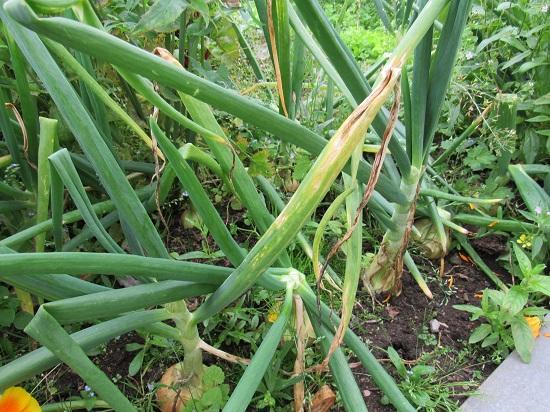
Onions in Bill Fernie's garden - they are easy to grow and relatively not bothered by pests. I weed sometimes when establishing the veggies but gradually they can take care of themselves. I enjoy doing a little rather than lot and its free fitness exercise and fresh air. It saes a very small amount of money but is huge on satisfaction when eating your own home grown produce.
I grow peas and beans as they are easy and do not need much attention other than string or netting to hold them up.
Yes I used to grow a lot of potatoes but being on my own these days I plant less and indeed find often some that have grown themselves even in the compost heap - free for no effort at all.
I grow some lettuce in a tub of the ground so no slugs.
Generally years to year I will try something new - herbs etc and I let seeds of flowers from previous years grow along with it all - the bees and insects love them.
So no neat garden veggie plot for me - weeds are just plants and I just try to make sure they do not take over - sometimes.