Producer Prices Are Falling — So When Will Consumers Feel the Benefit?
19th August 2026
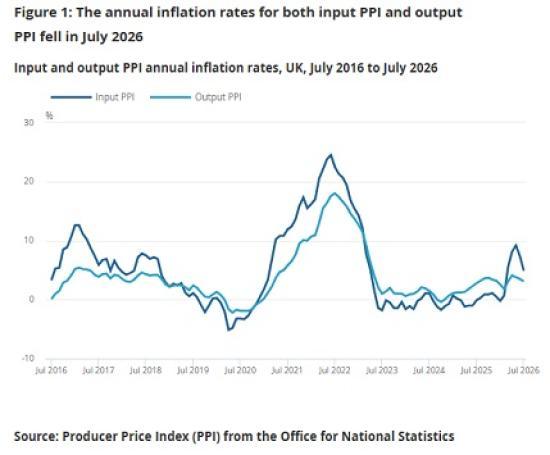
There is a piece of economic news in the latest figures from the Office for National Statistics which, at first sight, looks reassuring.
The cost of materials and fuels bought by British manufacturers has fallen sharply. Producer input price inflation dropped to 4.9% in the year to July, down from a revised 7.4% in June.
That is a substantial improvement but before we start expecting supermarkets, shops and other businesses to cut their prices, there is a catch.
Falling costs for producers do not necessarily mean falling prices for consumers and that distinction could become increasingly important over the coming months.
The pressure at the factory gate is easing.
The ONS Producer Price Index is effectively an early warning system for inflation.
It measures what businesses are paying for materials and energy and what manufacturers are charging for their products before those products eventually make their way through wholesalers, retailers and other parts of the economy.
In July, input prices fell by 1.7% during the month. Factory-gate output prices, meanwhile, increased by 0.2%.
Over the year, input prices were 4.9% higher while output prices were 3.1% higher.
That is a considerable change from earlier this year.
In April, annual input price inflation was running at 8.1%. By May it had reached 9.2%. It then fell to 7.4% in June and now stands at 4.9%.
The direction of travel is therefore clear.
The inflationary pressure coming through the production system has weakened considerably.
For consumers, that should eventually be good news.
But "eventually" is the important word.
Oil is doing much of the work
One of the biggest reasons for the improvement is crude oil.
Crude oil input prices fell by 18% between June and July. That followed a 20.9% fall in June.
Even after those falls, crude oil prices were still 10.6% higher than a year earlier.
The impact of oil goes far beyond the price displayed on a petrol station forecourt.
Oil affects transportation, manufacturing, agriculture, plastics, chemicals, packaging and countless other parts of the economy.
A sustained fall in oil prices can therefore gradually work its way through the entire supply chain.
The problem is that oil is also one of the most volatile commodities in the world.
The ONS itself warns that its latest data continue to be affected by the conflict in the Middle East. The oil figures are also subject to revision as more information becomes available.
That makes forecasting consumer prices particularly difficult.
If oil stays down, the inflation outlook could improve.
If geopolitical events send oil prices sharply higher again, much of that improvement could disappear surprisingly quickly.
Food provides another interesting signal
There is potentially better news for food shoppers.
Prices paid by manufacturers for domestic food inputs fell by 1.6% in the year to July.
Factory-gate prices for food products also fell, by 0.8%.
That does not mean food prices in the shops will suddenly fall by 0.8%.
The journey from farm or manufacturer to supermarket shelf involves transport, storage, processing, packaging, wages, energy, rents and retail margins.
But it does suggest that at least some of the underlying production pressure behind food prices has eased.
That is important because food is one of the areas where households notice inflation most directly.
If lower producer prices persist, consumers should eventually have more chance of seeing cheaper prices or, at the very least, slower increases.
But not everything is getting cheaper
There is a danger of looking at the headline figure and assuming that the inflation problem is disappearing.
It isn't.
Prices for metals and non-metallic mineral products were still 8.4% higher than a year earlier.
Chemical input prices were 6.1% higher.
And while crude oil prices have fallen sharply, fuel inputs were still 7.8% higher over the year.
These costs matter because they feed into a huge range of products.
Construction materials, machinery, packaging, plastics, manufactured goods and many other products remain exposed to these costs.
The ONS also reports that prices for other manufactured outputs increased by 4.6% over the year, while basic metals, fabricated metal products and machinery were 5% higher.
So the picture is not one of rapidly falling production costs across the board.
It is one of inflation becoming less intense.
That is an important difference.
Why businesses may not cut prices
There is another reason why consumers should not expect an immediate bonanza of falling prices.
Businesses have margins to protect.
Suppose a manufacturer has spent the past two years dealing with sharply rising energy, transport, finance, wage and raw material costs.
If some of those costs subsequently fall, the business may not immediately reduce its selling price.
It may use the improvement to rebuild margins.
That isn't necessarily profiteering.
A company which has seen its margins squeezed may need to restore profitability, repay borrowing or rebuild cash reserves.
There is also the question of timing.
Businesses may have purchased raw materials months earlier at higher prices. Contracts may lock them into particular costs. Retailers may have already bought stock.
Consequently, there can be a considerable delay between a fall in producer prices and any change in the prices paid by consumers.
The pound could help
There is another small piece of favourable news in the ONS figures.
Sterling's effective exchange rate was 0.6% higher in July than a year earlier.
Import prices fell by 2.5% during July, although they remained 5.2% higher over the year.
A stronger pound makes many imported goods and raw materials cheaper in sterling terms.
Britain is heavily dependent on imports, so movements in the exchange rate can eventually influence consumer prices.
If sterling remains relatively strong while international commodity prices fall, the combination could provide a useful double benefit.
But again, there is no guarantee.
Currency markets can move rapidly, particularly when investors become nervous about Britain's finances, interest rates, economic growth or international events.
What could happen to consumer inflation?
My expectation is that the July producer price figures increase the possibility that consumer goods inflation will moderate over the next several months.
But I would be much more cautious about predicting widespread price falls.
There is a difference between prices rising more slowly and prices actually falling.
For most households, the former is much more likely.
A packet of food which has risen from £2 to £2.50 does not become £2 simply because the cost of producing it has fallen.
Instead, the manufacturer might stop increasing its price.
That still matters.
If wages continue to rise while prices increase more slowly, household purchasing power can gradually recover.
That is one of the ways an economy can emerge from an inflationary period without requiring prices themselves to return to their old levels.
The biggest risk remains energy
For Britain, energy remains the wild card.
The July figures benefited significantly from falling crude oil prices.
That is welcome.
But it also means that a renewed oil shock could quickly reverse some of the improvement.
This is particularly important for rural areas where households and businesses can be more dependent on petrol, diesel and heating fuels because alternatives such as public transport or mains gas are less readily available.
A sustained fall in oil prices would therefore be particularly welcome outside Britain's major cities.
But the opposite is equally true.
Another oil-price surge would feed through into transport and business costs and could eventually put renewed pressure on household budgets.
The real test comes later this year
The July PPI figures should therefore be regarded as encouraging rather than conclusive.
Producer inflation is moving in the right direction.
Input price inflation has fallen from more than 9% earlier this year to 4.9%.
Output price inflation has also eased to 3.1%.
Food producer prices are falling.
Import prices fell sharply during July.
Sterling is slightly stronger.
There are several reasons to believe that some of the pressure on consumer prices could ease.
But there are still substantial costs embedded in the economy, and geopolitical events could change the picture very quickly.
The important question over the next six to twelve months is therefore not simply whether producer inflation falls.
It is whether lower production costs survive long enough, and spread far enough through the supply chain, for households to actually notice them.
That is where the latest figures become particularly interesting.
Britain may finally be moving past the worst of the production-cost shock.
But for families struggling with the cost of living, the recovery will only really begin when that improvement reaches the tills.
Source: Office for National Statistics, Producer price inflation, UK: July 2026. The latest PPI estimates are provisional and can be revised as additional data are received and validated.
Read the full ONS report HERE