A New 10p Coin in an Increasingly Digital Britain — Is This the Right Direction?
26th August 2026
Britain is becoming a much more digital economy.
We tap cards and phones to pay for coffee, use online banking rather than visiting branches and increasingly expect even small purchases to be completed electronically.
Cash is still important, particularly for some older people and those who prefer to budget with physical money, but its role in everyday transactions has been steadily declining.
So the arrival of millions of new 10p coins this week seems, at first sight, slightly odd. Just as Britain is becoming increasingly cashless, why are we putting millions of additional small coins into circulation?
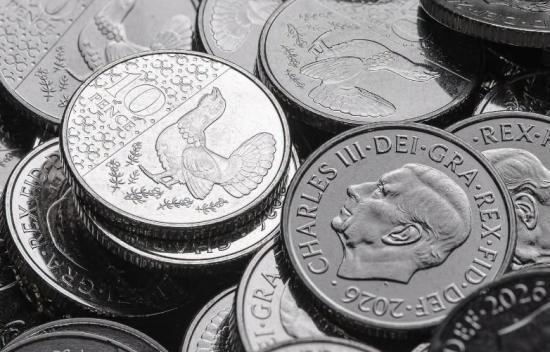
The answer is that these are not actually a new denomination. They are newly issued 10p coins bearing the portrait of King Charles III, and they are entering general circulation for the first time. Around 7.1 million are being released: 600,000 dated 2023 and 6.5 million dated 2026.
The reverse of the new coin features the capercaillie, the large Scottish grouse which is now seriously threatened in Britain. The design is part of the King's new definitive coinage, which uses British wildlife and plants on the smaller denominations.
There is therefore a perfectly reasonable explanation for the new coins. Britain is gradually replacing the Queen Elizabeth II coinage with the King's coinage, but it is doing so very slowly rather than withdrawing perfectly usable coins simply because they carry the previous monarch's portrait. The older Elizabeth II 10p coins remain legal tender and will continue circulating alongside the Charles III coins.
In fact, the Royal Mint says demand for 10p coins was sufficient to justify producing another batch. This is the first time that Charles III 10p coins have entered general circulation, although Charles already appears on the 5p, 50p and £1 coins.
That raises the more interesting question: if cash is declining, why is there still sufficient demand for 10p coins to justify making millions more?
The answer is that Britain is not yet a cashless society.
The latest figures cited by UK Finance show that cash payments fell to 3.9 billion in 2025, from 4.3 billion the previous year. That is a substantial decline, but 3.9 billion payments is still an enormous amount of activity. Around 1.4 million UK adults mainly use cash for their day-to-day spending, while millions more continue to use it occasionally.
This is an important distinction that can sometimes be lost in discussions about the decline of cash.
Cash use is falling, but it isn't disappearing.
There are people who rely on cash because they find digital payments difficult or inaccessible. Some people deliberately use cash because it helps them control their spending. Small businesses sometimes prefer it because it avoids card-processing costs, while cash remains useful when electronic payment systems fail.
And there is another consideration that is particularly relevant to the elderly and vulnerable: cash provides an alternative when technology doesn't work.
A power cut, telecommunications failure, banking-system outage or card-network problem can suddenly make a population that normally relies almost entirely on digital payments rather vulnerable. Cash doesn't require a mobile phone signal, battery, internet connection or functioning card terminal.
That means the Government and the Bank of England have to maintain a rather delicate balance. They want Britain to benefit from the convenience and efficiency of digital payments, but they also need to make sure that cash doesn't disappear before people are ready for it to disappear.
The new 10p coin therefore isn't really evidence that Britain is going backwards.
It is evidence that Britain is in transition.
What I do find interesting, however, is the sheer number of coins already in circulation. The Royal Mint says there are about 24.1 billion coins circulating in the UK, and the new Charles III 10p coins will represent only around 1% of that total.
That illustrates just how difficult it would be to eliminate coins quickly even if the Government decided that Britain should become predominantly cashless.
Coins have extraordinarily long lives.
A 10p coin doesn't need to be replaced every few years in the way a mobile phone does. It can circulate for decades. That means decisions about coinage have consequences long after the technology used for payment has changed.
There is also something rather pleasing about the particular design chosen for the new 10p.
The capercaillie is a Scottish bird, and putting it on millions of coins provides an opportunity to draw attention to a species that many people may never have seen. The Royal Mint says it hopes the coin will help raise awareness of the bird's precarious future in Britain.
For someone in the Highlands, there is perhaps an additional irony here. The capercaillie was once much more widespread in Scotland but has declined dramatically and is now restricted to a small number of areas. A Scottish bird appearing on one of Britain's everyday coins is therefore both a celebration and a reminder of what can be lost.
The coin also illustrates something else about physical money that digital money doesn't quite replicate.
Coins are tangible pieces of national infrastructure.
They can carry historical figures, symbols, wildlife and national identity around the country in millions of pockets. A digital pound transaction may be considerably more efficient, but it doesn't provide quite the same physical connection with the country.
That doesn't mean we should resist digital payments.
Far from it. Digital payments are faster, convenient and increasingly indispensable to modern commerce. Businesses benefit from simpler accounting and customers don't need to carry pockets full of change. The shift towards digital payments is likely to continue regardless of what happens to the 10p coin.
But I think there is a danger in assuming that because something is old it is automatically obsolete.
Britain's challenge is not to choose between cash and digital payments.
It is to allow both to coexist for as long as people need them.
The new 10p coin is therefore not really a contradiction. The Royal Mint isn't betting that Britain will suddenly return to paying for everything with coins. It is maintaining the physical currency system while the country gradually moves towards a different way of paying.
Indeed, the fact that only around seven million new 10p coins are being released against more than 24 billion coins already circulating tells us that this is a relatively small adjustment rather than a great expansion of the cash economy.
There is, however, one question I think is worth asking.
How long should Britain continue maintaining eight different circulating denominations — 1p, 2p, 5p, 10p, 20p, 50p, £1 and £2 — when so many transactions are now digital?
That is a much bigger issue than the new 10p itself.
The 1p and 2p coins in particular have long been questioned because their purchasing power has become so small. Yet they remain useful in cash transactions and removing them would create its own problems, particularly for pricing and rounding.
Perhaps the sensible approach is not to abolish denominations simply because fewer people use them. Instead, the Government should periodically examine whether each denomination still serves a useful purpose and whether the cost of producing and handling it is justified by the demand.
The same principle should apply to cash itself.
We shouldn't maintain a cash infrastructure simply because it has always existed, but neither should we dismantle it simply because most people now prefer cards and phones.
There is value in having a backup system.
So I don't think the new 10p coin is particularly odd when viewed in isolation.
What is interesting is the wider contradiction it highlights. Britain is simultaneously becoming one of the world's most digitally advanced payment economies while continuing to maintain billions of physical coins.
For the foreseeable future, that may actually be sensible.
The new King Charles 10p will probably become an increasingly familiar piece of change, while millions of people will never receive one because they rarely use cash.
And perhaps the most ironic thing about it is that the coin itself may become more interesting as cash becomes less common. With only around 1% of the country's circulating coins carrying the King's portrait at present, finding one in your change is likely to be something people notice.
So rather than asking "Why are we making new coins when everyone is going digital?", perhaps the better question is:
"How long will Britain need both systems — and when should we finally decide that one of them has become unnecessary?"
For now, the answer appears to be that cash isn't dead yet — and the new 10p is proof of that.
Notes
With the introduction of decimal coinage in 1971, the pre-decimal two shilling coin was re-denominated as a 10p piece and these coins continued to circulate alongside the 10p coins until 1993.
After a review of the United Kingdom coinage in 1987, the Government announced its intention to issue a smaller 10p coin.
The smaller coin was issued on 30th September 1992 and, as of 31st December 2005, there were an estimated 1,587 million 10p coins in circulation.
The 10p coin is legal tender for amounts up to £5.