Britain's Immigration Numbers Are Changing But the Story Is More Complicated Than the Headlines
28th August 2026
Britain's Immigration Numbers Are Changing — But the Story Is More Complicated Than the Headlines
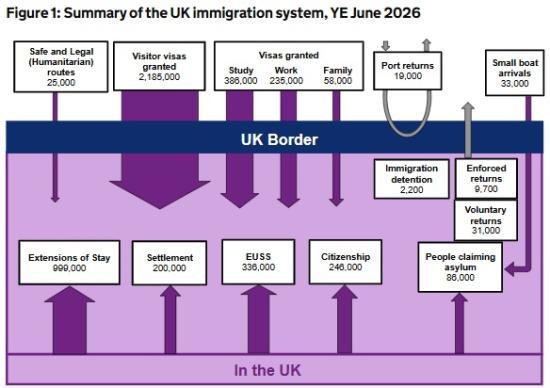
Britain's immigration system is changing rapidly, but the latest official figures suggest that there is no single story that can accurately be described simply as "immigration going up" or "immigration coming down".
The Home Office has published its latest Immigration System Statistics, covering the year ending June 2026, and the figures show significant falls in work visas, study visas, family visas and small-boat arrivals.
At the same time, asylum remains a major issue, while the number of people being granted settlement and British citizenship remains substantial.
The figures therefore provide a useful opportunity to look beyond the political arguments and ask what is actually happening.
Work migration has fallen dramatically
Perhaps the clearest change is in work visas.
There were 235,000 work visas granted, including dependants, in the year ending June 2026.
That was 18% lower than the previous year and 62% below the peak reached in December 2023.
The change is particularly striking in the Health and Care Worker route.
The number of Worker visas issued was 120,000, down 76% from the December 2023 peak.
Health and Care Worker visas fell by 90%, while Skilled Worker visas fell by 48% over the same period.
This is important because the immigration debate sometimes gives the impression that Britain is continuing to bring in large numbers of overseas workers at the same rate as before.
The latest figures suggest otherwise.
The government's changes to immigration rules have had a substantial effect.
But there is another side to this story.
The number of work-route extensions remained high at 731,000 during the year.
That reflects the large numbers who entered Britain during 2022 and 2023 and are now reaching the end of their initial visas and seeking to extend their stay.
So the effect of the earlier immigration surge has not suddenly disappeared.
International students are also declining
Study visas have fallen too.
There were 383,000 sponsored study visa grants in the latest year, 11% fewer than the previous year and 41% below the peak of June 2023.
The number of main applicants fell by 12%.
China and India remained by far the two largest sources, accounting for 46% of sponsored study visas issued to main applicants.
This matters economically as well as politically.
International students contribute substantially to universities and to the wider economy.
Reducing student migration may therefore have consequences for universities that go beyond the immigration statistics themselves.
There is a balance to be found between controlling immigration and maintaining an education sector that has become heavily dependent on international students.
Family migration has fallen
Family visas also declined.
There were 58,000 family visas granted in the year ending June 2026, 19% fewer than the previous year.
The reduction was partly due to the temporary suspension of new Refugee Family Reunion applications from September 2025 and a continuing fall in Partner visas.
However, family-related extensions increased sharply.
There were 82,000 family-related extensions, 46% higher than a year earlier.
That illustrates one of the difficulties in interpreting immigration figures.
A fall in people entering the country does not immediately translate into a similar fall in the number of people living here under immigration routes.
Once someone has arrived, their visa can be extended.
The small boats figure is down — but the problem hasn't disappeared
This is likely to be the most politically sensitive part of the figures.
There were 38,000 detected arrivals through illegal entry routes during the year ending June 2026.
Small boats accounted for 33,000 of these — about 88%.
The number of small-boat arrivals was 23% lower than the previous year.
But it remained broadly similar to the 31,000 recorded in the year ending June 2024 and the 35,000 recorded in the year ending June 2022.
So there has been a reduction.
But it would be misleading to describe the problem as solved.
Thousands of people are still making the dangerous Channel crossing.
The five most common nationalities — Eritrean, Sudanese, Afghan, Somali and Iranian — accounted for around two-thirds of small-boat arrivals.
Asylum claims are falling too
There is another significant change.
The UK received 86,000 asylum claims in the year ending June 2026.
That was 21% fewer than the previous year.
However, the number remains considerably higher than the levels generally seen before 2021.
More than half of asylum seekers had arrived through illegal entry routes.
But an important detail is easily missed: 41% had previously held a visa or other form of leave.
That complicates the assumption that the asylum system is simply a consequence of small boats.
There are several routes into the asylum system.
The asylum backlog is falling rapidly
This is probably one of the most significant positive developments in the latest figures.
At the end of June 2026, 40,000 people were awaiting an initial asylum decision.
That was 56% lower than a year earlier and a remarkable 77% below the peak of 175,000 in June 2023.
The Home Office made 116,000 initial asylum decisions during the year.
That was more than four times the average annual number of decisions between 2010 and 2019.
The grant rate was 38%, down from 48% the previous year.
This suggests that the government has made substantial progress in processing applications.
But processing a claim is only one part of the problem.
If someone is refused asylum and remains in Britain, the question becomes whether they can actually be removed.
The number of returns is rising
There were 41,000 returns from the UK in the year ending June 2026.
That was 8% higher than the previous year.
Of these, 9,700 were enforced returns and around 31,000 were voluntary returns.
Foreign National Offender returns also increased, reaching 6,000, 12% higher than the previous year.
This indicates that enforcement activity is increasing.
But it also illustrates the scale of the challenge.
Forty-one thousand returns sounds like a large number until it is compared with the hundreds of thousands of people moving through the various parts of the immigration system.
Settlement and citizenship remain substantial
While some routes into Britain are falling, the number of people moving towards permanent status remains significant.
There were 200,000 settlement grants in the year ending June 2026, 24% higher than the previous year.
There were also 336,000 grants of settled status under the EU Settlement Scheme.
And 246,000 people were granted British citizenship during the year.
These figures are not equivalent to new immigration.
Many people receiving settlement or citizenship will have lived in Britain for years.
But they demonstrate how the immigration decisions of previous years continue to shape Britain's population.
Immigration has a considerable time lag.
People arrive.
They work or study.
They may bring family members.
They extend their visas.
Eventually some qualify for settlement and later citizenship.
The consequences of today's immigration policies therefore stretch far beyond today's arrivals figures.
Britain received 136.8 million arrivals
One statistic requires particularly careful interpretation.
There were 136.8 million arrivals into the UK during the year.
That sounds enormous, but it includes British citizens returning home and millions of short-term visitors.
Indeed, 57% of arrivals were British nationals.
There were also 2.2 million Visitor visas and 23.2 million Electronic Travel Authorisations issued.
Only a relatively small proportion of those arrivals represent people coming to Britain to live permanently.
This is why simply quoting the total number of people entering Britain tells us very little about long-term immigration.
So what is actually changing?
The latest statistics suggest that Britain has entered a different phase of immigration.
The huge growth in work migration seen after the pandemic has been sharply curtailed.
Student migration is also falling.
Family visas are declining.
Small-boat arrivals are down.
Asylum applications are falling.
The asylum backlog is falling dramatically.
Returns are increasing.
But the effects of earlier migration continue through visa extensions, settlement and citizenship.
And the number of people in the asylum system remains substantial.
So perhaps the most accurate description is that Britain is moving from a period of very rapid immigration growth towards a period of tighter control — but the consequences of the previous period will remain with us for many years.
The question for Britain is no longer simply "How many?"
The more interesting question may be what sort of immigration Britain actually wants.
There is a difference between an overseas nurse filling a vacancy that cannot otherwise be filled, an international student paying university fees, a family joining someone already legally settled here, a refugee seeking protection and someone arriving illegally and subsequently claiming asylum.
Putting all of these people into one number called "immigration" may make for powerful political headlines, but it doesn't tell us very much about what the immigration system is actually doing.
The latest figures demonstrate that Britain can change migration rapidly when policy changes.
Work visas are already dramatically lower than they were two or three years ago.
But the figures also demonstrate something else.
Immigration policy is not a tap that can simply be turned off.
The people who arrived during the previous period are still here.
Some are extending visas.
Some are obtaining settlement.
Some are becoming British citizens.
Universities are adjusting to fewer overseas students.
Employers are adjusting to fewer overseas workers.
And the asylum system is still dealing with the consequences of earlier arrivals.
That means the real test of Britain's immigration policy will not be whether one year's numbers go up or down.
It will be whether the Government can create an immigration system that is controlled, economically useful, humane and capable of enforcing its own decisions.
The latest figures suggest that some parts of that system are beginning to move in that direction.
But they also show just how long it takes for changes in immigration policy to work their way through the country.
The numbers are falling in several important areas.
The debate, however, is far from over.
Read the full report HERE