The Economy Is Growing - So Why Doesn't It Feel Like It?
28th August 2026
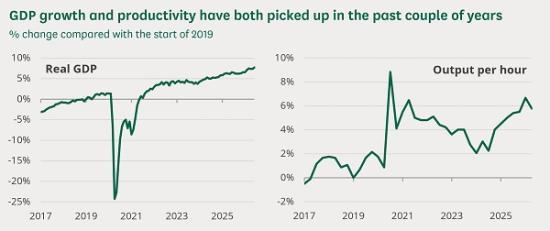
There is something rather strange happening in the British economy. The latest House of Commons Library economic update suggests that the UK economy has shown “unexpected resilience” despite the continuing conflict and its impact on energy prices. GDP is growing, productivity appears to be improving and consumer confidence has recovered. Yet for many households and businesses, the economy still feels remarkably difficult.
That apparent contradiction deserves more attention than another headline about whether Britain is technically growing or shrinking.
The latest figures suggest that the UK economy grew by around 1.1% in the year to the second quarter of 2026. That is hardly a boom, but it is better than many expected when the economic consequences of the conflict began to emerge. Forecasts for the year as a whole are now also around the 1.1% mark.
There is another encouraging development hidden within the figures. Productivity appears to have been improving. Britain has suffered from poor productivity growth for years, so any sustained improvement is potentially significant. If businesses can produce more with the resources they have, that creates the possibility of higher wages and stronger economic growth without simply requiring more people to work longer hours.
Consumer confidence has also improved, with the latest GfK measure reaching its highest level for two years.
So why doesn't the economy feel particularly strong?
The answer may be that GDP is a very broad measure of economic activity, while people experience the economy through their household bills, wages, mortgages, jobs and the prices they see every time they go shopping.
Inflation rose to 2.9% in July, well above the Bank of England's 2% target. Much of the recent increase has been connected with higher energy prices following the conflict in the Middle East. The latest Ofgem price cap brought a substantial increase in household gas prices, reminding us once again how quickly an international crisis can find its way into the finances of an ordinary British household.
That is particularly significant for rural areas.
For many people in places such as Caithness, energy isn't an optional expense that can easily be avoided. Larger houses, older properties and the lack of mains gas can make heating more expensive and leave households particularly exposed when energy prices rise. The national inflation rate therefore doesn't necessarily describe the financial pressure being experienced by every household.
There is a similar problem with mortgage costs.
Interest rates are considerably lower than they were at their peak, but mortgage costs remain a substantial burden for many households renewing fixed-rate deals. Government borrowing costs have also risen, and the Commons Library notes that five- and ten-year government bond yields are around their highest levels since 2008.
That matters because higher government borrowing costs eventually have to be paid for. Every pound spent servicing debt is a pound that cannot simultaneously be spent on something else.
The government's finances themselves present a mixed picture. Borrowing in July was higher than the Office for Budget Responsibility had expected, although the Commons Library stresses that monthly figures can be volatile and subject to revision. Overall borrowing so far in 2026/27 remains broadly in line with the OBR's forecast and slightly below the equivalent period last year.
So this isn't a story about the public finances suddenly collapsing.
But neither is it a story that allows the Government to spend without constraint. The combination of high debt, higher interest costs and relatively modest economic growth means that the Chancellor will have some difficult choices to make when the Budget arrives on 28 October.
Perhaps the biggest warning sign, however, comes from the labour market.
Payroll employment and vacancies have been falling. The services sector has seen employment decline for 23 consecutive months according to the S&P Global Purchasing Managers' Index survey, the longest uninterrupted period of job losses recorded by that survey since it began in 1996.
This creates one of the most interesting contradictions in the current economy.
Productivity may be improving partly because businesses are becoming more efficient and are doing more with fewer employees. From an economic perspective that can be a positive development. From the perspective of someone looking for a job, however, it is much less comforting.
An economy can therefore become more productive while becoming less welcoming to workers.
That is why the latest Commons Library report should probably not be interpreted as either good news or bad news. It is both.
The UK economy has proved more resilient than many expected. It has absorbed another major external shock without falling into recession. That is an achievement worth recognising.
But resilience isn't the same thing as prosperity.
A household can be financially resilient because it cuts its spending, delays replacing a car, turns down the heating or dips into its savings. A business can be resilient because it reduces staffing, postpones investment or absorbs higher costs by accepting lower profits. A government can be resilient because it delays spending decisions or raises taxes.
All three may keep going. But none necessarily feels better off.
This may explain why economic statistics and public sentiment can sometimes appear to be telling completely different stories.
The headline says GDP is growing.
The household sees the electricity bill.
The economist sees improving productivity.
The business owner sees higher wages, insurance, rates and energy costs.
The Government sees borrowing broadly under control.
The taxpayer sees another Budget approaching.
The labour market figures may be particularly important in deciding which of these competing narratives ultimately wins.
If employment begins to recover, wages continue to rise faster than inflation and energy prices settle, the current period of resilience could gradually turn into something that people actually feel in their everyday lives.
If vacancies continue to fall while inflation remains above target, however, the economy could remain stuck in an uncomfortable middle ground: technically growing, but without generating the sense of prosperity that normally accompanies economic expansion.
For rural Scotland, there is another question. National growth figures can hide enormous differences between regions. An economy growing by 1% nationally does not mean that every part of the country is growing by 1%. Nor does it mean that every household or business shares equally in that growth.
That is why the forthcoming Budget will be watched particularly closely in places such as Caithness. What matters locally will not simply be whether the Chancellor can point to another decimal place of GDP growth. It will be whether the policies announced help businesses invest, encourage employment, reduce pressure on household finances and support the infrastructure that allows remote communities to participate in the wider economy.
The latest Commons Library report gives Britain some reasons to be more optimistic than it might have expected a few months ago.
But perhaps its greatest lesson is that economic resilience is not the same as economic comfort.
Britain may be coping.
The more important question is whether it can turn that resilience into rising living standards that people can actually see in their own bank accounts.
Read the House of Commons Library economic update published 27 August 2026 It contains many links and charts.