Are Politicians Counting on Us Not Understanding the Numbers?
29th August 2026
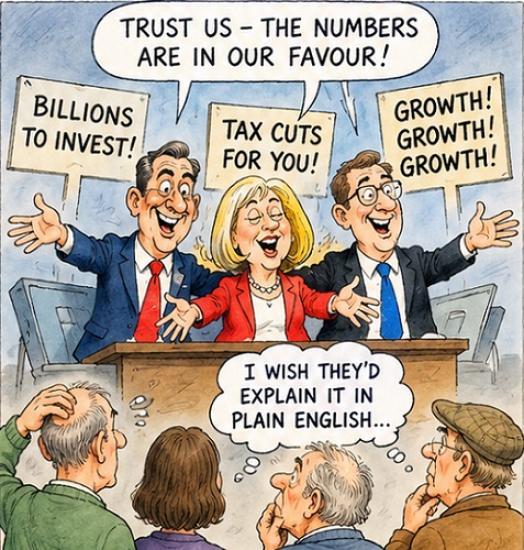
Politics runs on promises. Build more. Invest more. Cut taxes. Save billions. Spend billions. Create growth. It all sounds convincing – and it all sounds remarkably simple.
But behind the confident slogans there is a quieter question that many of us never get to hear answered: where does the money actually come from, and what does the promise really mean?
I don't think it is necessarily fair to say that politicians believe the public is economically illiterate. There is, however, a powerful incentive within modern politics to reduce complicated economic arguments to a sentence that fits into a television interview, a newspaper headline or a social media post.
That creates a problem for democracy.
Economic language can sound very impressive while concealing some extremely important details.
When a politician says, "We will invest £10 billion", what does that actually mean? Is it £10 billion of new government spending? Is it borrowed money? Is it money transferred from another programme? Or is it £10 billion of private investment that the government hopes its policy will encourage?
Those are four very different things.
The same applies when we hear that a government will "save £5 billion". Does that mean £5 billion will actually disappear from government spending? Is it a forecast saving compared with what might otherwise have happened? Is it an efficiency assumption? Or does it depend upon a policy that has yet to be implemented?
Then there is the familiar promise to "raise billions by closing tax loopholes". That might eventually produce additional revenue, but it is not the same thing as having billions of pounds already available to spend.
This distinction matters because governments cannot spend forecasts in the same way that they can spend money that has actually arrived.
Economic growth is another example.
Politicians of all parties understandably want to talk about growth. A growing economy can mean more employment, higher incomes and more tax revenue. But a forecast of future growth isn't money sitting in the Treasury's bank account.
Even when the economy is growing, the government can still face substantial borrowing pressures. And even when national GDP increases, individual households may not feel better off. GDP can grow while GDP per person grows much more slowly, or even falls.
The headline and the reality can therefore be very different.
This is not an argument against politicians making promises. It is an argument for politicians explaining them properly.
Nor is it an argument aimed at one particular political party. Labour, Conservatives, Liberal Democrats, SNP, Reform and others all have an incentive to present their own policies in the most favourable possible light and their opponents' policies in the most alarming way.
That is politics.
The danger comes when the public is given the headline but not enough information to judge what sits behind it.
Scotland provides plenty of examples of why this matters. When we hear about financial gaps running into billions of pounds, the figure itself is important. But the really important questions are what assumptions produced that figure, how reliable those assumptions are, what happens if they prove wrong and which decisions will eventually have to be made.
Simply repeating the number doesn't help the public understand the problem.
We don't all need economics degrees. What we need is a better habit of asking awkward but straightforward questions.
Perhaps the most useful question in politics is simply:
"Compared with what?"
If somebody promises £20 billion of additional spending, compared with what?
If they promise to save £10 billion, compared with what?
If taxes are going down, what happens to spending?
If spending is going up without taxes increasing, how is the difference financed?
If economic growth is expected to pay for a policy, what happens if growth doesn't arrive?
And ultimately, who pays?
These aren't complicated questions. They are questions that any household or business would ask before committing itself to a major financial decision.
Imagine if political interviews worked this way.
Instead of allowing a politician to announce a £10 billion programme and then move on to another subject, the interviewer could simply ask: "How much will it cost in total? Where will the money come from? When will it actually be spent? What assumptions does your calculation depend upon? And what happens if those assumptions are wrong?"
Those five questions could transform political broadcasting.
They would also make political promises much easier to compare.
Perhaps every major manifesto commitment should have what might be called a "reality box" attached to it.
Not another complicated 40-page report, but five plain-English facts: the cost, the source of funding, the timescale, the assumptions and the risks.
That would not prevent politicians from making ambitious promises. It would simply make it harder to disguise an aspiration as a certainty.
The public also has a responsibility.
We should become more suspicious of impressive numbers without becoming cynical about everything politicians say. There is an important difference between healthy scepticism and believing that nothing anyone says can be trusted.
Healthy scepticism means asking for evidence.
It means recognising that £10 billion can mean very different things depending upon how it is calculated.
It means understanding that government borrowing is not the same thing as government income, that GDP is not household income, that a forecast is not a fact and that an announced investment is not necessarily money already being spent.
Most importantly, it means refusing to be impressed simply because somebody has attached the word "billion" to a promise.
Britain is facing some very difficult economic choices. An ageing population, pressure on public services, higher debt costs, infrastructure requirements, defence spending and the transition to a different energy system all require decisions about scarce resources.
There is no magic pot of money large enough to satisfy every demand.
Every pound spent somewhere is either a pound that cannot be spent somewhere else, a pound that has to be raised through taxation, or a pound that has to be borrowed.
That doesn't mean governments should never borrow. It doesn't mean taxes should never rise or fall. It doesn't mean public investment is a bad thing.
It simply means there is always an economic reality behind the political slogan.
Perhaps that is what we should demand more often.
Not that politicians stop campaigning. Not that they stop making promises. Not even that they stop simplifying complicated subjects.
But when they give us the headline number, they should also give us enough information to understand what it really means.
And when broadcasters interview them, they should stop being satisfied with the slogan.
Ask the next question.
Then ask the one after that.
Because democracy works better when voters understand the choices they are being offered.
Slogans are easy. Numbers are harder. But if we want better decisions from our politicians, perhaps we need to demand a much bigger dose of economic reality.