Who Decides What Is ‘Proper’ Culture? The AfD, Art and the Dangerous Politics of Public Funding
30th August 2026
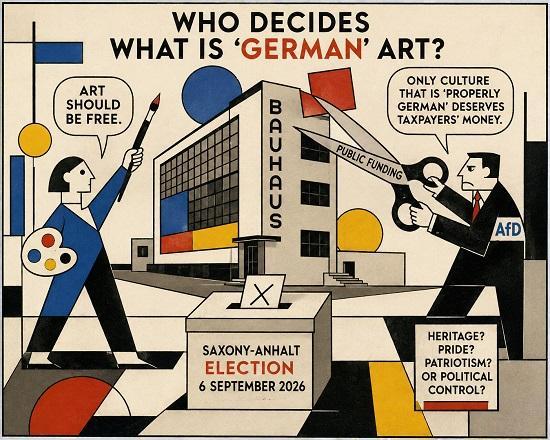
There is a fascinating and rather uncomfortable cultural battle taking place in Germany which deserves much more attention in Britain.
It is not really about whether taxpayers should fund art. Governments everywhere make choices about how much money should go to museums, theatres, galleries, music, heritage and other cultural activities. Those are legitimate political decisions.
The more troubling question is what happens when a government starts deciding that some culture is sufficiently national, sufficiently patriotic or sufficiently acceptable to deserve public money, while other culture is considered somehow hostile to the country.
That is the argument now developing around Germany's Alternative für Deutschland, or AfD, particularly in the eastern state of Saxony-Anhalt.
The timing could hardly be more significant. Saxony-Anhalt votes on 6 September, and the AfD is currently well ahead in the opinion polls. A recent Infratest dimap poll put it on 41%, compared with 24% for the CDU. If those numbers translated into seats, the AfD could potentially become the strongest force in the state and possibly form a government.
That would be a remarkable development in post-war Germany.
And culture has unexpectedly become part of the battle.
At the centre of the controversy is Bauhaus, the famous school of art, architecture and design founded in Weimar in 1919 and later established in Dessau. Its influence on modern architecture and design has spread around the world.
Yet Bauhaus has become a target for the AfD's campaign for what it describes as a more patriotic cultural policy. The party has criticised modernist and internationalist aspects of Bauhaus and argued for a stronger emphasis on German identity and heritage.
That might initially sound like an argument about architecture.
It isn't.
The bigger question is whether taxpayers' money should come with an ideological test.
If a government says it will spend public money supporting German history, traditional culture and national heritage, that is a political choice. Governments have always made choices about cultural priorities.
But what happens when the test becomes whether something is sufficiently "German"?
Who decides?
And what happens to the artist who produces work that criticises Germany, questions its history, attacks its government or challenges popular attitudes?
Does that work become less worthy of public support?
The distinction is crucial because Germany's Basic Law explicitly protects artistic freedom. Article 5 states that "arts and sciences, research and teaching shall be free." Germany's own explanation of its cultural system makes clear that this protection is intended to preserve the independence of art and culture, including through public funding.
So the AfD could not simply declare that an unpopular painting or play is illegal.
But governments do not necessarily need to ban something to make it disappear.
They can make it harder to obtain grants.
They can change funding priorities.
They can alter the boards of publicly funded institutions.
They can direct money towards different cultural projects.
They can encourage institutions to demonstrate that their work reflects particular political or national values.
And artists, knowing where the money is coming from, can begin to censor themselves.
That last point may actually be the most important.
You do not necessarily need a government minister standing in front of a theatre telling an actor what they can say.
If the theatre knows that its funding depends upon not offending the people who control the money, the message can be delivered without anyone issuing an explicit order.
That is why public funding and artistic freedom can become such a complicated relationship.
It is perfectly reasonable for taxpayers to ask whether an arts project represents good value for money. It is perfectly reasonable for politicians to debate whether £1 million should be spent on a museum, a theatre, a sports facility or something else entirely.
But there is a profound difference between saying "We cannot afford this" and saying "We will not fund this because we dislike what it says about our country."
The first is a budgetary decision.
The second begins to look like ideological control.
And Germany has particular reasons to be sensitive about that distinction.
Bauhaus itself provides the historical warning.
The movement was attacked by the Nazis and eventually forced to close in 1933. Its artists and designers were regarded by the Nazi regime as representatives of an unacceptable modernist and internationalist culture. Today, almost a century later, Bauhaus has once again become a target of nationalist criticism.
The historical circumstances are obviously different. It would be wrong to suggest that today's political situation is simply a repetition of the 1930s.
But history explains why Germans take the political independence of culture particularly seriously.
Art is not always comfortable.
That is partly the point.
Artists challenge assumptions. Writers criticise governments. Musicians provoke audiences. Theatre directors reinterpret history. Painters deliberately offend. Architects reject conventional ideas.
Some of it is brilliant.
Some of it is terrible.
Some of it is deeply political.
Some of it is deliberately provocative.
Some of it is simply rubbish.
That is the nature of culture.
The answer in a free society is not for government to decide which category each piece belongs to.
It is for audiences, critics, historians, curators and the wider public to make those judgements.
That does not mean taxpayers have an unlimited obligation to finance everything.
Public money is scarce, and governments have every right to establish priorities. There is nothing inherently undemocratic about deciding that a particular cultural project should receive less money.
The danger comes when the funding criteria become a disguised test of political loyalty.
And this is not solely a German problem.
Britain and Scotland have substantial systems of public cultural funding. Museums, theatres, galleries, festivals, heritage organisations and arts projects receive public support in various forms.
Imagine, for example, if a future British government decided that publicly funded cultural organisations should promote "British values".
At first, that might sound harmless.
But what exactly are British values?
Patriotism?
Monarchy?
Democracy?
Christian heritage?
Multiculturalism?
Individual freedom?
The Union?
Scottish independence?
English traditions?
Northern Irish identity?
Something else?
The moment government starts defining the approved version of national identity, the argument becomes much more complicated.
One person's patriotism can be another person's nationalism.
One person's defence of national heritage can be another person's attempt to rewrite history.
One person's criticism of their country can be another person's act of civic responsibility.
That is why culture needs room to disagree with the government that helps pay for it.
Indeed, there is an argument that publicly funded culture is particularly valuable when it challenges those in power.
A museum that only tells comfortable stories about a country is not necessarily serving democracy particularly well.
A theatre that is afraid to criticise the government is not really independent.
A university that avoids controversial subjects because funding might be threatened is not providing genuine intellectual freedom.
And an artist who decides not to create something because they fear losing a grant is not completely free, even if nobody has formally censored them.
That is the danger of what might be called soft censorship.
Nobody bans the painting.
Nobody arrests the playwright.
Nobody closes the gallery.
The money simply stops.
The result can be remarkably similar.
This is why the German debate matters beyond Germany.
The question is not whether the AfD likes Bauhaus.
It is whether a democratic government should have the power to determine which cultural ideas are sufficiently patriotic to deserve public support.
There is an entirely legitimate argument for giving more public money to traditional German culture if voters want that. A government elected on such a platform could reasonably redirect some funding towards museums, historic buildings, traditional music, literature or regional heritage.
But the test should be whether the alternative is worth funding, not whether the existing culture is politically loyal.
There is also a paradox here.
If the government funds only art that praises the country, it may actually produce less interesting culture.
Great culture often comes from disagreement.
Britain's literary, theatrical and artistic traditions are full of people who challenged the establishment of their day. Many works now regarded as part of the national heritage were once considered controversial, offensive or subversive.
If governments had always demanded ideological approval before providing support, some of the culture we now celebrate might never have existed.
There is another lesson in the Bauhaus controversy.
National culture does not necessarily have to be narrowly national.
Bauhaus was created in Germany. Its influence became international.
The same is true of Shakespeare, the Beatles, Scotch whisky, Scottish architecture, British engineering and countless other examples of cultural or commercial achievement.
A country can be proud of its culture without insisting that culture must remain inside national borders.
In fact, cultural influence is often one of the most successful ways a country projects itself internationally.
Germany has enormous cultural assets.
Bauhaus is one of them, whether the AfD likes its philosophy or not.
Trying to make it more "German" by attacking its international character could ultimately weaken rather than strengthen Germany's cultural influence.
That is perhaps the irony at the heart of this argument.
A government seeking to promote national pride could end up diminishing one of the country's most internationally admired cultural achievements.
Britain should watch what happens carefully.
Not because the AfD's policies can simply be transplanted to Britain. Germany has its own constitutional structure, history and political culture.
But because the underlying question is universal.
Who decides what culture is worth supporting?
Politicians?
Civil servants?
Cultural experts?
The public?
Or the artists themselves?
There is probably no perfect answer.
Public money inevitably involves public choices.
But perhaps there should be a line that governments are extremely reluctant to cross.
They can decide how much money culture receives.
They can debate which types of cultural activity deserve greater priority.
They can demand proper financial management and accountability.
But once they start deciding that culture should receive public money only when it reflects an approved national or political worldview, something much more fundamental is being changed.
The purpose of public cultural funding should not be to make artists grateful to politicians.
It should be to allow a society to see itself — including its uncomfortable, contradictory and sometimes unpleasant sides.
That means taxpayers will occasionally pay for something they dislike.
That is not necessarily a failure of democracy.
It may actually be one of its prices.
The real test of a free society is not whether the government funds art that everyone agrees with.
It is whether it can tolerate art that challenges the people holding the purse strings.
Germany is now wrestling with that question.
Britain should not wait until a similar argument reaches our own cultural institutions before deciding where we stand.
Because once a government acquires the power to decide what is "proper" culture, the next question becomes unavoidable:
Who decides what is proper about the government itself?
Read about Bauhaus