UK Unemployment Edges Higher as Jobs Market Remains Weak
15th September 2026
Britain's jobs market continues to lose some momentum, with the latest figures from the Office for National Statistics showing unemployment slightly higher than a year ago and the number of people on company payrolls continuing to fall.
The unemployment rate was estimated at 4.9% in the three months to July 2026, up 0.2 percentage points on a year earlier. It was broadly unchanged compared with the previous three-month period.
The employment rate for people aged 16 to 64 was 75.1%, down 0.1 percentage points over the year.
More worrying for the immediate outlook is the fall in the number of employees actually on company payrolls.
ONS figures show that payrolled employees fell by 101,000, or 0.3%, between July 2025 and July 2026. The number also fell by 19,000 between June and July.
There were an estimated 1.692 million people in the Claimant Count in August, an increase both over the month and the year. The figure is provisional and can be revised as more information becomes available.
Vacancies remain subdued
The number of vacancies also continues to suggest that employers are being cautious.
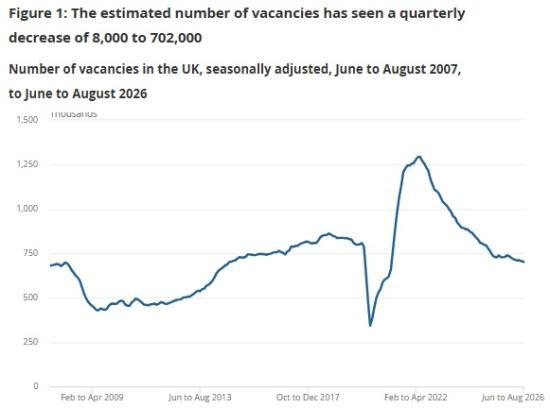
There were an estimated 702,000 vacancies between June and August, down 8,000 on the previous three months. ONS says vacancies have remained broadly flat since the beginning of the year.
Its survey suggests that some smaller businesses are holding back from recruitment because of higher labour costs.
This is an important point because the unemployment rate on its own does not tell the whole story.
Britain can have relatively low unemployment while the labour market is nevertheless becoming less dynamic. Fewer vacancies, falling payroll employment and cautious recruitment can indicate that businesses are becoming less willing to expand.
A mixed picture
There is some good news.
Economic inactivity among 16- to 64-year-olds fell slightly to 20.9%, down 0.1 percentage points over both the year and latest quarter.
But the overall picture remains one of a labour market that is struggling to generate strong employment growth.
That fits with the wider economic figures. GDP grew by 0.4% in the three months to July, but construction and production output have both been under pressure.
For the Government, the challenge is therefore becoming clearer.
It needs economic growth to translate into more jobs and more business investment, rather than simply a small increase in GDP.
The unemployment rate at 4.9% is not historically alarming. But the combination of falling payroll employment, subdued vacancies and cautious employers suggests that the jobs market is not particularly healthy.
For workers and jobseekers, the next few months will show whether this is simply a period of stagnation or the beginning of a more significant deterioration.
The headline unemployment figure remains relatively low. Underneath it, however, Britain's jobs market is showing signs of strain.
For more details go to
https://www.ons.gov.uk/releases/uklabourmarketseptember2026