ScotWind - Scotland’s £755 Million Windfall Raises Questions About Money, Jobs and Transparency
Submitted by Bill Fernie
17th September 2026
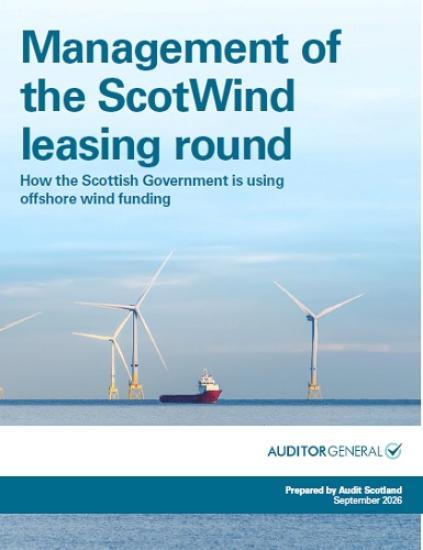
Scotland was promised a new era of offshore wind, billions of pounds of investment and the chance to build a major new industrial supply chain.
The ScotWind leasing round certainly produced one thing very quickly: a very large cheque.
The Scottish Government received £755 million from the initial leasing round, as developers paid for options to develop areas of Scotland's seabed.
Four years on, however, Audit Scotland has raised some uncomfortable questions about what has happened since.
Its new report does not say that ScotWind has failed. Indeed, it could eventually generate substantial benefits for Scotland.
But the public spending watchdog says the Scottish Government needs to be much more transparent about how the £755 million is being used and what it intends to do with the money that remains.
That matters because this was not simply another item of government income. ScotWind was presented as an opportunity to turn Scotland's offshore renewable resources into long-term economic benefits.
Where has the £755 million gone?
The first issue is the money itself.
Audit Scotland reports that the Scottish Government has so far drawn down about £96 million of the ScotWind money. Interest of around £95.6 million had also accumulated between 2022-23 and 2025-26.
The Government has used ScotWind money as part of its wider budget management.
That is legally possible. The money is not ring-fenced in the way that some specific grants or funds are.
But this is where the issue becomes more complicated.
The original announcements around ScotWind linked the revenues to the transition to net zero and the economic opportunities created by offshore wind.
Audit Scotland says it is not clear how the £96 million already used has supported the transition to net zero.
It also says the Scottish Government has not been sufficiently clear about how it intends to use the remaining money during the current parliamentary term and beyond.
The Government's own budget plans indicate that more ScotWind money will be used for day-to-day spending.
That makes ScotWind, in effect, another tool available to ministers when managing the Scottish budget.
There is nothing inherently wrong with government using a windfall to ease financial pressures. But it does raise a fundamental question.
If a one-off payment from Scotland's natural resources is used to meet today's spending pressures, it cannot also be invested to create a long-term financial asset for tomorrow.
That is the concern behind Audit Scotland's call for greater transparency.
The £460 million that became a budget problem
The issue became particularly visible during the Scottish Government's difficult 2024-25 budget settlement.
The Government had planned to use up to £460 million of ScotWind money to help balance its finances.
In the end, additional funding from Westminster and other changes meant that the whole amount did not have to be used.
Audit Scotland's previous annual audit reported that the planned use of the £460 million was ultimately not required in full because additional Barnett consequentials became available and the Government was able to reduce borrowing.
This is important because it demonstrates exactly how the money can operate as a budget-management tool.
The Scottish Fiscal Commission has also described Crown Estate revenues, of which ScotWind is by far the largest element, as money available to the Scottish Government that is not ring-fenced and can be used to smooth spending over time.
That may be financially convenient.
But it is very different from establishing a protected investment fund whose purpose is to turn today's offshore wind income into wealth for future generations.
The Scottish Government says it remains committed to establishing a ScotWind Wealth Fund during this Parliament.
For the moment, however, that remains a promise rather than an established fund.
The money is being kept readily available
There is another interesting financial detail in the Audit Scotland report.
Most of the £755 million has been placed on deposits of up to 12 months so that it remains available to the Scottish Government.
A smaller amount is held in an account giving ministers immediate access.
That gives the Government considerable flexibility.
But there is a trade-off.
Keeping money readily available means that Crown Estate Scotland has fewer opportunities to seek higher returns through longer-term investment.
Audit Scotland therefore identifies a choice between having immediate access to the money and maximising investment returns.
Again, that would make perfect sense if this were primarily a short-term government cash reserve.
But if the intention is to create lasting wealth from Scotland's renewable resources, the question becomes rather different.
Should Scotland simply spend the windfall, or should it use the windfall to build an asset that generates income for decades?
And then there are the jobs
This brings us to perhaps the most important part of the ScotWind promise.
The offshore wind projects could require enormous amounts of investment.
The Scottish Government points to £29.1 billion of wider supply-chain commitments associated with the projects.
That sounds impressive.
But a commitment to spend money in Scotland is not quite the same thing as a guarantee that the major components will actually be manufactured here, that Scottish ports will handle the work, or that large numbers of long-term Scottish jobs will be created.
ScotWind developers were required to produce Supply Chain Development Statements, setting out how they expected to develop their supply chains.
There are enforcement mechanisms. Crown Estate Scotland has said that failure to meet commitments can result in remedies ranging from financial penalties to being unable to progress to a seabed lease.
So it would be wrong to suggest that developers were simply given the seabed with no conditions.
The bigger question is whether Scotland secured enough hard, enforceable economic benefit when the deals were negotiated.
The Government has talked about an average projected investment of around £1.5 billion in Scotland per project.
Yet the eventual economic benefits will depend on what actually happens when the projects move from plans to construction.
That distinction is crucial.
A projected supply-chain spend is not the same as a factory being built.
A proposed investment is not the same as a Scottish worker receiving a permanent job.
And an ambition to develop ports and infrastructure is not the same as having the contracts in place to guarantee that work.
Scotland's manufacturing opportunity
This matters particularly in manufacturing.
Scotland has a long history of offshore engineering, shipbuilding, oil and gas and marine construction.
Offshore wind could have provided an opportunity to transfer some of those skills into a new industry.
But there is a danger that Scotland becomes primarily a place where wind farms are developed rather than a place where the equipment is manufactured.
Turbines, foundations, cables, electrical equipment and other major components can be produced elsewhere.
The Scottish Government itself recognises the need to strengthen Scotland's offshore wind infrastructure and supply chain. It has committed up to £500 million over five years for that purpose, with the intention of unlocking additional private investment.
That raises another question.
If Scotland has already received £755 million from granting access to its seabed, should more of that wealth have been tied directly to building the industrial infrastructure needed to exploit the opportunity?
That is not something Audit Scotland can decide.
It is a policy question for ministers and Parliament.
But it is precisely the sort of question that needs proper public scrutiny.
No single business case
Audit Scotland has also identified a significant weakness in the original process.
No single business case was produced for the ScotWind leasing round.
The leasing model was deliberately designed as a high-risk, potentially high-reward approach.
Scotland capped the option prices rather than using an entirely open-ended auction.
The intention was to encourage serious offshore wind development and secure longer-term economic benefits rather than simply maximise the upfront payment.
That strategy could still prove successful.
But Audit Scotland says its value for money cannot yet be determined.
If developers go ahead with long-term leases, Scotland could receive estimated annual payments of around £80 million to £110 million for up to 60 years.
That would potentially be a substantial and continuing source of public revenue.
But if projects abandon their options, the benefits could be considerably smaller.
The Auditor General, Stephen Boyle, therefore describes ScotWind as a "high risk and reward" approach.
That is a fair description of where Scotland now stands.
The transparency problem
For me, the most important conclusion from the Audit Scotland report is therefore not whether ScotWind was a good deal or a bad deal.
We simply do not know yet.
The more immediate problem is that the public cannot easily see what the Government's long-term plan is for the money and the wider benefits.
There are several separate pieces to the story:
The Government has received £755 million. Around £96 million has been drawn down so far. Almost £96 million of interest has accumulated. Some of the money has been used to support the wider Scottish budget. More money is expected to be used over the current Parliament.
A ScotWind Wealth Fund has been promised. Developers have made billions of pounds of supply-chain commitments. But the ultimate jobs, manufacturing and infrastructure benefits have yet to be demonstrated at the scale originally envisaged.
And the success of the whole scheme ultimately depends on developers progressing from options to actual projects.
That is a lot of uncertainty surrounding what could become one of Scotland's biggest economic opportunities for decades.
Scotland needs to know what it owns
There is a bigger principle here. Scotland has effectively sold the right to develop part of its seabed. That is a valuable national resource.
The initial payment was welcome. The potential future rental income could be even more valuable.
But a resource windfall should ideally produce something that remains after the original money has been spent.
That could be infrastructure or t could be manufacturing capacity. It could also be skilled jobs, an investment fund or it could be a combination of all four.
What matters is that the public can see clearly what is being achieved.
Audit Scotland is not saying that ScotWind has failed. Nor is it saying that the Scottish Government cannot use the money to support the wider budget.
Its message is much simpler. Be clearer about what is happening to the money and what Scotland is getting in return.
That seems a reasonable demand.
The next few years will tell us whether ScotWind becomes a foundation for a new Scottish offshore industry or simply another example of a large one-off government windfall being absorbed into the normal pressures of running the public finances.
At £755 million, and with potentially tens of billions more in investment at stake, Scotland deserves to know which path it is taking.
Read he full Audit Scotland report HERE
Pdf 38 Pages