Western Isles FPSO Could Move From Orkney to Kishorn
22nd September 2026
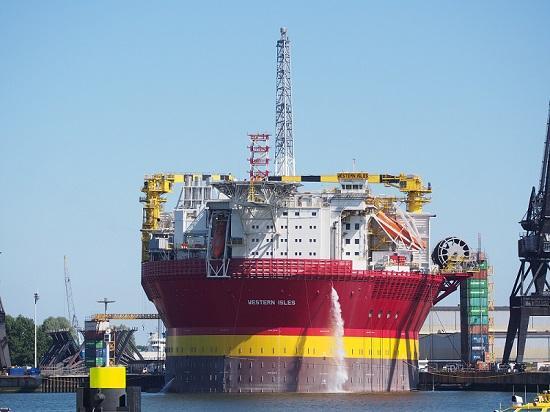
A huge floating oil production vessel that has spent the past two years in Scapa Flow could soon be heading for Loch Kishorn on the west coast of Scotland.
The Western Isles FPSO - Floating Production, Storage, and Offloading, operated by Dana Petroleum and jointly owned with NEO Energy, arrived in Orkney in July 2024 after being towed from its former location in the North Sea. It was brought into Scapa Flow for refit and repair work while preparations were made for its next role in the North Sea.
Now the next move is being planned.
A marine notice recorded by FishSAFE says Dana Petroleum intends to tow the Western Isles from Scapa Flow to Loch Kishorn. The proposed voyage is around 178 nautical miles, taking the vessel through the Pentland Firth, the North Minch and the Inner Sound. The journey is expected to take about two days, subject to weather conditions.
It is quite a journey for a vessel of this size.
The Western Isles is not a conventional ship. It is a Floating Production, Storage and Offloading vessel, or FPSO, effectively a floating oil-production facility. It has storage capacity for around 400,000 barrels of oil and a production capacity of 44,000 barrels a day. The vessel weighs more than 28,000 tonnes.
Its original job has now finished. The Western Isles fields, Harris and Barra, ceased production in May 2024 after producing around 36 million barrels of oil equivalent.
But the FPSO itself is not finished.
From Orkney to Kishorn
The reason for moving the vessel is essentially that it is being prepared for another life in the North Sea.
The Western Isles is intended to become the production facility for the Buchan redevelopment project, operated by NEO Energy with Serica Energy and Jersey Oil & Gas as partners. The project involves redevelopment of the Buchan field and potentially bringing other discoveries in the area into production later.
The FPSO is therefore a valuable piece of equipment that can be modified and reused rather than being sent for decommissioning.
Earlier plans envisaged first oil from Buchan in 2026, but the timetable has since moved back, with production now expected in late 2027. The work on the FPSO includes modifications such as water-injection equipment and preparations that could allow the vessel to be connected to future offshore electricity supplies.
That helps explain why Kishorn is becoming important.
Why Kishorn?
Kishorn Port has developed a particular niche in dealing with large offshore energy equipment.
The port has already handled FPSOs, drilling rigs and decommissioning projects. Its dry dock has been used for preservation and maintenance of the Voyageur Spirit FPSO, while other major offshore vessels and rigs have also used the facility.
Kishorn is also investing heavily in expanding its facilities.
The port says its enlarged dry dock will support offshore oil and gas, decommissioning, floating offshore wind and other energy projects. Its current facilities include a large dry dock, deep-water quayside and substantial space for construction and storage.
The expansion is significant. Around one million tonnes of rock have been blasted and moved as part of the work, with the extended dry dock and reclaimed foreshore now taking shape. Once completed, the expanded facility is intended to accommodate vessels up to 260 metres long and floating assets up to 160 metres wide.
For Kishorn, having a major FPSO arrive while this development is taking place would be another demonstration of what the facility can do.
There is also a Scottish economic angle
The Western Isles has already provided work for marine and engineering businesses in Orkney while it has been stored in Scapa Flow. When it first arrived, Orkney Harbour Authority said the owners intended to use local contractors and suppliers wherever possible.
A move to Kishorn potentially spreads some of that economic activity to the west coast.
There can be work in marine operations, engineering, maintenance, inspection, fabrication, logistics and support services. It is also the sort of project that can help demonstrate to future offshore developers that Scotland still has places capable of handling very large energy assets.
That may become increasingly important as the North Sea moves through a complicated transition.
Oil and gas production is declining in mature fields, but existing infrastructure does not necessarily become worthless when a particular field finishes producing. FPSOs, ports, fabrication yards and engineering skills can potentially be reused for new fields, decommissioning and, increasingly, offshore renewable projects.
Kishorn is explicitly positioning itself in that space.
From oil production to the energy transition
There is an interesting irony in the Western Isles story. The FPSO began life producing oil from the North Sea. It then moved to Orkney for refit and storage. Its next destination is expected to be Kishorn, where it can be prepared for another North Sea development.
At the same time, Kishorn is promoting itself as a facility for floating offshore wind as well as oil and gas, decommissioning and other marine work.
The Western Isles therefore sits somewhere between two versions of the North Sea economy.
It is still an oil-production asset, but the modifications planned for its next deployment include preparation for electrification. That reflects the wider attempt to reduce the emissions associated with offshore production while continuing to make use of existing infrastructure.
For Scotland's remote coastal communities, there is another important issue.
Large industrial projects do not need to be concentrated around the biggest cities. A facility such as Kishorn can create a role for a relatively small west-coast community because its natural deep-water location and large dry dock give it capabilities that cannot easily be replicated elsewhere.
The proposed arrival of the Western Isles is therefore about more than one FPSO moving from Orkney to the west coast.
It is another test of whether Scotland can retain and reuse the industrial infrastructure built up around the North Sea oil industry, while gradually adapting it to a much broader energy economy.
And for Kishorn, a 28,000-tonne FPSO arriving on its doorstep would be a fairly substantial way of demonstrating that the old oil-and-gas infrastructure still has a future.
PHOTO
Alf van Beem, Western Isles (ship, 2017) IMO 9736171 FPSO (Floating, Production, Storage, Offloading), Welplaathaven, Port of Rotterdam photo 1, marked as public domain, more details on [url=https://commons.wikimedia.org/wiki/File:Western_Isles_(ship,_2017)_IMO_9736171_FPSO_(Floating,_Production,_Storage,_Offloading),_Welplaathaven,_Port_of_Rotterdam_photo_1.JPG]Wikimedia Commons[/url]