How Fast Could We Get Used to Almost Instant Deliveries?
23rd September 2026
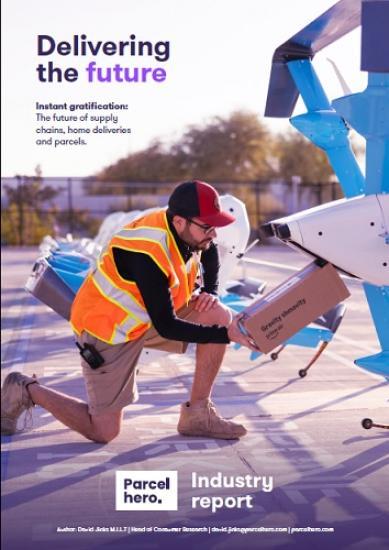
A new report from ParcelHero looks well beyond the familiar world of delivery vans and asks a rather intriguing question. How close are we to a world where the gap between ordering something and receiving it becomes almost invisible?.
Its report, Delivering the Future: Instant Gratification, looks first towards 2030 and then much further ahead to 2060 and beyond. The central argument is that delivery is likely to become progressively faster, but the biggest changes may happen behind the scenes rather than on our doorsteps.
The report points out that delivery times that once seemed remarkably fast are already becoming ordinary. One-hour delivery is increasingly a benchmark, while some grocery services are aiming for 15 to 30 minutes. Amazon, Tesco and Gopuff are among those experimenting with very rapid local deliveries.
Drones, robots and AI
Drones attract most of the attention, but ParcelHero suggests that ground-based autonomous robots may eventually handle a much larger share of deliveries.
Drones have taken longer to become commonplace than earlier predictions suggested, largely because regulation, safety, noise, privacy and public acceptance have proved more difficult than the technology itself. However, changes to UK drone regulations in January 2026 and Amazon's limited UK drone operation near Darlington suggest that commercial drone delivery is moving from experiment towards reality.
The report expects a mixture of autonomous vehicles, robots, drones and human couriers rather than one technology replacing everything else.
That is particularly interesting when it comes to employment. ParcelHero does not envisage the gig economy simply disappearing. Instead, automated systems could increasingly handle predictable deliveries while people deal with the awkward ones: difficult addresses, unusual buildings, deliveries requiring signatures or places where technology struggles.
AI could also become much more important inside the supply chain. Instead of simply predicting demand, future systems could automatically reroute shipments, adjust stock levels and respond to disruptions. In effect, supply chains could become increasingly capable of managing themselves.
The warehouse may move closer to you
One of the report's less obvious predictions is that faster delivery requires goods to be stored closer to customers.
Large warehouses outside towns could increasingly be supplemented by smaller automated "micro-fulfilment" centres and dark stores in urban areas. High-demand products would be positioned locally so that the final journey could be completed by electric vans, bikes, robots or even on foot.
The report also looks further ahead at warehouses becoming taller, partly underground and making greater use of rooftops for solar panels and potentially drone landing areas.
What happens by 2060?
Here the report becomes much more speculative, and sensibly avoids pretending that anyone can accurately forecast 34 years ahead.
It draws on DHL's Logistics 2050 scenarios, which envisage radically different futures. One is dominated by highly automated green cities, another by protectionism and fragmented global trade, while another imagines climate disruption making resilience more important than speed.
There is also the possibility of widespread 3D printing, where goods could increasingly be manufactured close to where they are needed rather than transported around the world. ParcelHero acknowledges that this remains speculative and that today's technology is nowhere near replacing global manufacturing.
And, at the extreme edge of the report, comes quantum teleportation. Researchers have demonstrated the teleportation of quantum information over three metres, although moving a physical object remains far beyond practical technology. The report uses it more as a thought experiment showing where the concept of "instant" delivery ultimately leads.
The more immediate conclusion is much less science fiction.
By 2030, ParcelHero suggests that for many everyday goods, delivery within an hour could become normal in many places, using a combination of autonomous vehicles, drones, robots and human couriers.
The really significant change, however, may be that we stop thinking of delivery as something that happens after we order.
AI could increasingly anticipate what we need, position the goods nearby and deliver them almost before we consciously decide to buy them.
That could change not only shopping, but the design of warehouses, towns, roads, jobs and even the value of individual properties depending on how easily they can be served by the delivery infrastructure of the future.
The full ParcelHero report, Delivering the Future: Instant Gratification, can be read HERE
Pdf 18 Pages