Could Caithness Plant Its Way to a More Colourful Future?
Submitted by Bill Fernie
30th September 2026
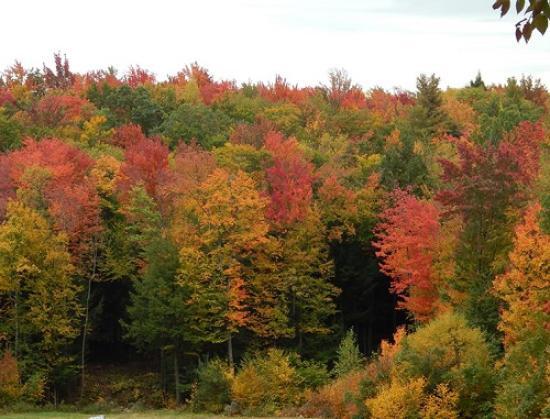
What if planting trees became part of Caithness's tourism strategy?.
Caithness has many things that visitors come here to see. Dramatic coastlines, castles, archaeological sites, beaches, wildlife, the Pentland Firth and some of the biggest skies in Scotland.
But there is one thing we don't necessarily think about when discussing tourism.
What Caithness itself looks like.
Imagine arriving in Wick or Thurso in October and seeing avenues and groups of trees turning yellow, orange and red. Imagine villages with carefully planned autumn planting, parks filled with colour and roads approaching our towns lined with trees chosen not simply because they grow here, but because they create an attractive landscape.
It wouldn't happen overnight.
But perhaps that is precisely the point.
We could start now and add to it year after year.
Why not create a Caithness autumn?
New England is famous for its autumn colours. Japan has made autumn foliage a visitor attraction in its own right.
There is no reason to imagine that Caithness could reproduce either landscape exactly. Our climate, soils and exposure are different.
But we could create something that is distinctly our own.
There are trees that provide strong autumn colour while also being capable of growing in Scottish conditions.
Rowan is an obvious candidate. It is already a familiar Scottish tree, its leaves turn orange or red in autumn and its berries provide food for birds. Forestry and Land Scotland describes rowan as one of Scotland's characteristic native trees.
Silver birch can provide golden-yellow foliage and has the advantage of being a familiar northern tree. Field maple, Britain's only native maple, can produce colours ranging from coral to gold. Aspen can turn yellow, bronze and sometimes red.
Then there are carefully selected ornamental maples and other trees that could be used in more sheltered locations where the spectacular reds and oranges we associate with Japanese landscapes could be introduced.
The answer would not be to plant one species everywhere.
It would be to create a palette of colours.
Start small and keep going
This could become an interesting community project because there is no need to wait for one enormous tree-planting scheme.
A council could plant 20 trees here, 50 there and perhaps another 100 somewhere else.
Schools could become involved. Community councils could identify locations. Businesses could sponsor planting around town entrances. Housing developments could incorporate attractive tree planting from the beginning.
Over time, those individual schemes would begin to connect.
A tree planted today may not make much difference to the appearance of Wick or Thurso next year.
But what about in ten years?
And what about 20 years?
That is the timescale on which trees should really be judged.
We often complain that councils, governments and other public bodies concentrate too much on the immediate future. Tree planting gives us an opportunity to do the opposite.
Plant something today that somebody else will enjoy in 2046.
It could be about more than autumn
There is another reason for thinking carefully about what we plant.
The objective shouldn't be to create a landscape that looks good for six weeks and then disappears into winter.
Different species can provide different attractions throughout the year.
Spring blossom can provide colour early in the tourist season. Summer foliage can provide shade and structure. Autumn can produce the great display of reds, oranges and yellows. Rowan berries and other fruits can provide colour into winter while supporting birds and other wildlife.
The Woodland Trust already highlights species such as aspen, field maple, hawthorn, silver birch and rowan for their autumn colour and wildlife value.
So the same investment could potentially contribute to biodiversity, townscape, recreation and tourism.
Caithness already has a starting point
This isn't entirely hypothetical.
Forestry and Land Scotland describes Sibster, near Halkirk, as a new broadleaf woodland on the site of an old Caithness farm, with trails, meadows and young trees that visitors can watch developing over time.
There is also tree planting associated with the A9 Berriedale Braes improvement project. The planting element cost about £28,000 and an inspection in 2023 estimated an 82% survival rate.
These are small examples compared with the landscape of the whole county, but they demonstrate something important.
Trees can be planted in Caithness.
The question is whether we start thinking about their wider visual and visitor value as well as their environmental value.
Don't cover Caithness in trees
There is an important qualification.
Caithness's openness is one of its greatest assets.
The huge skies, long views and relatively uncluttered landscape are part of what makes the county different. The answer is therefore not to plant trees everywhere.
Instead, planting could be concentrated where it has the greatest visual impact.
Approaches to Wick and Thurso.
Village entrances.
Parks and public spaces.
Roadside locations where trees would not obstruct views.
Around community facilities.
Along walking and cycling routes.
And perhaps carefully designed tree avenues at selected locations.
The landscape would still be recognisably Caithness.
It would simply have more colour and structure.
A tourism investment that grows every year
There is perhaps a bigger idea here.
Caithness has traditionally thought about tourism attractions as things that already exist: castles, beaches, archaeological sites, wildlife and scenic routes.
But the landscape itself can be an attraction.
Scottish Forestry says woodlands contribute to Scotland's natural beauty and support tourism, as well as providing recreation, biodiversity and other benefits.
Why not deliberately build on that?
Perhaps Caithness could eventually promote an Autumn in Caithness season.
Not a huge festival costing millions.
Simply a time when visitors are encouraged to come north to see the changing landscape, walk through community woodlands, visit Wick and Thurso, follow autumn trails and experience the county at a different time of year.
It would complement, rather than compete with, the existing attractions.
And unlike many tourism projects, it could keep growing.
Every year another group of trees could be added.
Every year some would become larger.
Every year the landscape would change.
Think 20 years ahead
There is an understandable temptation to ask what a tree planting project will achieve next year.
The better question might be what it could achieve in 20 years.
Imagine somebody arriving in Caithness in 2046 and finding that Wick, Thurso and some of our villages have developed their own distinctive tree landscapes.
Not New England.
Not Japan.
Caithness.
A place where the open northern landscape meets carefully planned splashes of autumn colour.
It would be a modest investment compared with many major infrastructure or tourism projects.
But unlike a publicity campaign, once the trees are planted and established, they keep working.
And perhaps that is one of the most positive things Caithness could do for its future:
Plant something today that makes the place more beautiful for the people who will live here tomorrow.
Over the years Caithness has planted thousands of daffodils that give splurge of yellow much like many other places so perhaps the time has come to lift the idea to a higher level - colour from trees.
And then there are shrubs
Dogwood (Cornus) – excellent for winter as well as autumn. Some varieties have brilliant red, orange or yellow stems after the leaves fall.
Viburnum – several varieties provide good autumn reds and purples, berries and spring flowers. They could give several seasons of interest.
Spiraea – relatively compact, with summer flowers followed by attractive yellow, orange or reddish foliage.
Berberis – particularly useful for strong red, purple and orange foliage, although thorniness means location matters.
Cotoneaster – berries can provide colour well into winter and are useful for birds.
Hawthorn – native, tough and particularly appropriate for exposed conditions, with blossom in spring and berries in autumn.
Hazel – native and useful for wildlife, although its autumn colour is less spectacular than some of the ornamental shrubs.
Escallonia – worth considering in sheltered coastal locations because it is evergreen and can tolerate some exposure, while also providing flowers.
Rugosa roses – particularly interesting for Caithness because they are tough, tolerate coastal conditions and produce large colourful hips after flowering.
Heather – perhaps an obvious Caithness plant, but mass planting different varieties could provide colour at ground level for a long period.
Euonymus – some varieties develop brilliant pink, red and orange autumn foliage and berries.
I'd be cautious about simply importing lots of exotic plants. The best scheme would mix native Scottish species with carefully selected ornamental varieties that can survive Caithness conditions.
And there is a really interesting design possibility.
Think in layers
Instead of just planting trees, imagine a town entrance with:
Tall trees – birch, rowan, maple, aspen
Medium shrubs – viburnum, dogwood, hawthorn, cotoneaster
Low planting – heather, hardy grasses, perennial flowers
Bulbs – daffodils, crocuses and other spring colour
That means the landscape changes throughout the year.
Spring: blossom and bulbs.
Summer: flowers and lush green.
Autumn: reds, oranges and golds.
Winter: berries, coloured stems and evergreen foliage.
PHOTO
Typical fall foliage in red maple country, in the Adirondack Mountains of Upstate New York
Digby Dalton
https://creativecommons.org/licenses/by-sa/4.0/