The Fall of the West: Has Owen Jones Really Explained Why Britain Lost Its Way?
30th September 2026
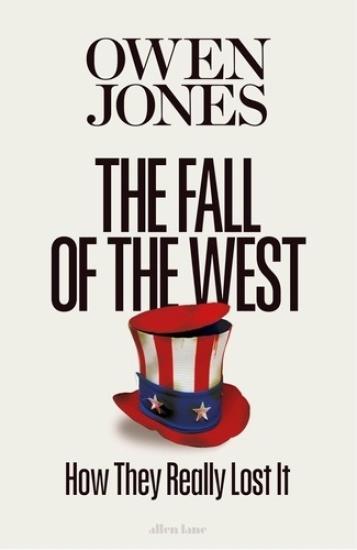
The Fall of the West: Has Owen Jones Really Explained Why Britain Lost Its Way?
There is something rather ambitious about calling a book The Fall of the West.
Owen Jones is not simply asking what has gone wrong with Britain. He is attempting to explain a much larger transformation in the Western world, stretching from the optimism that followed the end of the Cold War to today's much more uncertain world.
The book, published by Allen Lane, is released in the UK on 1 October. It is around 480 pages and takes Jones well beyond the domestic British politics that made his name. His argument covers military intervention, economics, the financial crisis, austerity, the rise of populism and the changing relationship between the West and the rest of the world.
At the heart of his argument is a fairly simple question.
What if the West's problems were not primarily caused by the people who have increasingly been blamed for them?
Jones argues that after the collapse of the Soviet Union, Western governments became convinced that their economic and political model had effectively won. The resulting confidence, he argues, produced a mixture of military overreach, economic complacency and political decisions that eventually undermined the very societies they were supposed to strengthen.
The Iraq and Afghanistan wars are central to the argument. Jones sees them not simply as individual foreign-policy failures but as evidence of a wider belief that Western power could reshape other countries.
The 2008 financial crisis provides the other major part of the story.
The West appeared economically dominant, yet the financial system then suffered a crisis on a scale not seen for generations. The response, followed in Britain and elsewhere by years of austerity, helped create a political environment in which large numbers of people became increasingly distrustful of established political institutions.
Jones connects that economic and political disillusionment with the subsequent growth of populist and far-right movements.
This is where the book becomes particularly relevant to Britain.
For many years, arguments about Britain's problems have tended to concentrate on immigration, the European Union, public spending, taxation, regulation, "woke" politics or the behaviour of particular groups.
Jones's argument is that these are often symptoms or distractions rather than the underlying causes.
His explanation instead places considerable responsibility on the economic and political choices made by those with power.
That is a powerful argument. But it is also where a reader should pause.
A convincing explanation of something as complicated as the decline of Western influence needs to deal with more than one cause. Countries have changed for different reasons. Technology has transformed economies. China has grown enormously. Russia has pursued a very different political and foreign-policy direction. Demographic change matters. The internet and social media have altered politics. Energy dependence matters. So does the rise of new economic powers.
The question, therefore, is not whether Jones has identified genuine failures. There is considerable evidence that the Iraq war, the 2008 financial crisis and the long aftermath of austerity changed Western politics.
The more difficult question is whether these events can be brought together into one explanation of "the fall of the West".
That is a much bigger claim.
An early Guardian review describes the book as a broad history of the changing world order and praises its ability to bring familiar events together into a coherent narrative. But it also notes that much of the territory will be familiar to readers who already follow these subjects closely.
That may actually be one of the book's strengths.
A good political history does not necessarily have to discover a completely unknown fact. Sometimes its value comes from putting facts that we already know into a different pattern.
For a British reader, there is another important question.
Has Britain really "lost its way", or has the country simply moved from one period of history into another?
Britain remains a wealthy country with substantial economic, diplomatic and military influence. But it is also wrestling with weak economic growth, pressure on public services, high government debt, housing shortages, regional inequalities and a political system that many people regard with increasing scepticism.
That makes Jones's argument difficult to dismiss simply as history.
But neither should it automatically be accepted.
The most interesting test of the book is therefore not whether the reader agrees with Owen Jones's politics. It is whether his explanation helps us understand why so many Western democracies have experienced growing distrust, political fragmentation and economic insecurity at roughly the same time.
And there is a particularly Scottish and Caithness question hiding underneath all this.
If the problem is partly that political and economic power has become concentrated in the hands of distant institutions, what does that mean for communities such as Wick and Thurso?
A financial crisis in London can eventually affect a local business in Caithness. Government decisions about defence, energy, nuclear decommissioning, infrastructure and public spending can have a much greater effect in a small Highland community than their appearance in a national economic statistic might suggest.
That raises an issue which goes beyond Owen Jones.
Perhaps the real test of Western political systems is not whether their economies continue to grow by one or two per cent a year. It is whether people living far from the centres of power believe that the system is working for them.
The Fall of the West appears to be an attempt to answer that enormous question.
Whether Owen Jones has found the explanation is another matter.
But it is certainly a question worth asking.
[url=https://www.penguin.co.uk/books/468587/the-fall-of-the-west-by-jones-owen/9780241740644]Buy
The Book HERE[/url]