ScotWind's £755 Million: Scotland Has the Money – But What Is It Really Being Used For?
1st October 2026
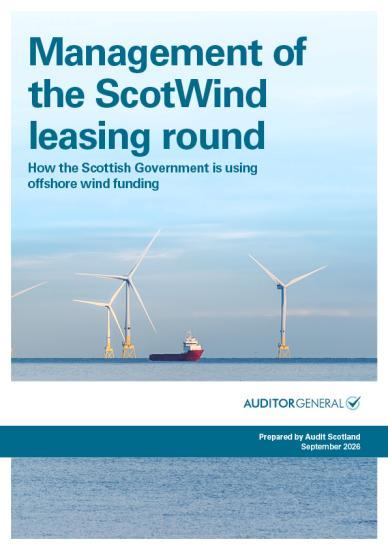
Scotland has a pot of money worth hundreds of millions of pounds sitting on deposit.
It came from the development rights for Scotland's offshore wind industry.
It was described when the money was first raised as an opportunity to help Scotland's transition to net zero, support the offshore wind supply chain and deliver wider economic benefits.
Four years later, Audit Scotland has produced a report asking a rather awkward question.
What is the money actually being used for?
The answer is more complicated than many people might expect.
The Scottish Government received £755 million from the ScotWind offshore wind leasing round, but Audit Scotland says it needs to be much more transparent about how the money is being used and what it intends to do with the balance.
And this is not simply an argument about whether offshore wind is a good thing or a bad thing.
It is about how a large public resource was created, the risks that were taken in creating it, and whether the financial rewards and wider economic benefits promised when ScotWind was designed are actually emerging.
What was ScotWind?
ScotWind was launched by Crown Estate Scotland in 2020 as the first major offshore wind leasing round in Scottish waters for a decade.
Developers were offered options over areas of the seabed. An option gives a developer an exclusive opportunity to progress a project and, if it eventually meets the necessary requirements, move on to a long-term lease.
Twenty option agreements were ultimately awarded, following the main and clearing rounds, with the successful developers paying £755 million in option fees.
The projects initially represented around 27.6GW of potential generating capacity. Audit Scotland's latest figures put the estimated target capacity of the 18 projects currently remaining at 28.8GW. One option has been terminated and another is in the process of being terminated.
For comparison, the original planning assumption for ScotWind was a maximum of about 10GW.
So the scale of what was eventually offered was considerably greater than originally anticipated.
That sounds like a great success.
But the financial story is where things become much more complicated.
Why didn't Scotland simply charge as much as possible?
This is one of the most important parts of the Audit Scotland report.
When ScotWind was designed, Crown Estate Scotland did not choose a conventional open auction in which developers simply bid against one another until the highest price was reached.
Instead, it used a capped pricing model.
The reasoning was that Scotland wanted to secure long-term offshore wind development rather than maximise immediate income from the seabed.
The concern was that very high upfront payments could increase developers' costs, affect project viability and ultimately reduce the likelihood that projects would actually be built.
Crown Estate Scotland therefore wanted to balance immediate revenue with the prospect of securing long-term lease payments and wider economic benefits.
That is an entirely understandable strategy.
But then something happened which made the decision much harder to defend or explain.
In February 2021, the UK-wide Round 4 offshore wind leasing process covering waters outside Scotland produced astonishing results.
It used an uncapped, open-pricing approach.
The successful bidders agreed to option fees worth £879 million a year, payable for up to ten years, potentially producing more than £8 billion in option payments for projects representing an estimated 8GW of generating capacity. Audit Scotland notes that the result reflected exceptionally strong market demand and a constrained supply of suitable seabed.
Crown Estate Scotland reacted by pausing ScotWind and carrying out a rapid review.
The maximum option-fee cap was increased from £10,000 to £100,000 per square kilometre.
A higher cap was considered but rejected because Crown Estate Scotland believed it could reduce the competitiveness of Scottish projects and therefore undermine longer-term economic benefits.
In the end, the ScotWind auction produced £755 million.
And this is where it is important not to jump to the conclusion that Scotland "lost" billions.
The two leasing rounds were different.
They involved different seabed areas, different project mixes, different market conditions and different approaches.
Audit Scotland does not conclude that Scotland should simply have copied the UK-wide auction and charged developers as much as possible.
Instead, it says the chosen strategy involved higher risk and higher potential reward, and that whether it represented value for money will only become clear as projects develop.
That is a much more nuanced conclusion.
The money has been earning interest
There is another figure in the report which is worth paying attention to.
The £755 million of ScotWind option fees has not been sitting under a mattress.
Crown Estate Scotland has been depositing the money, generally on terms of no more than 12 months, under arrangements agreed with the Scottish Government.
Between 2022/23 and 2025/26, the offshore wind option-fee balances generated £95.6 million of interest.
There is also another £65.1 million of option fees from the separate INTOG offshore wind process.
At the end of 2025/26, Crown Estate Scotland therefore had approximately £807.9 million of offshore wind option-fee money and interest still available.
That is an extraordinary amount of money by the standards of Scottish public spending.
It is also worth pausing to remember what this money actually is.
It is not annual tax revenue.
It is a large, largely one-off capital receipt arising from granting access to a public asset.
That distinction matters.
Only a fraction has been used so far
Audit Scotland says the Scottish Government has drawn down money from the ScotWind funds on two occasions.
In 2022/23, ministers transferred £96 million of ScotWind option fees plus £7 million of interest, a total of £103 million, to support the Scottish budget.
In 2023/24, ministers authorised a further £5 million to enable Crown Estate Scotland to purchase land at the Port of Nigg. That land was subsequently leased to Sumitomo for development of a high-voltage direct-current cable factory.
So in one sense, most of the original ScotWind money remains available.
At the end of 2025/26, approximately £808 million in ScotWind and INTOG option-fee money remained.
But the Audit Scotland concern is not simply that the money has been spent too quickly.
It is almost the opposite.
The problem is that its future use has not been set out clearly enough.
What was the money supposed to do?
This is where the report becomes particularly interesting.
The Scottish Government made a series of commitments about how offshore wind money would be used.
In 2021/22, the Government said some lease income would be invested in tackling climate change and biodiversity loss.
In 2022/23, it referred to using the money to facilitate the development of a Scottish offshore wind supply chain.
Budget documents subsequently said that ScotWind revenues would be invested in projects supporting Scotland's transition to net zero.
Audit Scotland has found, however, that over time the treatment of the money became increasingly integrated into the overall Scottish budget position.
The distinction is subtle but important.
The Government has continued to say that offshore wind funding can support climate and net-zero priorities.
But Audit Scotland says that, in practice, the planned use of the money has generally been managed as part of the wider budget position.
It says planned drawdowns have primarily been identified for resource spending, while planned capital elements have often not been assigned to specific projects.
That is what prompts the call for greater transparency.
A government can legitimately decide to use public money to help support its annual budget.
But if the public was originally told that a particular revenue stream would support a particular long-term objective, there should be enough information to establish whether that is actually happening.
£507 million more is expected to be used
Audit Scotland says the Scottish Government currently expects to call upon around £507 million of offshore wind funding between 2026/27 and 2030/31.
The planned total consists of £191 million of capital expenditure and £316 million of resource expenditure.
But the really striking figure is that £236 million of the 2027/28 allocation is planned as resource spending.
That does not automatically mean the money is being misused.
Resource spending pays for public services and other day-to-day costs, and governments have to balance their budgets.
But it raises a legitimate question.
If you receive a large, unusual payment from exploiting a finite public resource, should it mainly help meet today's spending pressures, or should a substantial part be invested to produce benefits for decades to come?
That is a debate Scotland needs to have.
A potential £5–6 billion future income stream
And perhaps this is the most remarkable part of the entire story.
The £755 million already received may not be the main financial prize.
If the offshore wind projects go ahead and become fully operational, Crown Estate Scotland and the wider industry estimate annual lease income of approximately £80 million to £110 million.
Because the leases can run for 60 years, Audit Scotland estimates the total potential income at roughly £5 billion to £6 billion over the lifetime of the leases.
But there is a large qualification.
That is a potential revenue stream.
It assumes the projects become fully operational and perform under optimal production conditions. It depends on which projects are actually built, when they become operational and how much electricity they ultimately generate.
So this is not £6 billion sitting in a bank account.
It is a possible long-term income stream.
That distinction is vital.
There is already evidence that not everything will happen as originally envisaged
One ScotWind option has already been terminated.
Another is currently being terminated.
Audit Scotland also notes that options were awarded over around 92% of the capped permissible development area identified in the sectoral marine plan.
That means the first ScotWind round has occupied much of the seabed identified for offshore wind, potentially limiting the scope for future large-scale leasing rounds.
So Scotland has already committed a large proportion of its available seabed in one major leasing exercise.
That makes getting the economic terms right particularly important.
What about the promised Scottish supply chain?
This is another area where the numbers look impressive.
Successful ScotWind bidders currently have £29 billion of Scottish supply-chain commitments, with aspirational ambitions rising to approximately £43.7 billion.
But Audit Scotland raises an important qualification.
The commitments are not all guaranteed expenditure.
They are commitments and ambitions associated with projects that are still at different stages of development.
And the arrangements for enforcing them could be stronger.
Audit Scotland says the maximum penalty for delivering between 25% and 50% of a particular supply-chain commitment is £250,000. Given the potential scale of the projects and the 60-year revenue streams, it considers a maximum £250,000 penalty unlikely to provide a strong enough deterrent where a developer falls substantially short.
It therefore recommends stronger contractual remedies for future leasing rounds.
Again, this is not saying the existing commitments are worthless.
It is saying that £29 billion of commitments should not be treated as though £29 billion has already been delivered.
That distinction will matter enormously to Scotland's manufacturing and supply-chain ambitions.
And what about the proposed ScotWind Wealth Fund?
This may ultimately be the most important part of the report.
The Scottish Government has committed to establish a ScotWind Wealth Fund by the end of the current parliamentary term.
The idea of a wealth fund is familiar from countries and regions that have tried to convert income from finite natural resources into long-term national wealth.
Audit Scotland explains that such funds can be designed to stabilise government finances, invest in strategic infrastructure or industries, or preserve resource wealth for future generations.
But here is the problem.
We still do not know exactly what Scotland's ScotWind Wealth Fund will be.
Audit Scotland says it is not yet clear whether it will contain the remaining option-fee money, receive future annual lease income, or operate in some other way.
It is also not clear what investments it will make.
The Auditor General's recommendation is straightforward: the Scottish Government should explain the purpose and parameters of the fund before it is established.
That seems particularly important because once future lease income starts arriving, Scotland could have a continuing annual revenue stream rather than another one-off payment.
Should this money be treated differently from ordinary government income?
This is probably the most interesting question for the public.
A government faces enormous pressure every year.
Health.
Education.
Social care.
Local government.
Transport.
Benefits.
Public-sector wages.
There are always demands for additional money.
So there is an understandable temptation to use every available pound to make the annual budget balance.
But there is another principle.
If a public body receives a large payment because it has granted private companies long-term rights to exploit a public natural asset, perhaps that money should be treated differently from ordinary tax receipts.
Instead of disappearing into the annual budget, some could potentially be invested in infrastructure, businesses, skills, research or financial assets that create returns for future generations.
That does not mean every pound should be locked away.
Governments also need flexibility.
But the principle of turning one-off or finite-resource income into permanent assets is precisely why countries establish wealth funds.
And that is why the lack of clarity over Scotland's proposed ScotWind fund matters.
There is also a Caithness and northern Scotland connection
The ScotWind story is often discussed as though it belongs to offshore developers and the Scottish Government in Edinburgh.
But the economic effects will be felt far beyond the capital.
Much of the offshore wind opportunity is located around Scotland's coasts and islands.
The north of Scotland has already been identified as a major part of the country's future energy system.
Caithness and the wider Highlands are also facing enormous investment in electricity transmission infrastructure as renewable generation grows.
So the question for communities such as Wick and Thurso is not merely how much money Scotland receives.
It is where the economic benefit actually lands.
If billions of pounds of supply-chain spending are eventually generated, how much comes north?
How many jobs are created?
How much manufacturing capacity is established?
How many companies become long-term suppliers rather than simply providing local services during construction?
And could some of the wealth generated from the use of Scotland's seabed be invested in the communities that host the infrastructure?
These are questions which the headline figure of £755 million does not answer.
Audit Scotland has not closed the book on ScotWind
Perhaps the most important point in the report is what it does not say.
It does not say ScotWind has failed.
It does not say Scotland should have abandoned its offshore wind ambitions.
It does not conclude that the £755 million was necessarily too little.
Instead, it says the approach was a high-risk, high-reward model, and that value for money will ultimately depend on what happens next.
If projects proceed and produce decades of lease income, investment and supply-chain activity, the original strategy may look very different with hindsight.
If significant numbers of projects fail to proceed, the calculation changes.
That is why the next few years matter.
The real asset may be what happens to the money
ScotWind began with a decision about how to lease Scotland's seabed.
It has now become a much bigger question about how Scotland manages wealth.
There is around £800 million of offshore wind option-fee money and interest available.
Around £500 million is currently expected to be called upon over the spending review period.
There is potentially another £80 million to £110 million a year in future lease income if the projects all become operational.
And there are claimed supply-chain commitments worth £29 billion, potentially rising to £43.7 billion.
Those are very large numbers.
But numbers alone do not create prosperity.
They have to be managed.
They have to be invested.
They have to be monitored.
And the public needs to be able to see what happened to them.
That is ultimately what Audit Scotland is asking for.
**Not that Scotland should spend less.
Not that it should spend more.
But that it should tell the public clearly what it intends to do with the money.**
For Caithness and the wider north, there is perhaps one final question.
Scotland has spent decades generating energy and sending much of its value elsewhere.
As offshore wind becomes a major new industry, will Scotland repeat that pattern?
Or can some of the money generated from Scotland's natural resources be turned into lasting economic assets for the people who live here?
That may prove to be the real test of ScotWind.
The £755 million was the beginning.
What Scotland does with it could matter for generations.
Read the Audit Scotland report HERE