Scotland’s £500 Million Offshore Wind Gamble: Will the Jobs and Investment Stay Here?
14th October 2026
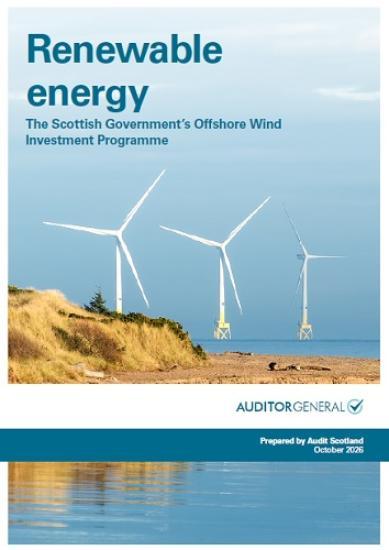
Scotland has the natural resources to become a major player in offshore wind energy. But a new report from Audit Scotland raises important questions about whether the Scottish Government is doing enough to ensure that the country benefits from the billions of pounds being invested in the industry.
The report examines the Scottish Government’s Offshore Wind Investment Programme, launched in October 2023, which aims to strengthen Scotland’s supply chain, encourage private investment and create jobs by helping Scottish businesses secure a greater share of the offshore wind market.
The programme has up to £500 million of public funding available over five years, running to March 2029. The ambition is straightforward: Scotland should not simply provide the sea space and natural resources for wind farms while much of the manufacturing, engineering and economic benefit goes elsewhere.
However, Audit Scotland has identified weaknesses in the programme’s progress, planning and oversight. While it is too early to conclude that the investment has failed, the report suggests that the Government needs to do more to demonstrate that public money is delivering the results promised.
£500 million available, but progress is slow
By July 2026, £141 million of public funding had been contractually committed across 17 projects. Five projects had been completed, while the remaining 12 were still being developed. A further eight approved projects had yet to reach contractual commitment.
The £141 million represents around 28% of the programme’s maximum available funding. With the programme due to end in March 2029, there is a growing need to establish whether the remaining money can be deployed effectively and whether the investments will deliver their intended benefits.
The delays have not occurred in isolation. Offshore wind developers and their suppliers operate in a market affected by changing costs, investor confidence, regulatory uncertainty and decisions about future energy policy. These factors can influence whether major industrial projects proceed and whether businesses are prepared to commit their own money.
Nevertheless, the report highlights the importance of updating the programme’s business case to reflect changing circumstances. A strategy developed in 2023 cannot simply be assumed to remain appropriate as the market evolves.
Private investment: an encouraging headline with a warning attached
One of the programme’s objectives is to attract private investment alongside public funding. The Government wants its money to encourage businesses to invest considerably more than they would otherwise have done.
The figures initially appear encouraging. The projects with committed public funding had attracted £413 million in private investment, suggesting a substantial contribution from businesses.
But a closer examination reveals a concentration of that investment in one project.
Of the £413 million, £327 million was associated with the Sumitomo project. Excluding that project, the other 16 projects had attracted approximately 70.5p of private investment for every £1 of public funding.
That does not necessarily mean those projects are poor investments. Some infrastructure requires substantial public support before private businesses can make their own commitments. However, it does show why headline figures need to be examined carefully.
A central question is whether public money is genuinely bringing forward additional investment, creating new economic activity that would not otherwise happen, or simply supporting projects that businesses would have undertaken anyway.
That distinction matters to taxpayers. The purpose of public investment should be to make things happen that the market would not deliver on its own, rather than simply transferring some of the cost of commercial projects to the public purse.
More grants, fewer recoverable investments
Another issue concerns how the money is being distributed.
Of the £141 million committed, £109 million was in grants, while £32 million was in commercial investments such as loans or equity.
Grants can be justified where the costs and risks of developing new industrial facilities are too high for private businesses to bear alone. Ports, manufacturing facilities and specialist infrastructure can require substantial upfront investment, while the returns may take years to materialise.
However, grants generally do not have to be repaid. Loans and equity investments, by contrast, can potentially return money to the public sector, allowing it to be reinvested in other projects.
There is no automatic rule that commercial investment is always preferable to a grant. Each project needs to be assessed on its merits. But the balance makes it particularly important that grants are carefully targeted and that their expected economic benefits can be demonstrated.
Audit Scotland has raised concerns about the consistency of project assessments and the ability to measure whether investments are delivering value for money.
The real prize is the jobs and supply chain
The wider economic opportunity should not be underestimated.
Offshore wind can create demand for engineering, construction, manufacturing, port services, maintenance and specialist technical skills. Scotland already has experience in many of these fields through its oil and gas industry.
There is an opportunity to use that expertise in a growing renewable energy sector, providing work for businesses and skilled employees as the energy system changes.
But building wind farms in Scottish waters does not automatically mean that the associated jobs will be based in Scotland.
Components can be manufactured elsewhere, specialist contracts can go to overseas suppliers, and profits can flow to companies headquartered outside the country. Scotland may benefit from the electricity generated without securing the full economic opportunity associated with producing and maintaining the equipment.
This is why the supply chain is so important. The Government's challenge is to ensure that Scottish businesses are in a position to compete for contracts and that investment creates lasting industrial capacity rather than a temporary burst of construction activity.
What does this mean for the Highlands and Islands?
For the Highlands and Islands, the questions are particularly relevant.
Ports, fabrication facilities, engineering businesses and maintenance services could all benefit from offshore wind developments. Existing industrial skills may also provide opportunities for people whose jobs have traditionally depended on oil and gas.
Highlands and Islands Enterprise is one of the programme's delivery partners, alongside Scottish Enterprise and the Scottish National Investment Bank.
Yet the wider ambitions do not guarantee that individual communities will benefit. Investment in a port or manufacturing facility in one part of Scotland does not automatically translate into jobs in Caithness or Sutherland.
The important questions are where facilities will be located, which businesses will secure contracts, what skills employers will need and whether local people will have realistic opportunities to fill the jobs created.
There is also a need to consider the long term. Communities cannot plan their futures around projects that remain uncertain or around employment figures that describe temporary construction work rather than permanent jobs.
For areas that have experienced the decline of traditional industries, a credible industrial strategy matters more than announcements alone.
Questions over planning and accountability
Audit Scotland also identified weaknesses in programme governance, risk management, project monitoring and information-sharing between the organisations responsible for delivering the scheme.
A data breach in late 2024 significantly restricted information-sharing between the Scottish Government and its delivery partners. A new information-sharing agreement has since been reached, but the episode illustrates the practical difficulties that can arise when several organisations are responsible for a major programme.
The report also highlights the need for clearer measures of success and a stronger understanding of what happens after the programme's current funding period ends in March 2029.
That is an important point. Businesses making substantial investments in industrial facilities need confidence that there will be a continuing market for their products and services. Ports, factories and specialist equipment are not investments that can easily be switched to something else if government policy changes.
The Government therefore needs a convincing long-term plan, not simply a series of individual funding decisions.
What happens after 2029?
The programme's current end date creates a further challenge. Offshore wind infrastructure and supply chains take years to develop, while the economic benefits may continue for decades.
If public support ends before the industry has become commercially sustainable, some investments may struggle to reach their full potential. Conversely, continuing to provide funding without clear evidence of results would be difficult to justify when public services and other parts of the economy are under financial pressure.
The answer is not necessarily to spend the full £500 million simply because it has been made available. It is to ensure that each investment has a sound business case, that risks are understood and that public support produces benefits that would not otherwise occur.
Audit Scotland is not declaring the programme a failure, nor is it concluding that public money has been wasted. Many projects are still developing, and some benefits will take years to emerge. Its warning is that weaknesses in planning and oversight could undermine the programme unless they are addressed.
Scotland must capture more than the electricity
Scotland has an obvious interest in expanding renewable energy. But producing electricity is only one part of the economic equation.
The larger prize is to develop an industry that supports skilled employment, strengthens Scottish businesses, attracts private investment and creates opportunities that last beyond the construction of individual wind farms.
The Scottish Government's £500 million programme was intended to help achieve that ambition. Audit Scotland's findings suggest that the Government now needs to demonstrate more clearly how the money is being used, what it is expected to deliver and how success will be measured.
For the Highlands and Islands, the outcome could be particularly significant. Offshore wind offers a potential source of industrial activity at a time when traditional energy industries are changing. But that opportunity will not automatically translate into jobs for local communities.
The ultimate test is not how much public money has been announced, how many projects have been approved or how much electricity will be generated.
It is whether Scotland can turn its natural advantages into a competitive domestic industry, and whether the jobs, skills and economic benefits are retained here.
Otherwise, Scotland risks providing the wind, the sea and the public subsidy, only to discover that much of the lasting economic reward has blown elsewhere.
Read the full Audit Scotland report HERE
Pdf 36 Pages