Scotland’s Renewable Energy Industry Supports Almost 50,000 Jobs – But How Much Reaches the Highlands?
29th October 2026
New research reveals the scale of renewable energy’s contribution to Scotland’s economy, but the challenge is turning that national success into lasting jobs and prosperity for local communities.
Scotland’s renewable energy industry supports almost 50,000 full-time equivalent jobs and generates nearly £15 billion in economic output, according to a new report published on 28 October by the Fraser of Allander Institute at the University of Strathclyde.
The findings underline the growing importance of renewable energy to the Scottish economy. But they also raise an important question for areas such as Caithness and Sutherland, where wind farms, energy infrastructure and other developments are becoming an increasingly familiar part of the landscape.
How much of this economic activity translates into permanent local employment, business opportunities and lasting improvements in the communities hosting these projects?
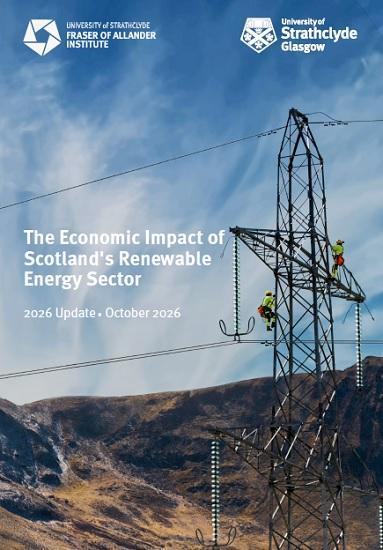
The report, The Economic Impact of Scotland’s Renewable Energy Sector – 2026 Update, examines the industry’s contribution in 2023 and 2024. It was commissioned by Scottish Renewables, with the economic analysis undertaken by the Fraser of Allander Institute.
The headline figures
The report estimates that Scotland’s renewable energy industry directly generated £9 billion in turnover and employed approximately 16,800 full-time equivalent workers in 2024.
However, its economic influence extends well beyond the companies directly involved in producing renewable energy.
When the researchers include activity supported through supply chains and the spending of workers’ wages, the estimated contribution rises substantially.
The industry supported:
£14.9 billion in economic output across Scotland in 2024.
£5.1 billion in gross value added, a measure of the additional economic value created.
Approximately 49,200 full-time equivalent jobs across the wider economy.
These figures help explain why renewable energy is increasingly seen as an important part of Scotland’s economic future, rather than simply a means of reducing carbon emissions.
The report’s headline figures are estimates, not a count of individual people employed by renewable energy companies. They include jobs supported in other industries, and one full-time equivalent job could represent two people working part-time.
Source: Fraser of Allander Institute – 2026 report.
Why the economic impact is bigger than the industry itself
To understand the figures, it helps to look at how a renewable energy project affects the wider economy.
Consider a wind farm being developed in the Highlands. The obvious businesses involved are the developer, turbine manufacturer and companies responsible for installing and operating the equipment.
But the economic connections do not end there.
Construction companies, engineers, transport operators, equipment suppliers, legal advisers and other professional services may all benefit. Hotels, shops and restaurants may receive additional business while workers are on site. Employees spend their wages in the local and wider economy, supporting further jobs.
Economists describe these as direct, indirect and induced effects.
The direct effect is the activity within the renewable energy industry itself. The indirect effect comes through its supply chains. The induced effect reflects the additional economic activity created when workers spend their earnings.
The Fraser of Allander Institute uses a model of Scotland’s economy to estimate these wider effects.
This is important because looking only at the number of people employed directly by wind farms or renewable energy companies would miss a considerable part of their economic contribution.
However, economic output should not be confused with profit, tax revenue or the amount of money available to spend on public services. Nor should the £14.9 billion output figure be added to the £5.1 billion gross value added figure. They measure different aspects of economic activity.
Wind power dominates the employment figures
The report identifies offshore wind as the renewable technology supporting the largest number of full-time equivalent jobs in Scotland in 2024.
The estimates are:
Renewable technology
Jobs supported
Offshore wind
18,800
Onshore wind
17,825
Hydropower
4,100
Renewable heat
3,025
These are estimates of employment supported across the economy, not simply people working at wind farms or power stations.
Offshore and onshore wind together account for most of the employment shown in these four categories. Hydropower remains an important contributor, while renewable heat also supports jobs through equipment, installation and associated services.
The figures demonstrate that renewable energy encompasses a variety of activities and skills. Its workforce needs can range from engineering and construction to electrical work, maintenance, project management and specialist professional services.
That variety matters for Scotland because the benefits need not be confined to the places where electricity is generated.
A note of caution about the figures
The report provides an encouraging picture, but there are reasons to treat the numbers carefully.
Renewable energy is not recorded as one separate industry in the UK's National Accounts. The researchers therefore have to construct an estimate using official data from the Office for National Statistics and a model of the Scottish economy.
The analysis draws on the ONS Low Carbon and Renewable Energy Economy survey, together with Scottish Government economic data.
The researchers also warn that the underlying survey estimates have considerable margins of error, particularly when individual technologies are examined.
Although the report presents figures for both 2023 and 2024, these should not be treated as a definitive measure of year-on-year growth. Changes in the underlying data, revisions to earlier estimates and an updated economic model complicate comparisons with previous reports.
The study is therefore best understood as an estimate of the scale of the industry's economic contribution, rather than an exact annual count of jobs or a guarantee of future growth.
What does this mean for Caithness and Sutherland?
For the Highlands, the report is particularly relevant.
Caithness and Sutherland have considerable renewable energy resources, including onshore wind, offshore wind opportunities, hydropower and emerging marine energy technologies. The area also has experience in engineering, energy infrastructure and specialist technical work.
But the existence of renewable energy projects does not automatically mean that all their economic benefits will be retained locally.
A development may provide substantial work during construction, followed by a much smaller permanent workforce once it becomes operational. Specialist equipment may be manufactured elsewhere, and contracts may go to companies based in other parts of Scotland, the rest of the UK or overseas.
Some workers may live locally, while others travel to a site for a limited period. The effects on accommodation, shops and other businesses can consequently vary from one project to another.
This is why the distinction between jobs supported across Scotland and jobs created in a particular community is so important.
The report does not provide a separate total for renewable energy employment in Caithness and Sutherland. Its Scottish figures should not be presented as though they were local employment figures.
Nevertheless, the research reinforces the case for ensuring that northern Scotland is not simply a place where energy is generated, but also a place where businesses can win contracts, people can develop careers and new economic opportunities can take root.
Moving beyond the construction phase
One of the challenges for communities is that construction activity can create a temporary economic boost without providing a comparable number of permanent jobs.
There is nothing unusual about this. Major infrastructure projects often require large workforces for a limited period. But for places seeking long-term economic renewal, the question is what follows.
Could more local firms supply equipment, engineering services, transport, accommodation and maintenance? Are young people being given opportunities to acquire the qualifications and skills required by the industry? Can local colleges and universities help businesses recruit and train the workforce they need?
These are practical questions for developers, local authorities, Highlands and Islands Enterprise, education providers and both Scottish and UK governments.
There is also an opportunity to build on existing strengths. Caithness has an established engineering and technical heritage associated with the nuclear industry and its decommissioning. Some of that experience may be relevant to other energy-related activities, although the skills required for individual jobs will need to be assessed rather than assumed to be interchangeable.
Better links between developers and local suppliers could help more contracts remain in the area. Clearer information about forthcoming projects would also give smaller businesses more time to prepare, invest and compete.
Investment is only part of the story
Scottish Renewables has used the report's findings to argue that governments should remove barriers to investment and provide greater certainty for businesses planning future developments.
There is a case for considering the economic opportunities alongside the need for reliable electricity supplies, environmental protection and affordable energy.
But attracting investment is not the same as maximising its local benefit. Planning approvals, grid connections and new projects matter, yet so do the skills, infrastructure and supply chains that enable communities to participate in the resulting economic activity.
There are also legitimate questions about the distribution of benefits and costs. The economic contribution estimated by the report does not tell us how much individual households will save on their electricity bills, how much public revenue will be raised locally or whether every community will gain equally.
Those issues require separate evidence and should not be confused with the report's employment and output estimates.
An opportunity that needs to be captured
The Fraser of Allander Institute's research provides a useful reminder that Scotland's renewable energy industry has become a significant part of the national economy.
Its contribution reaches well beyond the electricity generated by turbines and other renewable technologies. It supports activity across construction, manufacturing, transport, professional services and other businesses.
For Caithness and Sutherland, the opportunity is to secure a meaningful share of that wider activity.
That means asking not only how many renewable energy projects are planned, or how much electricity they will produce, but also where the contracts will go, who will carry out the work, what skills will be needed and how much employment will remain when construction is finished.
Scotland's renewable energy resources are valuable. The greater economic prize is to ensure that the businesses, workers and communities of the Highlands can benefit from developing them.
The challenge is to turn a national success story into a lasting local one.
[url=https://fraserofallander.org/wp-content/uploads/2026/10/2026-The-Economic-Impact-of-Scotlands-Renewable-Energy-Sector.pdf]The Economic Impact of Scotland’s Renewable Energy Sector 2026 Update[/url]
Pdf 16 Pages