Trump Still Has the White House, But the Democrats Could Now Have the Power to Rein Him In
4th November 2026
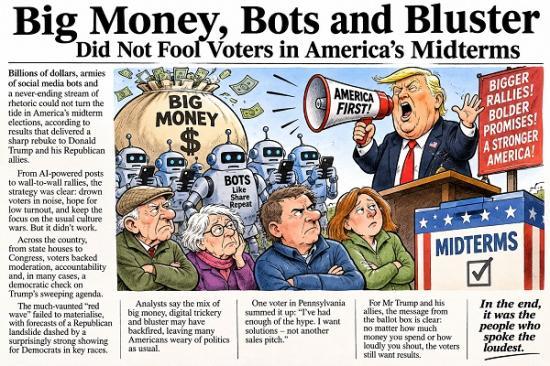
America's midterm election results could usher in a new period of political confrontation. Donald Trump remains President and Commander-in-Chief, but a Democratic-controlled Congress could make it considerably harder for him to pursue his domestic and foreign policies without challenge. The war with Iran could become the biggest test.
The American political landscape could be entering a very different phase following the Democrats' strong performance in the 2026 midterm elections.
Donald Trump remains in the White House, but the prospect of Democrats taking control of both chambers of Congress presents him with a significant problem. For the first time in this period of his presidency, he could find himself facing an opposition that controls the legislative branch of government.
The distinction is important. Winning Congress does not make the Democrats the government, nor does it remove Trump from office. The President retains considerable constitutional powers, including command of the armed forces and responsibility for implementing foreign policy.
However, the American system was designed to prevent too much power from resting in one place. Congress has its own constitutional responsibilities, and a change in its political composition can have considerable consequences.
Congress can block, investigate and challenge
The first consequence is that Trump could find it much harder to get legislation through Congress.
The President can veto legislation passed by Congress, but Congress controls whether proposed laws receive approval in the first place. A Democratic majority could block Republican initiatives, challenge parts of Trump's domestic programme and introduce legislation intended to reverse some of his policies.
Overriding a presidential veto requires a two-thirds majority in both the House of Representatives and the Senate. That is a difficult hurdle, so Democrats would not have a free hand.
However, legislation is only part of the story.
Congressional committees have considerable investigative powers. They can demand documents, summon government officials and hold public hearings. These investigations could examine everything from immigration enforcement and government spending to presidential decisions about military action.
For an administration accustomed to having its own party controlling Congress, this would represent a substantial change.
The war with Iran could become the biggest confrontation
Perhaps the most important question is whether a Democratic Congress could stop Trump continuing military operations against Iran.
The American Constitution gives Congress the power to declare war, while the President is Commander-in-Chief of the armed forces.
Over successive administrations, presidents from both political parties have relied on their constitutional authority to undertake military operations without obtaining a formal declaration of war.
However, Congress has an important additional instrument in the War Powers Resolution of 1973.
Broadly, this requires the President to notify Congress within 48 hours of introducing American forces into hostilities in circumstances covered by the legislation. Military involvement generally has to end within 60 days unless Congress authorises it, with a further 30 days available for withdrawal.
A Democratic-controlled Congress could therefore challenge the legal basis for continuing military operations and introduce legislation requiring them to end.
There would be complications. Trump could argue that particular operations were necessary to defend American interests or respond to threats. The precise constitutional limits of presidential military authority have been disputed for decades.
The Democrats cannot simply issue an instruction to the Pentagon and expect the President to comply.
Nevertheless, they could make continuing the war much more difficult.
The money could be the Democrats' strongest weapon
There is another important constitutional consideration.
Congress controls federal spending. Military operations require enormous sums of money, covering aircraft, naval deployments, missiles, ammunition, fuel, personnel and logistical support.
A Democratic majority could refuse additional funding for particular military operations or attach conditions to future military appropriations.
This would put Trump in a difficult position. He could veto spending legislation, but doing so would create another confrontation with Congress.
Republican politicians would also face difficult decisions. Would they continue supporting the President's military policy if the war became increasingly unpopular and expensive?
For American taxpayers, the financial consequences of a prolonged conflict could become an increasingly important political issue.
Could Trump be impeached?
A Democratic-controlled House could also consider impeachment proceedings.
The House can impeach a President by a simple majority, but impeachment does not automatically remove someone from office.
A trial takes place in the Senate, where conviction and removal require a two-thirds majority of senators present.
Even if the Democrats control the Senate, they would need considerable Republican support to remove Trump.
Impeachment could nevertheless become a major political issue if investigations uncovered evidence of serious wrongdoing. It would also keep the administration under considerable scrutiny.
Trump still has two months before the new Congress takes over
There is an important timing issue.
The newly elected members of Congress do not take their seats immediately. The new Congress begins on 3 January 2027.
Until then, the existing Republican-controlled Congress remains in place.
That gives Trump a period in which he can continue pursuing his programme without the immediate prospect of a Democratic congressional majority.
After January, however, the political circumstances could change considerably.
What does this mean for Britain and Europe?
The consequences extend well beyond American domestic politics.
Britain and European governments will be watching closely to see whether Trump's foreign policy becomes more difficult to implement.
NATO, Ukraine, trade relations and the Middle East are all areas where American policy has international consequences.
If Congress begins challenging the President's decisions, foreign governments may have to consider whether commitments made by the White House have sufficient political and financial support to survive.
The Iran conflict is particularly important. A prolonged war could affect oil supplies, shipping routes, energy prices and the wider global economy.
For Britain, already exposed to international energy market movements, the economic consequences could be considerable.
The Republicans may become the deciding factor
One of the most interesting developments to watch will be the behaviour of Republican politicians themselves.
Some may continue supporting Trump regardless of congressional opposition. Others may begin distancing themselves from decisions that could damage their own electoral prospects.
If enough Republicans decide that the President's approach is no longer in their political interests, the balance of power could shift further.
The Democrats will also have to demonstrate that they can do more than oppose Trump. They will need to show that they can offer practical alternatives on the economy, immigration, healthcare and foreign policy.
The next presidential election is in November 2028, and the political battle is already likely to be shaped by what happens over the next two years.
A President still in power, but facing new limits
The American system does not allow a President to be removed simply because the opposing party wins congressional elections.
Trump remains President, retains command of the armed forces and has considerable executive authority.
But control of Congress gives the Democrats the opportunity to investigate, challenge, block legislation and place conditions on government spending.
Whether that proves sufficient to change the course of the war with Iran remains uncertain.
The important distinction is that Trump may still occupy the White House, but he could find that he no longer has the political freedom he enjoyed when his own party controlled Congress.
For the United States, and for countries watching its decisions around the world, the next two years could be a significant test of how effectively American constitutional checks and balances actually work.