The Great Highland Power Line: Who Benefits from a £29 Billion Electricity Revolution?
25th November 2026
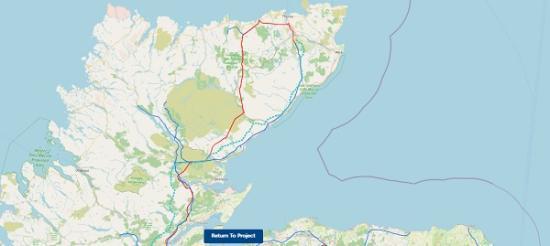
Caithness and Sutherland are becoming increasingly important to Scotland's energy future. Wind farms, renewable energy developments and major electricity infrastructure projects are transforming the region. Now one of the most significant proposals is facing a public inquiry, with questions being raised about its impact on Highland communities, landscapes and local businesses.
The proposed Spittal–Loch Buidhe–Beauly 400kV transmission line is part of a much wider investment programme by SSEN Transmission, which says it plans to invest around £29 billion in upgrading and expanding electricity networks across the north of Scotland over the next five years.
This is an enormous investment, but an important question remains: how much of the resulting economic benefit will actually reach the communities hosting the infrastructure?
Why is the new power line needed?
The proposed overhead line would run approximately 173 kilometres from a new substation at Banniskirk, near Spittal in Caithness, through the Loch Buidhe area near Bonar Bridge and onwards to Fanellan, near Beauly.
It would use steel lattice pylons averaging around 57 metres in height. The application also includes approximately 18 kilometres of diversions to existing electricity lines, bringing the total amount of new overhead line infrastructure associated with the development to approximately 191 kilometres.
The reason for the investment is relatively straightforward. Scotland is generating increasing amounts of renewable electricity, particularly from wind power, but the existing electricity transmission network does not have sufficient capacity to transport all the electricity that could potentially be generated.
The problem is particularly relevant to the north of Scotland, where considerable investment in wind farms is taking place, often in relatively remote locations.
Generating electricity is only part of the challenge. It must also be transported to homes, businesses and industries, many of them hundreds of miles away.
SSEN argues that without substantial investment in transmission infrastructure, Scotland will struggle to make full use of its renewable energy resources and meet its energy security and clean power ambitions.
A £29 billion investment and thousands of jobs
SSEN's wider investment programme is being presented as one of the largest private infrastructure investment programmes in Scotland's history.
Its June 2026 economic report, Re-energising the North: Transforming Scotland, estimates that the programme could support up to 10,000 jobs in the north of Scotland and 24,000 across Scotland.
The company also estimates that, alongside investment by other electricity transmission operators and renewable energy generators, the wider infrastructure programme could add around £60 billion to UK economic output over the longer term.
These are substantial figures, although it is important to understand that they relate to the wider investment programme, not simply the Spittal–Beauly line.
For Caithness and Sutherland, the opportunities could include construction employment, engineering, transport, accommodation, catering, materials supply and a range of specialist services.
Local businesses could benefit from contracts and increased demand, while investment in infrastructure could help make the region more attractive for further energy-related developments.
However, there is a difference between jobs supported by a major investment programme and permanent jobs created in the communities where construction takes place.
Much of the specialist work may be undertaken by large contractors and companies based elsewhere. Construction workers may travel into the area rather than relocate their families.
It will therefore be important to establish how many opportunities will genuinely be available to local people and businesses.
The environmental and community cost
The economic arguments are only one side of the debate.
The proposed route crosses areas of considerable natural beauty and historical importance. For people living along the route, the prospect of nearly 200 kilometres of new overhead electricity infrastructure is a major concern.
Highland Council has objected to the proposal, prompting Scottish Ministers to refer it to a Public Local Inquiry.
The inquiry began in Dornoch on 24 November 2026. Landscape and visual impacts are among the issues being examined, with cultural heritage, traffic, ecology and community concerns also forming part of the process.
Community representatives have argued that the development could cause lasting damage to landscapes and historic sites. Some believe alternative routes should have been considered, including greater use of underground or subsea cables.
There is also frustration among some residents who feel that consultation has not given communities sufficient influence over decisions affecting their surroundings.
SSEN, however, maintains that the project has undergone extensive consultation and detailed technical and environmental assessment. It argues that the proposed route represents a necessary part of the wider electricity network improvements.
The inquiry provides an opportunity for these competing arguments to be examined independently. Scottish Ministers will ultimately decide whether consent should be granted.
Who pays for the investment?
There is another question that deserves attention: who ultimately pays for the £29 billion investment?
Although SSEN describes this as private infrastructure investment, that does not mean the costs simply disappear into the company's accounts.
Electricity transmission companies operate under a regulated system overseen by Ofgem. They raise finance for investment and recover approved costs over time through regulated revenues and network charges, which ultimately form part of electricity bills.
Ofgem has acknowledged that the scale of planned investment will increase network costs for consumers in the short term.
Its estimates suggest that electricity transmission network charges for a household with median energy consumption could rise by around £108 a year by 2031 if all the prospective investment proves necessary.
However, Ofgem argues that this should not be confused with an equivalent increase in the overall electricity bill. Better transmission connections should reduce the need to pay wind farms to switch off when electricity cannot be transported, while allowing more cheaper renewable electricity to reach consumers.
Whether those savings materialise on the scale anticipated remains an important question.
Consumers are entitled to expect that such enormous investment will be carefully managed and that the benefits will eventually outweigh the costs.
What does Caithness actually get out of it?
For Caithness, there is a particular reason to take an interest.
The area has considerable renewable energy resources and is already seeing major investment in wind power, battery storage and electricity infrastructure.
The Banniskirk substation near Spittal is an important part of the proposed development, while other projects are strengthening connections between the north and the rest of Scotland.
There are opportunities for local businesses, particularly those involved in construction, transport, engineering, accommodation and catering.
SSEN has also outlined a commitment to more than £100 million in community benefit funding across its wider transmission investment programme in the north of Scotland.
That is potentially significant, but it is important to distinguish between a regional commitment and money actually allocated to individual communities.
Caithness and Sutherland residents will reasonably want to know what funding will be available locally, how it will be distributed and whether it will support projects that leave a lasting legacy.
There is also an opportunity to develop local skills and training so that young people can secure well-paid employment in the energy industry without having to leave the area.
That requires more than temporary construction jobs. It means developing a local supply chain, training opportunities and permanent employment.
An energy revolution needs local support
There is little doubt that Scotland needs a stronger electricity transmission network if it is to make full use of its renewable energy resources.
The transition to cleaner electricity, greater energy security and reduced dependence on imported fossil fuels requires investment on a considerable scale.
But the way that investment is delivered matters.
Communities in the Highlands should not simply be expected to accept major changes to their landscapes because the electricity is needed elsewhere.
Equally, opposing every new development would make it difficult to deliver the infrastructure required to support Scotland's energy ambitions.
The challenge is to find a reasonable balance between national requirements and local interests.
The Spittal–Beauly proposal is now facing detailed examination through the public inquiry. Its outcome will be important, not just for the immediate communities along the route, but for the future development of electricity infrastructure across the Highlands.
The £29 billion investment programme offers enormous economic possibilities. However, the real measure of success should not simply be how much money is spent, how many pylons are erected or how much electricity is transported south.
It should also be measured by how many lasting jobs are created, how many local businesses benefit, how much investment remains in Highland communities and whether consumers ultimately receive more reliable and affordable electricity.
Caithness and Sutherland have an important role in powering Scotland's future. They should also have a meaningful share in the prosperity that future is expected to bring.
[url=https://www.ssen-transmission.co.uk/projects/project-map/spittal--loch-buidhe--beauly-400kv-connection/]Spittal – Loch Buidhe – Beauly 400kV Connectio updates[/url]
Unfortunately the planning appeals web site is currently beng updated showing
https://www.dpea.scotland.gov.uk/CaseDetails.aspx?T=76&id=126873
The DPEA Case Management System (CMS/Portal) will be unavailable from 20 - 27 November 2026 inclusive due to planned migration activities. During this period users will be unable to access case information. Normal service is expected to resume from 30 November 2026. We apologise for any inconvenience caused and thank you for your patience while we complete these essential improvements to our service
Comment
The project is controversial in the eyes of objectors so how would you balance thousandsof new jobs against the changes close to where people live, scenery etc - and should the planning system be used to slow down natioanlly important projects.