Forget Expensive Weight-Loss Jabs? Could Ordinary Porridge Oats Help Britain Tackle Its Obesity Problem?
26th November 2026
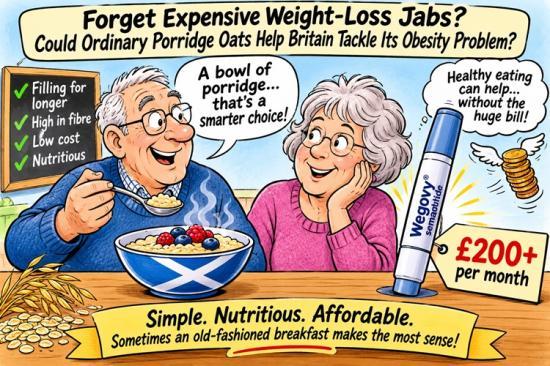
For generations, porridge was a familiar breakfast in Scottish homes. It was inexpensive, filling, easy to prepare and provided energy to get through the day. Now, rather unexpectedly, this traditional breakfast is enjoying a new lease of life as consumers look for ways to manage their weight without spending substantial sums on weight-loss injections.
The interest follows growing demand for medicines such as Wegovy and Ozempic, which have transformed the weight-loss market. But there is a growing question: could some of the benefits people are seeking from these expensive treatments be supported, at least in part, by ordinary foods such as porridge oats?
There is certainly some science behind the renewed interest.
Why are porridge oats becoming popular again?
Waitrose has reported a 124% increase in sales of its own-brand Scottish oats over the past year. Searches for overnight oats on its website have also increased by 160%.
Its latest Food and Drink Report suggests that consumers are increasingly interested in foods that help them feel fuller for longer. A survey found that 64% of shoppers were actively choosing foods such as oats for this reason.
Social media has even given the trend a pharmaceutical-sounding name: "Oatzempic", sometimes described as nature's Ozempic.
That description is rather exaggerated, but it reflects a genuine nutritional benefit.
Oats contain a soluble fibre called beta-glucan. When mixed with liquid, this fibre forms a thick, gel-like substance which can slow digestion and help prolong the feeling of fullness.
In practical terms, someone eating a bowl of porridge for breakfast may be less inclined to reach for biscuits, snacks or another meal shortly afterwards.
That does not automatically mean weight will be lost. However, if feeling fuller helps someone consume fewer calories throughout the day, it can make a contribution.
What makes oats different?
Oats offer several advantages over many highly processed breakfast foods.
They contain fibre, some protein and a range of minerals. Their soluble fibre can also help reduce the rise in blood cholesterol, while the way oats are digested can help moderate the rise in blood glucose after eating.
A typical 40g portion of dry porridge oats contains approximately 150 calories, although the final figure depends on what is added.
Unlike some breakfast cereals, ordinary oats do not need added sugar, flavourings or expensive packaging to provide a nutritious meal.
There is also a financial advantage. A bag of ordinary oats can provide many breakfasts for considerably less than the cost of specialist weight-management products.
Of course, what goes into the porridge matters. Adding generous quantities of sugar, honey, syrup or cream can quickly increase the calorie content. A little fruit, berries or cinnamon can provide flavour without turning a modest breakfast into a high-calorie meal.
Can porridge compete with Wegovy?
This is where some caution is necessary.
Wegovy contains semaglutide, a medicine which mimics the action of a naturally occurring hormone called GLP-1. It acts on the body's appetite regulation systems, helping people feel fuller and reducing hunger. It can produce substantial weight loss when used alongside dietary and lifestyle changes.
Oats work differently. They do not reproduce the hormonal effects of semaglutide, and there is no credible evidence that eating porridge can deliver comparable weight loss.
Research into oat fibre does support improvements in feelings of fullness and appetite control. But feeling fuller is not the same as demonstrating significant long-term weight loss.
The distinction matters because social media can sometimes turn a modest nutritional benefit into an exaggerated health claim.
For people who need medical treatment for obesity, porridge is not a substitute for a proper medical assessment or prescribed medication.
Nevertheless, it may be a useful part of a healthier eating pattern, including for people who are taking weight-loss medicines.
The cost of tackling obesity
The growing popularity of weight-loss injections raises another important issue: affordability.
Medicines such as Wegovy can be expensive when purchased privately. NHS access is subject to clinical eligibility requirements and the availability of specialist weight-management services.
Not everyone who wants to lose weight will qualify for treatment, and not everyone wants to use medication.
There is therefore a strong argument for making affordable, healthy food more accessible and helping people understand how everyday dietary choices can influence their weight.
Oats are only one example. Beans, lentils, vegetables, fruit and other fibre-rich foods can all contribute to a more filling diet. Including adequate protein is also important, particularly for older people who need to maintain muscle as they age.
The answer to obesity is unlikely to be found in one food or one medicine. It requires a combination of healthier eating, appropriate physical activity, support and, where necessary, medical treatment.
Could Scotland rediscover the value of traditional food?
There is something rather ironic about the latest food trend.
At a time when the food industry is developing increasingly sophisticated products and pharmaceutical companies are producing expensive weight-management treatments, consumers are rediscovering something that has been part of Scottish diets for centuries.
Porridge was never marketed as a miracle cure. It was simply an affordable, nutritious and filling meal.
Perhaps that is part of its appeal today.
For households struggling with the cost of living, a breakfast that is inexpensive, nutritious and helps keep hunger at bay makes considerable sense.
It would be wrong to suggest that porridge can replace modern medical treatments for obesity. But it would be equally wrong to dismiss the contribution that ordinary foods can make.
Britain does not need to choose between medical science and better everyday eating. Both have a role to play.
And perhaps one of the simplest lessons is that before spending hundreds of pounds on the latest weight-loss products, it might be worth looking again at what is already sitting in the kitchen cupboard.
Sometimes an old-fashioned bowl of Scottish porridge makes rather more sense than its modern pharmaceutical-inspired nickname suggests.