Dounreay Foreshore Particle Latest Finds

25th February 2022
Photograph of Dounreay Foreshore Particle Latest Finds

Particles are fragments of irradiated nuclear fuel discharged to sea as a result of historic practices in reprocessing.

Used fuel from the reactors on site and other research reactors in Britain and abroad was recycled in the site's reprocessing facilities.

The swarf produced during the procedure was discharged from fuel ponds with the water and were released to sea.

It is not known how many particles were released but extensive research suggests that the bulk were released between 1958 and 1984.

The most hazardous fragments are located close to an old discharge point on the seabed.

Their disintegration is believed to be the source of smaller, less hazardous particles detected on local beaches since the early 1980s.

Health risks
Expert laboratory research into the potential health effects of different particles has been carried out by the Health Protection Agency for Scottish Environment Protection Agency (SEPA), and studied by the independent Dounreay Particles Advisory Group (DPAG). The work looked at the likely health effects of different particles being swallowed, inhaled or coming into skin contact.

DPAG concluded that only those particles in the significant category pose a realistic potential to cause harm to members of the public, and that the probability of the most frequent beach-users at Sandside coming into contact with a relevant particle is one in 80 million.

A number of studies on the potential effects of particles have been completed by independent bodies. Explanations of the hazards and risks can be found at:

SEPA
Committee on Medical Aspects of Radiation in the Environment (COMARE)
Food Standards Agency (FSA)
Monitoring
Beach monitoring continues and forms part of the Environmental Authorisation (Scotland) Regulations 2018 (EASR18) authorisation granted to the site by SEPA. Monitoring of land owned by third parties is subject to agreements on access.

During 2003-2008 an extensive consultation programme was established to identify the best practicable environmental option (BPEO). The consultation led to recommendations to Government bodies on the way forward which is environmentally and publicly acceptable.

This process recognised that recovery of every particle was impractical but that it was feasible to seek recovery of larger, more hazardous particles that pose a significant health risk and which had settled in the sediment close to Dounreay. That, along with on-shore monitoring specifically at Dounreay foreshore and Sandside beach, was identified as the preferred way forward.

Underwater clean-up started in August 2008, targeted at a 60-hectare area of seabed known as the "plume" where the most hazardous particles were located. This work continued each summer until 2012.

This programme was guided by the independent expert Particles Recovery Advisory Group (Dounreay), PRAG(D), which advises both DSRL and SEPA.

All particles recovered from the seabed were returned to Dounreay.

The Dounreay foreshore and Sandside beach in the bay adjacent to the site are monitored on a regular basis. Strathy beach and Murkle beach act as ‘gatekeepers' and are monitored twice a year to ensure that the offshore work has not adversely impacted the surrounding beaches.

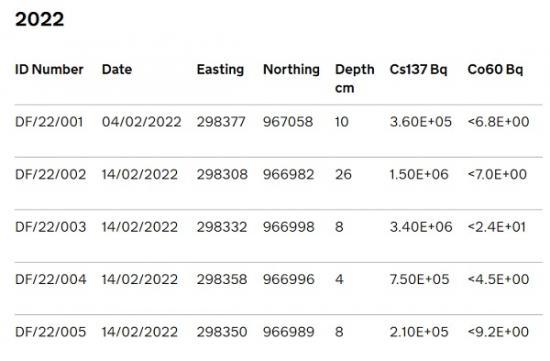
When a particle is detected, it is retrieved and taken to Dounreay for analysis. The regulator is informed, and the find is reported publicly via this website. Any unusual finds are treated in the same manner.

In the 1990s extensive additional surveys of the site were carried out. This included roadside verges, cliff top land and drainage systems. By 2009, these surveys had yielded 89 particles.

Detailed investigations identified a number of areas of the site where more particles could be expected to be found during decommissioning.

The effectiveness of the clean-up is reported by Dounreay to SEPA, PRAG(D) and other interested parties, including the site stakeholder group.

For more information go HERE


Related Businesses


Related Articles

21/9/2026 : Other Public Services

What happens when the number of jobs and the amount of spending generated by Dounreay eventually begin to fall?

Dounreay is no longer the giant nuclear research establishment it once was, but a new economic assessment shows that it remains one of the most important pillars of the Caithness and north Sutherland economy.   The question that follows from that is perhaps even more important.  

21/9/2026 : Other Public Services

Dounreay Supports Almost One in Four Jobs Across Caithness and North Sutherland

Dounreay Supports Almost One in Four Jobs Across Caithness and North Sutherland Dounreay's importance to the Caithness economy is even greater than many people might realise.   A new economic impact assessment commissioned by the Nuclear Decommissioning Authority and carried out by PwC estimates that the Dounreay site supported £179 million of economic activity in Caithness and North Sutherland during 2024/25.  

21/9/2026 : Other Public Services

 
Dounreay's Famous 'Golf Ball' Will Be Painted – But When Will It Finally Come Down?

There is something slightly strange about spending money painting a building which is eventually going to be demolished.   That is what is happening at Dounreay, where the famous steel sphere containing the Dounreay Fast Reactor is being maintained while the difficult job of removing what remains inside it continues.  

14/8/2026 : Other Public Services

Scotland Has the Sites, Skills and Dounreay — So Why Is It Saying No to Britain's Nuclear Future?

There is something increasingly strange about Scotland's position in Britain's emerging nuclear revival.   Scotland has nuclear sites.  

28/7/2026 : Other Public Services

Caithness at the Centre of Scotland’s Electricity Revolution: The Transformation Happening Around Us

Caithness at the Centre of Scotland’s Electricity Revolution: The Transformation Happening Around Us Look across Caithness today and it is easy to see individual electricity projects – a new substation here, a cable route there, construction work around Dounreay or Spittal.  But put them together and a much bigger picture emerges.  

28/7/2026 : Other Public Services

Orkney Link Reaches Major Milestone at Dounreay – What It Means for Caithness and Scotland’s Energy Future

A major piece of underground engineering at Dounreay has been completed, bringing the Orkney electricity link another step closer to reality and putting Caithness at the centre of a project designed to unlock hundreds of megawatts of renewable energy.   SSEN Transmission has announced the successful completion of horizontal directional drilling (HDD) at Dounreay, describing it as a major milestone in the construction of the Orkney Link.  

30/6/2026 : Other Public Services

 
Innovative robotics trialled to tackle nuclear waste challenges

Innovative robotic solutions being trialled at Nuclear Restoration Services (NRS) Oldbury site to tackle most challenging aspects of legacy waste management.   Oldbury nuclear decommissioning site is a trailblazer for robotics and other innovative approaches, with NRS deploying robotics trials in South Gloucestershire to tackle some of the most challenging aspects of legacy waste management, reducing risk to workers and improving efficiency.  

16/6/2026 : Other Public Services

 
NDA group employees recognised by His Majesty the King

Three NDA group employees awarded honours in the 2026 King’s Birthday Honours list.   Three NDA group employees have been awarded honours in the 2026 King’s Birthday Honours list, for services to the nuclear industry and the local community.  

4/6/2026 : Other Public Services

Wylfa Decommissioning But With Good Propects For Future Nuclear Dvelopments

Wylfa, located on Anglesey, North Wales, is a historic nuclear site that operated from 1971 to 2015, featuring the UK's largest and last Magnox reactors.   Known for its significant contribution to UK energy, it is currently undergoing decommissioning while being designated as a premier location for new, small modular reactor (SMR) technology.  

20/5/2026 : Other Public Services

 
Scottish nuclear site hails e-learning platform as great example of industry collaboration

The Engineering Construction Industry Training Board’s (ECITB) award-winning e-learning platform has been hailed as a great example of industry collaboration in action.   To mark Learning at Work Week 2026, NRS Dounreay has highlighted how the ECITB’s Learning Experience Platform (LXP) has become a “go-to training solution” for its 1,400 workers.