Cairngorm Funicular Reinstatement Enters Final Stages - Service Due To Relaunch Early Next Year - Final Cost £25million
15th November 2022
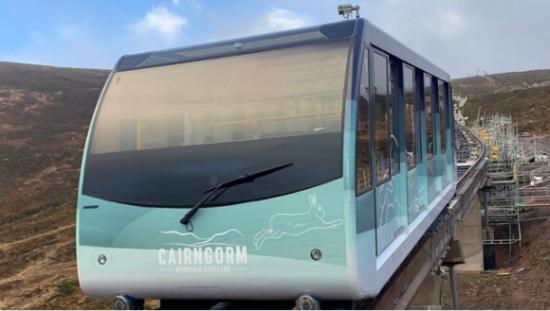
One of Scotland's most complex and challenging civil engineering projects of recent years - the multi-million pound reinstatement of the Cairngorm funicular railway - is entering its final stages.
One of Scotland's most complex and challenging civil engineering projects of recent years – the multi-million pound reinstatement of the Cairngorm funicular railway – is entering its final stages.
Contractor Balfour Beatty, working on behalf of estate owner Highlands and Islands Enterprise (HIE), is nearing completion of the programme of works required to strengthen the viaduct that supports the 2km track on the UK’s highest railway, and is currently demobilising from the mountain.
The focus now turns to engineers from Swiss company Garaventa/Frey, who are installing a new control system to ensure safe operations once the funicular comes back into service early in 2023.
Over the coming weeks they will lay fibre optic cabling and test the system repeatedly in live conditions. This means that Cairngorm Mountain trains are using the funicular track again for the first time in four years.
Testing is expected to continue into December. Safety certificates from the Department for Transport will also be required and HIE expects these will be obtained early in the new year.
While work continues on the control system, car park improvements at Cairngorm Mountain are nearing conclusion. A new conveyor system is also being installed to provide uplift for snowsports beginners and, in future, family-friendly mountain biking.
The Ptarmigan building at the top station, which houses the UK’s highest restaurant, a shop, exhibition space and viewing platforms, has been given a major makeover too.
A key attraction at the Cairngorm Mountain resort, the funicular opened in 2001 and was taken out of service in October 2018 following a safety inspection.
After this, HIE commissioned specialist engineering studies to investigate the condition of the structure in detail and assess what would be required to resume safe operation.
A detailed options appraisal then considered a range of actions – from removing the funicular altogether to replacing it with an alternative form of uplift – before recommending reinstatement of the existing structure.
Contractors began preparatory works on the viaduct in November 2020 before the major strengthening programme got under way in April 2021.
Originally planned to conclude by autumn 2021, the construction timetable had to be extended due to multiple factors, including spring blizzards, impacts arising from Covid and Brexit, and technical challenges which resulted in additional works needing to be carried out.
Significant cost inflation in the construction sector and the weakness of sterling in international exchange rates have also delivered financial impacts.
As a result, HIE now estimates that the final cost of reinstating the funicular railway will be in the region of £25m. This compares with £16.16m that was originally budgeted as part of a wider capital investment package approved by the HIE Board and the Scottish Government in 2020.
HIE has reallocated uncommitted funds from the wider Cairngorm masterplan capital investment package to meet the additional costs. The Scottish Government also allocated £7m additional funding in June 2022.
HIE is currently pursuing legal action against the funicular’s original designer and construction contractor in the Court of Session, in a bid to recoup public funding.
Dave Macleod, head of property and infrastructure with HIE said: "The funicular reinstatement programme is undoubtedly one of the most challenging civil engineering projects currently taking place in Scotland.
“Essentially, it involves strengthening a series of 94 interconnected bridges which are part of a 2km structure, each with its own challenges and at high altitude in a difficult mountain environment. The loop section where the carriages pass one another on separate tracks is another feature that required a great deal of ingenuity to solve.
“Balfour Beatty have truly pulled out all the stops to reach this vital stage in the project and it’s really exciting to think that we are now looking at the prospect of passengers riding on this spectacular mountain railway again early next year."
Hector MacAulay MBE, managing director of Balfour Beatty’s UK Construction business in Scotland said: “We are delighted to have played a key role in the reinstatement of this iconic piece of infrastructure.
“As the project nears completion, we are excited to see the benefits the Cairngorm funicular railway will provide, enabling local residents and tourists alike to access the unique mountain environment all year round.”
Contractors will continue to work on the mountain removing final materials and demobilising until the end of the year.
Environmental restoration works, including replanting and re-seeding, will proceed during 2023 and beyond.
Related Businesses
Related Articles