From Headlines to Hidden Lines - Dounreay's Quiet Legacy of Radioactive Particles
3rd February 2026
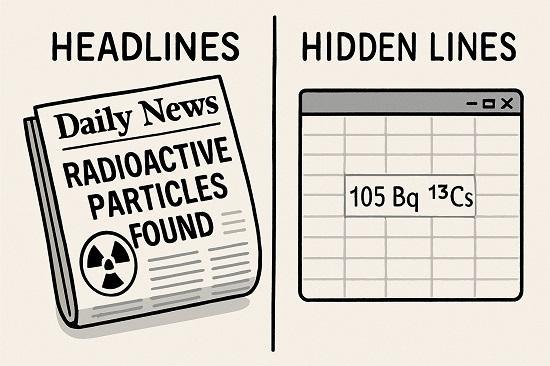
For years, radioactive particles discovered near Dounreay were headline news. Each find triggered a press release, picked up by local and national outlets, reminding communities that the nuclear legacy was still with us.
But in recent years, the press releases have dried up. The particles haven't vanished—only the announcements have.
Today, particle finds are logged quietly on GOV.UK. The information is technically transparent, but practically invisible. Unless you're the kind of citizen who checks government spreadsheets for fun, you'll never see it.
This shift—from press releases to spreadsheets—matters, because it changes not just how information is shared, but how risk is perceived.
The facts haven't changed as particles are still being found. What's changed is the framing. In the press release era, each find was a story. In the spreadsheet era, each find is a line item. Transparency exists in form, but not in practice.
The Communications Shift
Press Release Era
Frequent press releases, each find framed as "news"
Journalists alerted → headlines generated
Public awareness heightened
Operator seen as proactive
Communication style: narrative, emotive
Spreadsheet Era
Routine GOV.UK updates, each find logged as data
Journalists must proactively check lists
Public awareness reduced
Operator seen as compliant but less visible
Communication style: technical, bureaucratic
Why the Change?
Risk framing: Treating particle finds as routine data makes them seem unremarkable.
Control of narrative: Centralized reporting avoids sensational headlines.
Regulatory compliance: The industry can claim transparency while minimizing reputational damage.
Critics argue this is a way to avoid bad press. The burden has shifted: instead of the operator informing citizens, citizens must now inform themselves.
What Do These Numbers Mean?
Reports often look like this: "105 Bq Cs‑137 (with associated Sr‑90/Y‑90 and lower activities of actinides)." For non-scientists, here's how to decode it:
Bq (becquerel) = one radioactive decay per second.
105 Bq means 105 tiny bursts of radiation every second.
For comparison, a banana is about 15 Bq (from natural potassium‑40).
Cs‑137 (Cesium‑137): A fission product that emits gamma radiation. Harmless unless swallowed or held against the body for long periods.
Sr‑90/Y‑90 (Strontium‑90/Yttrium‑90): Beta emitters. Stopped by skin, but harmful if ingested because they lodge in bone.
Actinides (Plutonium, Uranium, Americium): Alpha emitters. Harmless outside the body, but dangerous if inhaled or swallowed.
Rule of thumb for citizens:
Minor particle (tens of Bq) → negligible risk.
Relevant particle (hundreds-thousands of Bq) → worth removing, but not a public health emergency.
Significant particle (tens of thousands of Bq or more, especially with actinides) → rare, but could cause harm if ingested.
Citizen's Checklist
How to Stay Informed
Bookmark the GOV.UK Dounreay page - the official source of updates.
Check the update frequency - look for "last updated" dates.
Understand classifications - minor, relevant, significant.
Scan for trends - rising, falling, or clustering finds.
Compare with historical records - are things improving?
Set reminders - monthly calendar alerts to check updates.
Share locally - bring findings to community groups and papers.
This checklist turns passive transparency into active citizenship. It's not ideal, but it's practical.
Dounreay's radioactive particles are still being found. What's changed is how the story is told. From headlines to hidden lines, the nuclear industry has redefined transparency in a way that reduces public scrutiny.
For Caithness and beyond, the challenge is clear - don't let spreadsheets silence the story. Communities must reclaim visibility, turning technical logs back into public narratives. Because when it comes to radioactive particles, what you don't know can hurt you not just physically, but democratically.
Sites checked for particles
Dounreay Foreshore
Sandside Beach
Murkle
Strathy
Where to find the particles information now
Onshore monitoring of radioactive particles near Dounreay
Information leaflet about the monitoring of beaches near Dounreay
Related Businesses
Related Articles