Currency Choices for an Independent Scotland: The Decision That Shapes Everything - Article 2
6th July 2026
Part 2 of the series: Scotland at the Crossroads – Money, Markets, and the Economics of Independence.
Few questions in the independence debate carry as much weight or as much confusion as the question of currency. It’s the foundation of every other economic decision: borrowing, mortgages, pensions, savings, trade, investment, and even property values. Yet it’s also the area where political parties often give the vaguest answers.
This article explains the three real currency options Scotland would face if it became independent, the trade‑offs behind each, and why this decision is so central to Scotland’s economic future.
Why Currency Matters More Than Almost Anything Else
Currency determines:
How Scotland borrows
How stable its banking system is
How people’s savings behave
How mortgages are priced
How businesses trade with rUK and the EU
How pensions are paid
How investors view Scotland’s credibility
It’s not just about what’s in your wallet — it’s about the entire economic architecture of a country.
The Three Currency Options Scotland Would Face
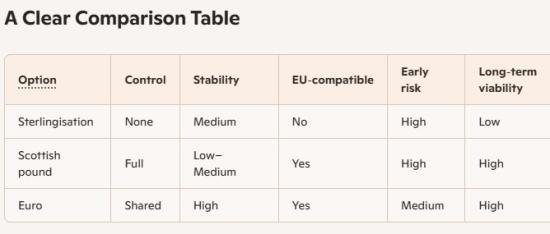
Economists agree that Scotland has three viable choices:
Sterlingisation — keep using the pound without a formal agreement
Create a Scottish pound — launch a new national currency
Join the euro (later) — adopt the euro after joining the EU
Each option has strengths, weaknesses, and political implications.
Option 1: Sterlingisation — Using the Pound Informally
What it means
Scotland keeps using the pound, but without a formal currency union and without the Bank of England backing Scottish banks.
Pros
No immediate disruption
People keep savings, wages, mortgages in GBP
Businesses avoid early conversion costs
Familiar and stable in the short term
Cons
Scotland has no control over interest rates
No lender of last resort → weaker banking stability
Borrowing costs likely higher
Limits Scotland’s ability to respond to recessions
Not compatible with long‑term EU membership
Why critics say it’s not credible
Because Scotland would have all the risks of independence but none of the monetary tools of a sovereign state.
Option 2: Creating a Scottish Pound
What it means
Scotland launches its own currency, central bank, and monetary policy.
Pros
Full control over interest rates
Ability to adjust exchange rate to support exports
Proper lender of last resort → stronger banking stability
Compatible with EU membership
Clear national economic identity
Cons
Early volatility likely
Exchange‑rate uncertainty affects mortgages and savings
Requires building a central bank and reserves
Borrowing costs likely higher at first
Businesses face conversion costs
Why critics say the SNP avoids this option
Because it is politically risky — voters fear instability, even though many economists see this as the most realistic long‑term solution.
Option 3: Joining the Euro (Not Immediate)
What it means
If Scotland re‑joined the EU, it would eventually be expected to adopt the euro — but not immediately.
Pros
Access to the world’s largest single market
Stable currency backed by the ECB
Lower borrowing costs
Strong investor confidence
Cons
Requires meeting EU convergence criteria
Scotland must first have its own currency before joining
Creates a hard border with rUK (Scotland’s biggest trading partner)
Loss of independent monetary policy
Why critics say the SNP is vague here
Because the party emphasises EU membership but downplays the inevitable euro question, which has major implications for trade with rUK.
A Non‑Obvious Insight
Currency Choice Determines Scotland’s Entire Economic Model
This is the part most political debate misses.
Sterlingisation - Scotland becomes a “dollarised‑style” economy with limited tools.
Scottish pound - Scotland becomes a fully sovereign Nordic‑style small state.
Euro - Scotland becomes an EU‑integrated economy with shared monetary policy.
Currency isn’t just a technical choice — it’s a philosophical choice about what kind of country Scotland wants to be.
Synthesis
There is no perfect currency option. Each path has trade‑offs:
Sterlingisation is easy to sell politically but weak economically.
A Scottish pound is economically credible but politically scary.
The euro is stable long‑term but creates friction with rUK.
This is why the currency debate feels unresolved — because it is unresolved. It’s the hardest question in the independence conversation, and the one with the most profound consequences.
Note
rUK refers to the rest of the United Kingdom ie England, Wales, and Northern Ireland.
Part One
Currency Choices for an Independent Scotland
Further parts in this series will come each day.