What Scotland Pays vs What It Receives: Understanding the Fiscal Balance Inside the UK - Article 1
5th July 2026
Part 1 of a series: Scotland at the Crossroads – Money, Markets, and the Economics of Independence.
Other articles will be publish in the coming week expanding the topic about various aspects of how money, savings mortgages etc might be treated under an independent Scotland without bias one way or another.
Scotland’s fiscal position inside the United Kingdom is one of the most misunderstood and most politically charged topics in the independence debate.
Supporters of independence argue Scotland is held back by UK economic structures. Opponents argue Scotland benefits from UK‑wide pooling and sharing. Both sides often rely on slogans rather than numbers.
This article tries to cut through the noise. It explains, hopefully clearly and calmly, how much Scotland raises, how much it receives, and why the gap exists.
The Core Question: Does Scotland Pay More or Receive More?
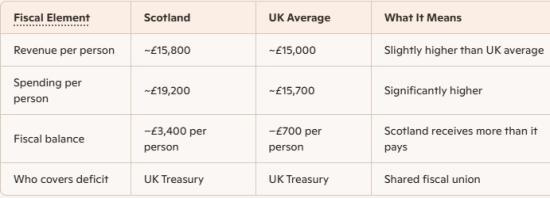
The best source for understanding Scotland’s public finances is GERS — Government Expenditure and Revenue Scotland. It’s not perfect, but it’s the most detailed and internationally recognised set of figures available.
The latest GERS data shows:
Revenue raised in Scotland: £87 billion
Public spending for Scotland: £106 billion
Net fiscal balance: around – £19 billion (a deficit of roughly 9–12% of GDP depending on the year)
In simple terms:
Scotland receives more public spending per person than it raises in tax.
But that headline alone doesn’t tell the full story.
Why Scotland Receives More Than It Pays
The Barnett Formula
The UK allocates spending to Scotland, Wales, and Northern Ireland using the Barnett formula. Scotland receives higher per‑capita funding because of:
Higher rural and island service costs
Greater health needs in some regions
Historical spending patterns
Geographic challenges
This isn’t a “subsidy” in the emotional sense — it’s a formula.
Demographics and Geography
Scotland’s population is older on average than England’s, and its geography is more expensive to serve. Running hospitals, schools, roads, ferries, and emergency services across rural and island communities costs more per person.
UK‑Wide Services Scotland Benefits From
Some spending isn’t “Scottish” or “English” — it’s UK‑wide:
Defence
Pensions
Debt interest
Welfare
National infrastructure
Economic stabilisation
Scotland benefits from these shared services regardless of how much tax it raises.
Does Scotland Subsidise the UK or Vice Versa?
This is where politics enters the picture. The facts:
Scotland’s deficit is larger than the UK average
Scotland: 9–12% of GDP
UK overall: 5–6% of GDP
But regional fiscal gaps exist everywhere
London and the South East run large surpluses.
Northern Ireland, Wales, the North of England, and Scotland run deficits.
This is normal in a fiscal union. Richer regions subsidise poorer ones; poorer regions benefit from shared services.
It’s not a moral judgement — it’s how modern states work.
A Non‑Obvious Insight: Scotland Doesn’t “Pay” Its Own Deficit
Inside the UK:
Scotland does not borrow separately
Scotland does not issue its own bonds
Scotland does not face market interest rates
The UK Treasury absorbs Scotland’s deficit as part of the UK‑wide budget.
This is why some argue Scotland benefits from being part of the UK, while others argue Scotland could restructure its economy differently if independent.
So What Does This Mean for Independence?
This article isn’t about arguing for or against independence — it’s about understanding the starting point.
The key takeaway:
Independence doesn’t erase Scotland’s fiscal gap. It changes who is responsible for managing it.
Inside the UK, the Treasury absorbs the deficit.
Outside the UK, Scotland would need to finance it directly.
Earlier Articles In This Series About Possible Scottish Currency Questions
Will People Move to England if Scottish Independence Looks Likely Article 7
[url=https://caithness-business.co.uk/article/32384]Savings, ISAs and Investments in a New Scottish Currency – What Would It Mean for Your Money - Article 6[/url]
Pensions and Independence: What Really Happens - Article 5
Mortgages Under a New Scottish Currency If Scottish Independence Happens - Article 4
How a Scottish Pound Would Be Introduced In An Independent Scotland - Article 3
Currency Choices for an Independent Scotland: The Decision That Shapes Everything - Article 2
What Scotland Pays vs What It Receives Understanding the Fiscal Balance Inside the UK - Article 1
Topics will include how saving, mortgages, Isa's etc might be treated following independence if it happens. We will try to avoid any preferences and stick to facts - Bill Fernie