Nuclear Decommissioning - Demolition Starts On Windscale Chimney
1st March 2019

The first blocks of concrete have been removed from the top of one of the world's most recognisable chimneys.
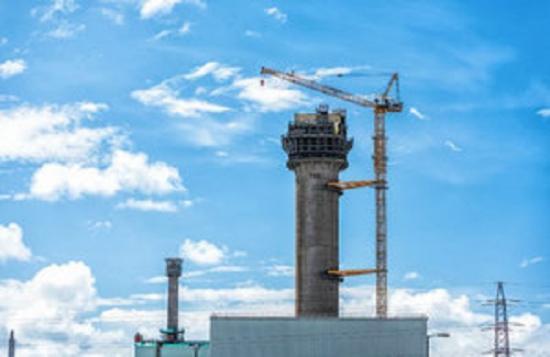
This marks the start of the demolition of Sellafield's Windscale Pile One stack.
The 125m tower - the scene of Britain's worst nuclear accident - will now start to disappear.
Workers are cutting out 6-tonne ‘chunks' of concrete using diamond wire saws.
The blocks are then removed with the help of a giant crane, which at 152 metres is the tallest structure ever built at Sellafield, just six metres shorter than the Blackpool Tower.
Stuart Latham, head of remediation, said:Following a period of intense planning, we're delighted to share this very visible demonstration of the work being done to make Sellafield a safer place.
Not only does it reduce the risk associated with this historic, redundant stack, but it will also change the Sellafield skyline forever.
This is a huge step in our clean-up mission at Sellafield , so everyone was incredibly proud to see those first blocks safely removed. This is thanks to the dedication and collaboration of the Sellafield and supply chain teams involved.
The Windscale Pile One chimney, with its distinctive top-heavy appearance, has dominated the Sellafield skyline for nearly 70 years.
The first piece to go will be the square-shaped ‘diffuser’ at the top, which will disappear before 2022.
Famously, this bulky filtration system was a last-minute addition, placed unusually at its summit.
Despite being mockingly referred to as ‘Cockroft’s Folly’, after its designer Sir John Cockroft, it turned out to be a masterstroke.
In 1957, fire broke out in the Windscale Pile One reactor. The sky-high filters captured an estimated 95 per cent of the radioactive dust created.
Now, the chimney is a decommissioning project.
Teams from Sellafield Ltd and its supply chain are working together to safely pull it down.
The project is a collaboration between Sellafield Ltd and the supply chain. Partners include: DSA Progressive Alliance (Cavendish and AECOM) for design and engineering, DDP Framework ADAPT (Doosan Babcock, Atkins, and AREVA) for procurement and construction, and Access Installation Framework (Kaefer Engineering) for scaffolding systems.
Because buildings containing nuclear material surround the stack, traditional demolition techniques like explosives cannot be used.
Related Businesses
Related Articles
Joint venture to develop neutral beams for fusion and non-fusion applications, creating high-skilled jobs and establishing a critical supply chain. TAE Technologies, a leading US private fusion energy firm with over 25 years at the forefront of scientific innovation, today announces a bilateral and reciprocal investment commitment with the United Kingdom's national fusion laboratory, the UK Atomic Energy Authority (UKAEA) to commercialise TAE's proprietary particle accelerator technology for the global market.
The Nuclear Decommissioning Authority (NDA) has released its 2025 Mission Progress Report is a slightly sprawling document chronicling one of the UK's most complex environmental undertakings. The safe dismantling of its early nuclear legacy.
The Civil Nuclear Constabulary (CNC) welcomes its newest recruits. The CNC hosted two passing out parades for the graduating Authorised Firearms Officers (AFOs) of Initial Foundation Programme (IFP) 106.
Nuclear Restoration Services Dounreay's Kate Thomson has won Modern Apprentice of the Year at the Highlands & Islands Apprenticeship Awards in Inverness. Kate, who is in the second year of her apprenticeship in commercial and quantity surveying, said she was thrilled by the honour.
Nuclear Regulatory Taskforce publishes final report and calls for radical reset of overly complex nuclear regulatory system. An overly complex nuclear regulatory system has contributed to the "relative decline" of the UK's ability to deliver faster and cheaper nuclear projects.
A specialist ports consultant has been appointed to develop a long-term strategic plan for Wick Harbour Authority (WHA) in Caithness. WHA has secured £47,775 from Highlands and Islands Enterprise (HIE) and the Nuclear Restoration Services, NRS Dounreay towards the cost of the services.
Rising star from North Scotland honoured at event to celebrate brightest and best in industry. An electrical apprentice from North Scotland is celebrating after being recognised for her contribution to industry at the 13th annual Engineering Construction Industry ECI Training and Development Awards in London.
The NDA group graduate scheme offers far more than just a stepping stone into the nuclear industry; it's a chance to grow professionally, explore new places, and become part of a supportive community. Nuala Ledward, Assurance and Performance Graduate, shares how her secondment to Dounreay brought these benefits to life.
At its recently opened Central Support Facility (CSF), UKAEA has commissioned an electron beam additive manufacturing machine that can be used to incorporate tungsten into components, alongside a selective laser manufacturing machine. Fusion can play a key role in a global low carbon energy future.
As part of the Fusion Futures (FF) programme, UKAEA's Remote Applications in Challenging Environments (RACE) has partnered with industry leaders to develop two groundbreaking technologies for remote maintenance in fusion energy engineering. Thanks to FF funding, industry has taken the lead in maturing UKAEA technology concepts—delivering real-world solutions that enhance operational autonomy and reduce maintenance burdens in extreme environments.