Will Wick Pavement Widening Be Helpful Or A Disaster For Businesses
17th November 2025
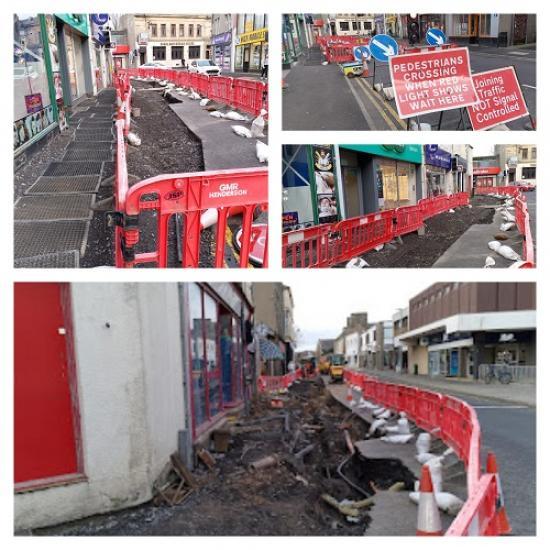
Wick Street Design project is currently underway, and its total value is around £2.1 million.
There are misgivings by local town centre businesses if traffic cannot move smoothly through the main streets.
Taxi drivers say they may have to reroute to avoid the town centre adding to fuel costs and time to go from A to B if traffic piles up.
The works includes: new surfacing, lighting, seating, planters, artwork, and pedestrian improvements (i.e., more than just pavement widening).
The project is funded in part through the Active Travel Infrastructure Fund.
The funding window is such that all works must be completed by March 2026.
There's also a resurfacing programme in Caithness (including Wick) — in one year, Highland Council spent about £1.677 million on Caithness road resurfacing.
In that resurfacing, there's an allocation of £3.2 million capital funding for Caithness broadly, covering a number of roads in Wick.
Narrowing the road to widen the pavements may sound good for pedestrians but if buses and other large vehicles take more time to negotiate the corners will this affect bus timetables and cause snarl ups.
The £2.1 million figure is likely the closest to the "widening pavements + street design" that you're seeing. It's not just pavements — it's a full street redesign (surfaces, bollards, lighting, seating, etc.).
The project has multiple elements - not just just widening pavements.
There are a number of complaints / concerns about the Wick street-design work, especially around how the pavement widening and re-alignment could affect traffic.
What the Complaints Are
From the john O'Grot Journal
Road Narrowing & Traffic Congestion
A shop owner (Neil Harrold, Harrold Brothers butcher) calls the road narrowing "madness," warning that it could lead to more congestion when deliveries are being made.
He argues that reducing the road width will make two-way flow with large delivery lorries very difficult.
There is concern about the removal of a loading bay / stopping area: during the redesign, part of the wider road used for deliveries is being changed, which worries local business owners.
The provost of Wick (Councillor Jan McEwan) has expressed concern that the changes could cause "bottlenecks" and obstruct emergency vehicles.
Access and Deliveries
As noted above, business owners worry that deliveries (especially by large lorries) will become more difficult due to the narrowing of roads.
The butcher has specifically pointed out that his shop gets frequent heavy deliveries (e.g. meat) and that making them go via a different route (or off the main road) could be very impractical.
Pedestrian / Vehicle Access Balance
The design includes footway build-outs ("build-out" at the junction of High Street / Bridge Street) to give more space to pedestrians.
However, not everyone is convinced that the design has fully thought through vehicle access (especially for larger vehicles) at key junctions.
There is also discussion of rising bollards (to restrict vehicle access) — these will be controlled remotely, and there is some concern about how flexibly this will work in practice.
How did we get here
Wick Active Travel Masterplan
There is a Wick Active Travel Masterplan (refresh), produced in partnership between HITRANS, Sustrans, and Highland Council.
HiTrans
According to the masterplan, barriers to active travel in Wick included "motor vehicles using High Street pedestrianized zone"; this was a core part of the justification for the redesign.
HiTrans
The plan emphasises improving walkability, safe crossings, and creating a "comfortable and safe environment to walk, wheel and cycle."
HiTrans
Concept Design Document
Highland Council has a concept design PDF for Wick High Street.
The design includes: narrowed vehicle paths, raised road sections (to act as traffic-calming), and widened footways.
There are "automatic hydraulic bollards" at both ends of the pedestrian-priority section to restrict/monitor vehicle access.
The design suggests a central delineation and level crossing features to slow vehicle speed.
Council Updates
Highland Council's “Wick Street Design” project page notes that at the Bridge Street / High Street junction, improvements will make it “easier for pedestrians to cross” and access nearby car parks.
The same page indicates that the rising-bollards system will help “ensure that any authorised traffic ... reduce speed,” which should help pedestrian safety.
There was a drop-in event to discuss how construction will run, and traffic management is
Strategic Planning Context
The Caithness & Sutherland Town Centre Strategy (Oct 2020) notes that prior transport and active travel audits identified problems with “congested streets” and poor pedestrian / cycle safety in town centres like Wick.
Also, a Caithness Internal Transport Connectivity Study conducted by HITRANS (with Highland Council) previously flagged geometric limitations in Wick town centre, particularly for large vehicles.
HiTrans
What's Missing / Not Clear
There does not appear to be a standalone, up-to-date Traffic Impact Assessment (TIA) publicly posted specifically for the current High Street works.
There's no obvious detailed modelling report released by Highland Council showing projected traffic flows (e.g., simulations of queueing, traffic displacement, peak congestion) after the design changes.
The concept designs and masterplans are fairly high-level concept / design documents; they don't go into granular, junction-by-junction traffic modelling (at least from the publicly available versions).
Interpretation & Risk
The design philosophy strongly supports reduced through-traffic, slower vehicle speeds, and prioritising pedestrians — the bollards and narrowed carriageways are a deliberate traffic-calming / access-limiting measure.
Because there isn’t a clearly published, detailed TIA, some of the local concerns (about “bottlenecks” or access by large vehicles) may not have been fully modelled in the public domain.
The lack of a public, detailed traffic-modelling report increases the risk that some of the negative outcomes feared by locals (traffic delays, difficult deliveries) are under-appreciated or under-communicated to the community.
There is some transport / traffic planning evidence, but it’s more conceptual (masterplans, concept designs) than deeply technical in terms of traffic modelling.
The project does acknowledge and plan for vehicle-access control and traffic calming (bollards, narrowed carriageway), which could mitigate some of the concerns — but not necessarily all, especially for larger vehicles or during peak delivery times.
Without a detailed publicly-available TIA, it’s hard to be very confident in how much the traffic flow will worsen (or improve) once works are fully implemented.
Related Businesses
Related Articles