New guide to support growers with controlled environment agriculture

21st March 2026

Photograph of New guide to support growers with controlled environment agriculture

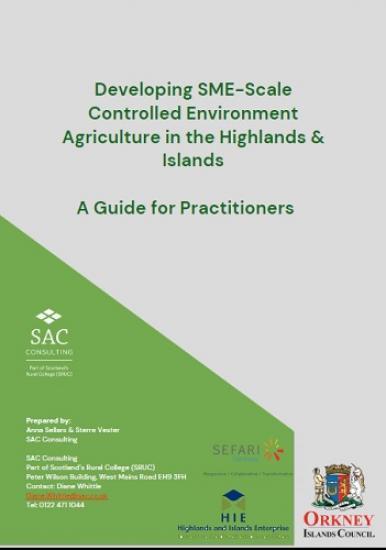
A new guide has been published (20 March 2026) to help growers who want to explore the potential for controlled environment agriculture (CEA) in rural and island locations.

CEA is the practice of growing crops in a controlled setting where factors like temperature, light, humidity, and nutrients can be carefully managed for optimal plant growth.

The guide is for existing growers looking to diversify their production systems, as well as for businesses, community groups, and small or medium sized enterprises (SMEs) with little or no horticultural experience.

It outlines options, technologies, market research, and practical considerations for businesses and organisations and includes four case studies.

The guide has been produced following a study commissioned by SEFARI Gateway (Scottish Environment, Food and Agriculture Research Institute) on behalf of Highlands and Islands Enterprise (HIE) and Orkney Islands Council (OIC).

This study was carried out by Anna Sellars and Sterre Vester of SAC Consulting, part of Scotland's Rural College (SRUC), as a fellowship focused on identifying sustainable business models for CEA in the region.

A detailed report of the research recommends collaborative pilot projects as an effective way to test a range of CEA business models and gather robust evidence on feasibility, costs and market opportunities.

It highlights a number of challenges relating to CEA, including financial sustainability, the limitations of high-tech systems such as vertical farming, and the constraints of centralised supply chains.

It also identifies several promising opportunities for CEA development in the Highlands and Islands. These include lower-tech solutions, such as polytunnels or container farms, which offer a more accessible entry point for SMEs.

CEA also has the potential to support rural repopulation, contribute to a just transition and stimulate future‑facing skills and employment opportunities.

The report sets out a series of recommendations to address knowledge gaps, identify strategic opportunities, and make sure CEA development aligns with local needs, market conditions and sustainability goals.

These include further research into the economic feasibility of CEA and market demand for CEA-grown produce. Another is that HIE should embed community wealth building principles into its support for CEA.

A strategic approach to increasing feasibility and reducing risks is also advised. This would focus on topics such as financial support, energy optimisation, low-tech solutions, and collaborative trials.

Senior development manager at HIE Andrea McColl said:

"It's clear that controlled environment agriculture offers new opportunities around food security, job creation, rural repopulation and the energy transition. We very much welcome this guide and report. They'll be extremely valuable in shaping how we look at CEA and how best to support its development in the Highlands and Islands as a growing contribution to Scotland's economy. We look forward to working with our partners on taking forward the recommendations."

SEFARI Gateway director Charles Bestwick said, "The report shows that Controlled Environment Agriculture encompasses a range of approaches that can, excitingly, fit across budgets and as a realistic option for community centred business."
Read More HERE

Download the Guide HERE
Pdf 55 Pages
Pdf


Related Businesses


Related Articles

16/7/2026 : Visitor Attractions

John O'Groats Distillery Wins International Success with Scottish Enterprise Support

One of Caithness's newest success stories is proving that location is no barrier to reaching customers around the world.   8 Doors Distillery in John O'Groats, Scotland's most northerly mainland whisky distillery, is expanding into international markets with support from Scottish Enterprise and Team Scotland, demonstrating how businesses from the far north can compete on the global stage.  

8/7/2026 : Advisory / Counseling Services

How Rural Job Creation Actually Works

Rural job creation is one of the most misunderstood parts of economic development.  Politicians talk about “hundreds of jobs created”, enterprise agencies publish glossy figures, and press releases celebrate “transformational investment”.  

8/7/2026 : Advisory / Counseling Services

Fixing Enterprise Job Reporting: A Blueprint for Honesty, Accuracy, and Rural Reality

Enterprise agencies in Scotland have spent decades publishing glossy numbers about “jobs created” and “jobs retained”.  As the Highlands knows all too well, these figures often bear little resemblance to what actually happens on the ground.  

8/7/2026 : Advisory / Counseling Services

How Enterprise Agencies Inflate Job Numbers

Enterprise agencies in Scotland — Scottish Enterprise, Highlands and Islands Enterprise (HIE), and the South of Scotland Enterprise regularly publish impressive sounding figures about “jobs created”, “jobs retained”, and “economic impact”.  These numbers appear in annual reports, ministerial speeches, and press releases.  

25/6/2026 : Advisory / Counseling Services

Annual investment shows size of economic opportunity in the Highlands and Islands

More than £50m of additional public investment was attracted to the Highlands and Islands last year by the region’s development agency.   Highlands and Islands Enterprise (HIE) almost doubled its £53m opening budget from the start of financial year 2025/26, delivering an annual spend of £105m to create hundreds of jobs and grow the regional economy.  

19/6/2026 : Advisory / Counseling Services

 
OWGP signs Memorandum of Understanding with HIE at Global Offshore Wind

The Offshore Wind Growth Partnership (OWGP) has signed a Memorandum of Understanding with HIE at Global Offshore Wind 2026, marking a shared commitment to strengthen the offshore wind supply chain in Scotland.   The Offshore Wind Growth Partnership (OWGP) has signed a Memorandum of Understanding with HIE at Global Offshore Wind 2026, marking a shared commitment to strengthen the offshore wind supply chain in Scotland.  

17/6/2026 : Advisory / Counseling Services

The Salmon Nobody Wants to Name: Why Consumers Are Turning Away from Scottish Farmed Fish and Why Agencies Pretend It’s Just “Aquaculture”

A press release from Highlands and Islands set us digging - see it at the bottom of this article.   Something strange is happening in Scotland’s salmon industry, and it’s not the kind of thing you’ll find in a government press release.  

14/6/2026 : Local Authority

How Caithness Can Strengthen Its Case for Major Capital Investment in an Era of Shrinking Budgets

Caithness has reached a moment where the old assumptions about public investment no longer hold.  For decades, the region could rely on a three‑pillar system: HIE to drive economic development, Scottish Enterprise and national programmes to support growth, and Highland Council to deliver the infrastructure that underpins daily life.  

14/6/2026 : Advisory / Counseling Services

When the Money Moves South: How HIE’s Shrinking Budget Has Hit Caithness and Why “Record Funding” Doesn’t Mean What It Used To

For decades, Highlands and Islands Enterprise was the economic backbone of the far north.  It wasn’t perfect, but it was one of the few institutions that understood the basic truth of life in Caithness: distance costs money, and if the state doesn’t step in, the market won’t.  

26/5/2026 : Advisory / Counseling Services

 
Argyll firm secures funding for halibut farming commercial development project

Otter Ferry Seafish Ltd is aiming to demonstrate that juvenile halibut can be grown successfully and commercially in sea cages in Scottish waters.   A £97,400 aquaculture research and development project in Argyll, is aiming to demonstrate that juvenile halibut can be grown successfully and commercially in sea cages in Scottish waters.