Views sought on proposals to introduce Short Term Let Control Areas in Highland
12th May 2026
A public consultation opens today on proposals to introduce Short Term Let Control Areas (STLCA) in Highland with the aim of striking a better balance between tourism growth and local housing need.
The Highland Council is seeking views from residents, communities, businesses and the tourism sector on proposals to introduce two STLCAs:
Inverness City STLCA, which would cover the wards of Inverness West; Inverness Central; Inverness Ness-side; Inverness Millburn; and parts of Inverness South, including Westhill, Milton of Leys and Slackbuie, and;
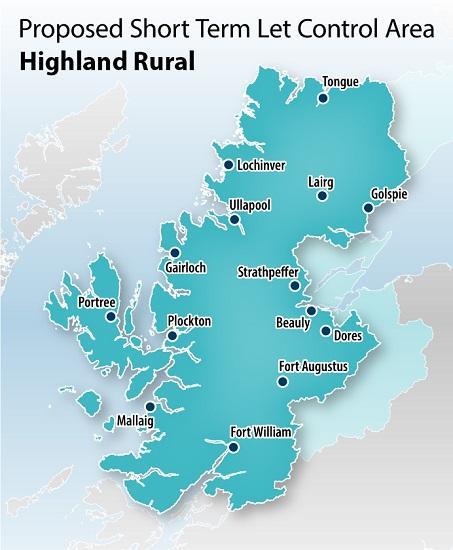
Highland Rural STLCA, which would cover the wards of Lochaber; Wester Ross, Strathpeffer and Lochalsh; Sutherland; Skye and Raasay; Aird and Loch Ness; and parts of Inverness South, including Tomatin and Daviot.
Within a control area, planning permission will always be required for a future change of use of a residential home to a secondary short-term let – where the owner does not normally live in the property but rents it out on a short-term basis. Currently, planning permission is only required if the development is considered a material change of use. Control areas do not introduce a ban on short-term lets, or affect second homes, empty properties or purpose-built holiday accommodation.
While data varies across communities, many locations within the proposed control areas experience high concentrations of short-term lets. In some communities, including parts of Inverness, Portree, Dornoch, and Fort William, short-term lets account for more than 20% of all homes.
Many areas also experience strong demand from buyers out with the Highlands, with a significant number of properties sold or newly built subsequently converted into short-term lets. This pressure is particularly acute in areas like Skye and Lochalsh, where 13.6% of homes sold between 19/20 and 23/24 became short terms lets, and across the proposed Highland Rural control area, where 9.5% of houses built within the last five years now operate as short-term lets.
The consultation also follows concerns raised through local place planning about the impact of high concentrations of short-term lets on local housing and the amenity and character of some neighbourhoods.
Short term lets are not the sole cause of housing pressures in Highland, but they are one of several contributing factors leading to the loss of residential homes in some areas. Control areas are one of several measures being explored by the Council to address the Highland Housing Challenge, which includes a coordinated approach to increase finance for housing delivery, increase land supply and speed up the planning process, and build delivery capacity and confidence across the public and private sector. Around 24,000 new homes are needed across the Highlands by 2034.
A control area has existed in Badenoch and Strathspey for two years, with early indications suggesting it has slowed the growth of secondary short-term lets across the area.
Cllr Bill Lobban, Convener of The Highland Council, said: “Tourism is vital to the Highlands - STLCAs are not a ban on short-term lets, and we recognise the important role they play in our visitor economy. What they allow us to do is balance tourism growth with local housing need by managing concentrations of short-term lets in areas where housing availability or neighbourhood amenity is adversely affected. We face a housing challenge in Highland and the availability of local housing for people to live and work in the region is critical to the future sustainability of our communities and the wider socio-economic transformation of our region. No decisions have been made yet and the feedback gathered through the consultation, along with the evidence available, will help shape the Council’s next steps.”
The Council is running two consultations to reflect the different pressures experienced in Inverness City and Highland Rural:
In Inverness City, short-term lets are predominantly self-contained flats concentrated around the city centre and in particular streets. This has reduced the availability and affordability of housing for residents and, in some neighbourhoods, resulted in a detrimental impact on the local amenity, including complaints regarding noise and waste management.
In Highland Rural, short-term are lets are more dispersed but represent a significant proportion of the housing stock in some areas. With fewer homes available, even a modest number of short-term lets can significantly reduce housing availability for residents. Despite the Council building affordable homes in rural areas, the lack of large-scale house building means homes lost to short-term letting are not quickly replaced. These pressures can have wider impacts on communities, including depopulation and declining school rolls.
The consultation runs for six weeks, from Tuesday 12 May to Tuesday 23 June, with drop-in information events taking place in Plockton (14 May), Lochinver (18 May), Fort Augustus (21 May), Inverness (22 May), Portree (25 May), Fort William (29 May), and Ullapool (1 June). To take part in the consultation, and find out more, visit: www.highland.gov.uk/STLCAConsult
Related Businesses
Related Articles