Highland Council’s Debt Crunch: Rising Borrowing Costs Put 20?Year Capital Plans Under Pressure
6th May 2026
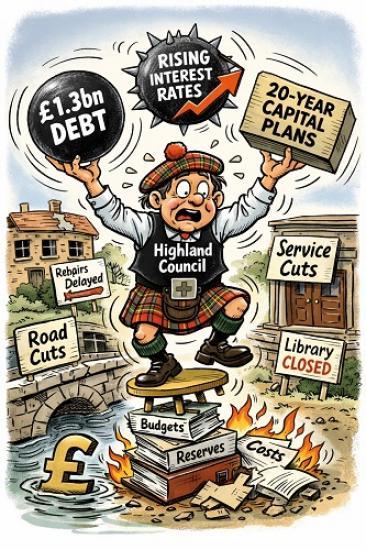
Highland Council is heading into a tougher financial climate than at any point since the financial crash and the pressure is coming from a direction that residents rarely see: the cost of government borrowing.
Following the UK’s latest rise in borrowing costs, the price councils pay for long‑term loans has increased again. For most Scottish councils this is unwelcome. For Highland one of the most indebted local authorities per head in the country it is potentially transformative.
This article sets out where Highland sits in Scotland’s debt league, why rising interest rates matter so much here, and what it means for the council’s ambitious 20‑year capital programme.
Highland Council: One of Scotland’s Highest‑Debt Authorities
Highland’s total debt now sits at around £1.3 billion, placing it among the largest borrowers in Scotland. But the more important measure is debt per head and on that metric Highland is near the top of the national table.
Debt per head (approx.)
West Dunbartonshire: £8,885
Aberdeen City: £6,666
Highland: £5,476
Glasgow and Edinburgh carry higher total debt, but far lower per‑head levels.
The Scottish average is £3,166 per person. Highland is therefore well above the national norm, reflecting the cost of maintaining infrastructure across a vast rural region.
This high starting point means that any rise in borrowing costs hits Highland harder and earlier than most other councils.
Why Highland’s Debt Is So High
Three structural factors drive Highland’s debt burden:
A vast geography with ageing assets
More roads, more bridges, more schools, more depots — spread across the largest local authority area in the UK. Maintaining and replacing these assets requires sustained borrowing.
Historic under‑investment
Years of deferred maintenance have created a backlog in roads, buildings and essential infrastructure.
The Highland Investment Plan
A multi‑billion‑pound programme to rebuild schools and modernise infrastructure, heavily reliant on long‑term loans.
Borrowing itself is not the problem — the cost of borrowing is.
Rising UK Borrowing Costs: Why They Matter
When UK gilt yields rise, the Public Works Loan Board (PWLB) — the main lender to councils — raises its rates. This means:
New loans cost more
Refinancing becomes more expensive
Debt servicing consumes a larger share of the revenue budget
Audit Scotland has already warned that Scottish councils face growing capital financing pressures. For Highland, the effect is magnified because:
A large existing debt stock means more exposure to rate rises
Limited reserves reduce flexibility
High rural delivery costs leave little room for manoeuvre
The council already faces a multi‑year funding gap
In short: rising interest rates tighten the financial vice.
What Is Prudential Borrowing — and Why Should Highland Residents Care?
Prudential borrowing is the system that allows councils to borrow for long‑term investment, provided they can prove the borrowing is affordable, prudent and sustainable.
It funds the big-ticket items:
school rebuilds
road upgrades
bridges and flood schemes
community facilities
major refurbishments
But prudential borrowing comes with a fixed cost: every loan must be repaid from future budgets. When interest rates rise, those repayments rise too.
For Highland residents, this matters because the council already carries one of the highest debt levels per head in Scotland. Rising rates mean:
more of the council’s budget goes to lenders
less is available for frontline services
capital projects become harder to deliver
council tax and charges may face upward pressure
Prudential borrowing is essential — but it is not painless.
What Rising Borrowing Costs Mean for Highland’s 20‑Year Capital Programme
Highland’s long‑term capital plan is ambitious, covering school replacements, road improvements, community facilities and major infrastructure upgrades. But rising borrowing costs change the affordability test.
Re‑testing affordability
The plan was modelled on lower interest rates. Updated assumptions may show that some projects are no longer affordable on the original timetable.
Re‑phasing and delaying projects
To avoid taking on too much debt too quickly, the council may need to push some projects further into the 20‑year horizon.
Prioritising statutory and safety‑critical works
Bridges, school condition failures, flood defences and essential maintenance will move to the front of the queue.
Pressure on council tax and charges
If the council wants to keep the capital programme intact, it may need to raise more income locally.
Reduced financial resilience
High debt + rising rates + limited reserves = less ability to absorb shocks.
The risk is not that the 20‑year plan collapses — but that it slows, shrinks, or changes shape.
Should Highland Council Re‑Examine Its Plans?
Yes - it may have little choice.
A responsible council must re‑test its capital programme whenever borrowing costs shift significantly.
This does not mean abandoning the plan. It means:
updating interest‑rate assumptions
re‑profiling borrowing
prioritising essential works
being honest with communities about trade‑offs
Failing to do so risks locking the council into unaffordable commitments that would ultimately force deeper cuts to services.
What This Means for Caithness and the Wider Highlands
For residents and businesses, the implications are clear:
Some projects may slip
Budgets will tighten
Local taxes and charges may rise
Rural areas may feel the impact more sharply
But with transparent planning and realistic assumptions, Highland can still deliver a long‑term investment programme just not at the pace or scale originally imagined.
Related Businesses
Related Articles