Highland Council To Act As One Of The Host Local Authorities For The 2023 EV Rally Of Scotland

11th August 2023
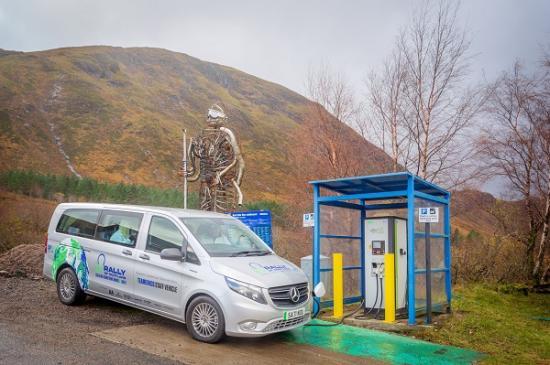
Photograph of Highland Council To Act As One Of The Host Local Authorities For The 2023 EV Rally Of Scotland

Highland Council has been named as one of the host local authorities when vehicles taking part in the 2023 EV Rally of Scotland (EVROS) start their journeys on 16 August.

The two-day event, which aims to showcase electric vehicle technology and the charging infrastructure network in Scotland, will stop at locations in Highland.

The Highland leg of the rally includes a checkpoint at Aviemore on 16 August with vehicles stopping at the following checkpoints on 17 August: Inverness Caledonian Thistle Stadium, Port of Cromarty Firth, Hydro Ness in Inverness, Loch Ness Viewpoint, Fort Augustus, Struy and Cannich.

The rally will cover 560 miles and begins in Glasgow. It aims to build on the successful EVROS event held during COP26 in 2021, and then the Tri-Hub EV Challenge in 2022.

The rally is being organised by Green Fleet Events which helps organisations "drive the switch," to a cleaner fleet and is supported by Transport Scotland.

Chair of the Economy and Infrastructure Committee, Cllr Ken Gowans, said: “Highland Council remains committed to meeting its Net Zero targets and decarbonisation of our fleet is just one of the ways we are meeting the challenge.

“The Council is delighted to be hosting a section of this year's EV Rally of Scotland, which will showcase that fleet decarbonisation is no longer a dream, but a reality. The rally will benefit from the significant EV infrastructure already in place in Highland.”

He added: “The Climate and Energy Team has worked hard to build the EV infrastructure here in Highland and that work continues to further enhance the network over the coming months and years.”

The EVROS event comprise of ten teams, which will be representing Scottish business. Each Team enters an EV of their choice (car or van), along with a driver and co-driver.

They will embark on a 560mile, all-electric mile moving showcase, with two to three checkpoints per day. Each Checkpoint will be photographed and posted on social media using specific hashtags, such as #evros, #evrally, #collaboration, #netzero and the Checkpoint drivers are at, for example, #CP1 for Caledonian Stadium.

The Highland Council has responsibility for over 7000km of roads within the region and is committed to supporting the development of a sustainable EV network to help tackle the climate emergency.

The Highland Council has already installed an initial infrastructure of over 100 EV charge points with many more planned in the coming months and years as it moves from a government funded model to a sustainable, self-funding model, encouraging a transport transition to electric.

The Council and other public sector organisations in the region have an ambition to ensure that access to EV Charging is fair and equitable to all, regardless of where they live and work, being mindful of the challenges of local geography.

Highland Council is committed to progressing the transition to low carbon transport and aim to be a leading authority to help enable low carbon connectivity across our city and rural communities. The Council sees this as a crucial contribution to the reduction in carbon emissions as it works towards being a Net Zero region.

To date, the Highland Council has met guidance for EV charge points to be available at a minimum of every 30 miles, providing confidence and ease of access to charging facilities for residents and visitors. Its ambition now is to accelerate this provision towards the critical mass of charging infrastructure to ensure that range anxiety is a thing of the past.


Related Businesses


Related Articles

Yesterday : Local Authority

Homelessness statistics in Scotland - April to September 2025

An update on Homelessness Statistics covering 1 April to 30 September 2025 has been released today.   Over that period: There were 20,643 applications for homelessness assistance.  

29/1/2026 : Local Authority

Council Services Outsourced But Not Immune - Why High Life Highland Is Still Vulnerable to Budget Cuts

When Highland Council transferred responsibility for leisure, culture and community learning services to High Life Highland (HLH), the move was often presented as a way to protect valued local services from the worst of council budget cuts.   By placing libraries, leisure centres, swimming pools and cultural provision into a charitable trust, the council could take advantage of tax reliefs, external funding opportunities and more flexible operating arrangements.  

29/1/2026 : Local Authority

How Highland Council's Budget Decisions Expose Some Services More Than Others

Highland Council faces a set of financial pressures that are both familiar across Scottish local government and uniquely intensified by its geography, population size, and historic investment choices.   While headline debates often focus on council tax rises or total debt levels, the real impact of financial tightening is felt in how different services are protected, redesigned, or reduced over time.  

29/1/2026 : Local Authority

Which Services Are Most Likely to Face Cuts or Reductions At Budget Day

When budgets tighten in Highland Council, cuts tend not to fall evenly.  Some services are much more exposed than others because of how local government funding rules work and because of Highland's geography.  

29/1/2026 : Local Authority

How Highland Council Debt Affects Local Services

Highland Council's high debt connects to local services and council tax, in practical, day-to-day terms.   Council debt doesn't pay for services directly — but it affects them.  

29/1/2026 : Local Authority

 
Highland Council Debt Is One Of Highest Per Person in the UK

Highland Council has one of the higher levels of debt among Scottish local authorities, especially when looked at per person.  It is not necessarily the absolute highest in total debt compared with councils that have much larger populations like Edinburgh or Glasgow.  

29/1/2026 : Local Authority

 
Scotland's councils risk becoming financially unsustainable

Whilst councils have made significant savings, the cost of delivering services is rising faster than available funding.  This risks the financial sustainability of councils over the next three to five years.  

29/1/2026 : Local Authority

Asset Management is a catalyst for change for The Highland Council

At the Housing & Property Committee (Wednesday 28 January 2026), Members approved the introduction of a new framework to guide decisions on the future of its assets, supporting a more efficient, sustainable and future-ready approach to service delivery.  The Strategic Asset Management Plan (SAMP) will help streamline the estate, embed new ways of working, and contribute to significant savings set out in the Council's Delivery Plan.  

29/1/2026 : Local Authority

Reduction in households in temporary accommodation and improved housing outcomes

At Housing & Property Committee (Wednesday 28 January 2026), The Highland Council reported a strong performance across several key housing indicators, including a reduction in households in temporary accommodation, improved repairs times, and the lowest level of rent arrears in three years.   New figures show that the number of homeless households living in temporary accommodation has fallen to 421, the lowest level recorded since The Scottish Government introduced this measure in April 2016.  

24/1/2026 : Local Authority

 
New facility for additional support needs pupils at Wick High School

Last week Wick High School was delighted to welcome guests from The Highland Council, Wick High Parent Council and the wider community to the open day of a new facility for children with additional support needs.   Avonlea, which was previously a residential unit, has now been repurposed, and this enhanced provision represents a significant step forward for pupils with complex additional support needs.